A New No. 1 Tee for the Ryder Cup
Haigh confides that the Ryder Cup Committee did consider alternative routings of the holes at Bethpage Black to allow additional spectators, but ultimately decided to keep the traditional routing. However, there was a major change to the very first hole. A new first tee was constructed 40 yards in front of and to the left of the traditional tee to make room for a huge triple-decker grandstand that wraps around the first tee and the 18th green that will seat 3,500 Ryder Cup spectators.
“While this lessens the sharp dogleg right somewhat, it allowed us to be able to build a huge grandstand behind and on top of the existing No. 1 tee that will now encompass views of both No. 1 tee and No. 18 greens, which will be a unique situation for the Ryder Cup and will offer incredible views of the matches as they start and finish – that is for any match that goes to the 18th hole,” says Haigh.
“Also, depending on the wind direction for the matches, it may be possible for some players to actually drive over the corner of the dogleg and reach the green, which will make for some great excitement and theater at the start of any match.”
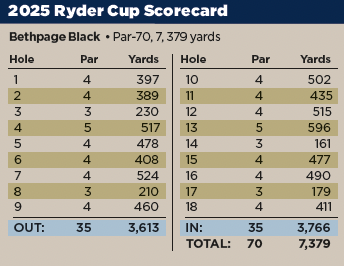
Indeed, Haigh enjoys offering players a drivable par 4 on most of his major championship setups, and reducing the first hole by some 40 yards promises to provide great risk-reward drama to begin every match at The Black. With the first-hole alteration, Bethpage Black will play at 7,379 yards and a par of 70 instead of stretching beyond 7,400 yards for previous major championships.
Match Play Takes Over
All previous major championships contested amid the narrow fairways (average of 26 yards wide) and deep rough (average of 6 inches tall) at Bethpage Black were stroke-play events – man vs. golf course and Old Man Par. The Ryder Cup will have a different vibe with the U.S. and European teams engaged in head-to-head match-play confrontations.
“Historically, scoring at the Ryder Cup has been very good,” observes Haigh. “One of the reasons is the match-play format, which allows players to be more aggressive than they may be in a 72-hole, stroke-play championship. It will also depend on how the course is set up, particularly the height of the rough and what the weather will be like. If there is a lot of wind, then we can expect it to be more challenging than if it is calm and wet.
“Bethpage Black should be a fun and interesting match-play course. Everything is pretty much in front of the players and there are no real tricks. Good ball strikers and good putters will always do well.”
Several Demanding Holes
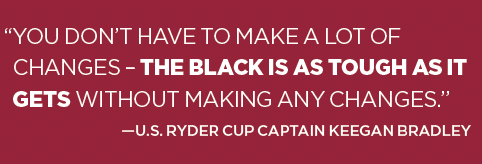
There is no shortage of demanding, difficult holes at The Black that could sway any match under any format. “The Black is a long, tough track from start to finish,” summarizes Bradley, who played Bethpage Black regularly while attending college at St. John’s University in Queens and knows The Black inside and out. “When you add the pressure and environment of a Ryder Cup to the difficulty of the course, it promises to be a great Ryder Cup.”
High on the list of potentially pivotal holes at Bethpage Black for the 45th Ryder Cup is the 477-yard, par-4 15th hole. Nicknamed “The Beast,” the 15th played as the most difficult hole statistically in the 2002 and 2009 U.S. Opens, and the 2019 PGA Championship. It could be a hole that is won with a par during the Ryder Cup matches.
“The 15th hole at Bethpage Black is indeed a very challenging hole,” agrees Haigh. “It plays 477 yards and demands a straight drive that must hit the fairway. From there, the hole turns to the left but plays severely uphill to an elevated and well bunkered green that is angled right to left as the player hits into it. The green itself is probably one of the most severe on the entire course, sloping from back to front, and will present a lot of challenges to everyone who plays it. Any ball that misses the green calls for a very difficult up and down.”
Strong Set of Par 3s
The four par 3s at Bethpage Black – two on each nine – promise to provide their share of drama in the match-play format and could be important “swing” holes that turn a match or two each day. The Black yielded three aces on par 3s in the 2002 U.S. Open – to Shigeki Maruyama (14th hole, second round), Andy Miller (3rd hole, fourth round) and Scott Hoch (17th hole, fourth round).
The 17th hole, surrounded by bunkers with a wide but shallow green that will play at 179 yards for the Ryder Cup, was the scene of a unique one-two punch delivered by players in the final round of the 2019 PGA Championship. European Tour player Lucas Bjerregaard of Denmark one-hopped his tee shot into the hole on the 17th hole for an ace. Moments later, his playing partner, 2009 U.S. Open Champion Lucas Glover, holed his second shot from a back bunker for a birdie that brought a huge New York roar from the crowd.
“There is a nice mix of yardages on the four par 3s,” notes Haigh. “The longest is the third hole, which plays at around 230 yards. No. 8 plays around 210 yards but is downhill and has a pond in front.
“The two shorter par 3s are on the back nine. The short 14th is 161 yards and the 17th will play at 179 yards, which is shorter than at the 2019 PGA Championship, but that allowed us to build a large grandstand behind the tee to watch the excitement of any match coming down to the wire. The green on hole 17 has two plateaus, left and right with massive bunkers surrounding it but with the shorter tee, should provide plenty of opportunities for birdies.”
Potentially Pivotal Holes
Since every hole at Bethpage Black is highly challenging, identifying which holes will be most important amid the cauldron of pressure and patriotism of the 45th Ryder Cup is difficult. But Haigh and Bradley agree that the par-3 third, the 524-yard par-4 seventh, the 502-yard par-4 10th, along with the “beastly” 477-yard par-4 15th could be particularly pivotal. Then, of course, if a match comes down to the par-4 18th hole with thousands of fans rooting for their favorite team, that will provide a dramatic conclusion to any match.
The 18th at Bethpage Black isn’t particularly long at 411 yards, but the fairway is narrow and bunkers abound down each side of the fairway and guard the tricky green, which slopes severely from back to front. Wayward tee shots will be severely penalized by the deep fairway bunkers on the 18th, but an accurate approach shot to the green will be rewarded with a good birdie opportunity.
“When you talk Ryder Cup strategy, you always want to have your guys play the 18th hole well in any match that comes down to the last hole because there are always team points at stake,” explains Bradley. “It’s mandatory that you hit the fairway on the 18th at The Black and, if you do, you have a good shot at making birdie. I think guys can play aggressively with their second shot from the fairway. The 18th isn’t the longest par-4 on The Black, but it could very well be the most important in the Ryder Cup.”
Adds Haigh, “While every hole in match play is important, the most difficult and challenging holes will likely be holes 3, 7, 10 and 15. Hole 3 is a long and difficult par 3, which will likely be into the prevailing wind. Holes 7, 10 and 15 are all demanding and testing long par 4s with trouble lurking all around both tee shots and the green complexes.”
—Roger Graves