By Scott Kramer, Contributing Equipment Editor
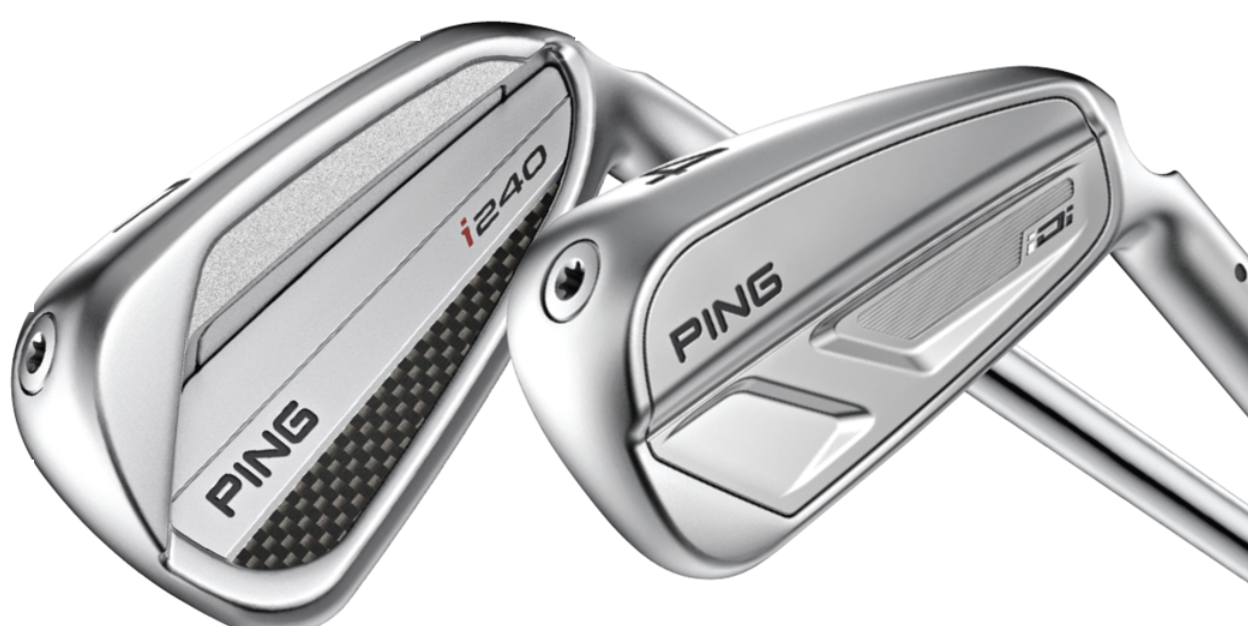
The new Ping i240 irons ($232/club with graphite shafts, $217 with steel) could be a good fit for multiple types of golfers at your facility. They’re “engineered to appeal to a wide range of skill levels,” insists John K. Solheim, Ping’s CEO and President.
“They provide precision and control with a great feel, so they technically fit into the ‘players iron’ category. But they also offer the moment of inertia (MOI) and higher launch of a game-improvement iron. We’ve designed it with more of a true cavity back look to inform golfers of its forgiveness properties. They’re a great solution for avid players who like the look, feel and performance of a blade-style iron, but can also benefit from added forgiveness when they aren’t as precise with their ball striking. These irons pack a lot of performance into one model.”
Indeed they do. A more traditional cavity design signifies the perimeter-weighting benefits of the iron while maintaining a clean, players-style look. The cavity badge and activated elastomer technology allowed engineers to save significant weight, and re-allocate it within the clubhead to position the center of gravity lower for more distance, control and launch trajectory. That also boosts forgiveness, most notably in the long and mid irons.
Golfers can expect tighter dispersion and higher launch throughout the set, as well as extra repeatable distance. The multi-material badge includes a carbon fiber inlay, and the activated elastomer insert supports the clubface for a more efficient energy transfer across the entire face, softer feel and pleasing sound.
“The i240 is a workhorse for the avid player,” says Marty Jertson, PGA, Ping’s VP of Fitting and Performance. “It delivers an order of magnitude with more forgiveness than our Blueprint irons – both through inertia for impact mishits and the bounce profile, which can dampen imperfections in delivery and help players who are steep.
“Compared to our i530, it’s going to generate a lot more spin, which is vital for control and stopping power. It really is a perfect combination for the avid player who doesn’t flush every single shot. The fitting options are immense; with our power spec you can achieve a little more distance if desired while being mindful of on-course, full-set gapping.”
To make these irons appeal to tour professionals and amateurs, the face technology was updated with fewer and wider grooves – after a request from tour professionals seeking more spin from the fairway. The head size also stayed smaller for distance and trajectory control. The topline is thin and the sole has a rounded leading edge with enough bounce to achieve smooth turf interaction for solid contact. The multi-material construction includes a 431 stainless steel body, elastomer insert, chrome-plated ABS cavity badge with carbon fiber inlay, high-density toe/shaft tip weights and a hydropearl 2.0 finish. And to boot, the stock shaft is Nippon’s N.S. Pro Modus3 Tour 115. Its optimal weight and predictable mid launch and mid spin helps with responsiveness and stability with tight dispersion.
For better players seeking help at the long end of the bag – in terms of versatility and trajectory control – Ping has also debuted the iDi driving irons ($295/club with graphite or steel shaft) in lofts of 17 (2-iron), 20 (3) and 23 (4) degrees that are each optimized for launch and spin. Available for custom fittings at authorized Ping retailers, they offer a metalwood-like construction.
“We’ve seen excellent success with our Crossover products, and now we’re pushing further into the driving-iron space in a different way, with three lofts designed to provide ball-flight variation to help this level of player hit their precise trajectory windows,” says Solheim, who adds that iDi is a great option off the tee and for long approach shots into the green.
Inside the clubhead is a patent-pending technology called inR-Air. It’s literally a small pocket of air strategically inserted into the club that activates on impact to help attenuate the frequencies, greatly improving and softening the feel and sound. The integrated i-Beam structure inside the head also adds support and contributes to the improved sound and feel. Weight savings from the covered cavity, in addition to other shaping changes, help optimize the CG position and increase the MOI, especially on high and low impacts.
The iDi 2-iron is a traditional driving iron, delivering low launch and spin to provide maximum performance off the tee. It’s meant to fly low, is a great tee shot club and works in windy, firm conditions – generally reserved for players with a lot of swing speed.
The iDi 3-iron is designed to be a driving iron or long-iron replacement with mid launch and spin profiles. This broad appeal, offering a blend of performance off the tee and off the turf, makes it Ping’s most popular driving iron on tour.
And the iDi 4-iron launches higher with more spin, making it easier to hold greens. It’s also recommended as a long-iron replacement, as it’s much easier to hit. In addition, tour professionals like it: Corey Conners, for example, replaced his 4-iron with the iDi 4-iron. All three lofts produce higher ball speeds thanks to a thin, maraging steel face and lower CG position that’s closer to the impact location to produce more energy transfer. The chrome-plated face is robotically welded to the 17-4 stainless steel body, yielding a higher launch for better stopping power.
The head is deep from front to back, while the face is shallow. And it’s short from heel-to-toe, with a slightly flatter lie angle that makes it easier to turn over. For more shot control, each club is shorter than the previous generation. The fixed hosel allows for all 10 Ping color codes and custom loft adjustments.
PGA of America Golf Professionals should not be shy about combining the new models with other Ping irons during a fitting session.
“We are very calculated in offering the same loft specs for the i240, Blueprint S and Blueprint T,” says Jertson. “This makes it seamless to do mixed sets. We built very advanced logic into our Co-Pilot gapping app that determines when your peak height starts to drop to a critical level, and gives tips for where exactly to split the set.
“One configuration we are seeing at our Proving Grounds fittings now is iDi 4-iron, i240 5-7 and Blueprint S 8-W – but we recommend everyone use our gapping app to build their blended set.”