By Scott Kramer, Contributing Equipment Editor
More golfers than ever are walking the course these days. So, products associated with that trend are selling well, including push carts and electric caddies. We sat down with Motocaddy’s Andy Warren, PGA, and MGI’s William Holbrook – executives at the category’s two largest manufacturers – to find out the details and opportunities for golf facilities.
How is the popularity of push carts and electric caddies spreading in the U.S.?
Andy Warren, PGA, Vice President of Sales at Motocaddy: We’re seeing exponential growth in this country. Many courses and retailers we talk to have the same kind of anecdotal stories in which they’re seeing more people ask about them. Demand for walking in general is going up, and electric is certainly leading that growth.
William Holbrook, Vice President of U.S. Sales at MGI: It’s the fastest growing category in golf. Nearly every golfer who’s had a chance to use push carts and electric caddies has felt the difference after they play, noticing how much less fatigue they have and increased energy.
Who’s buying them, demographically?
Warren: Historically, golfers 55 and up were the electric consumers in the U.S. It’s shifting down, but still skews toward the older end of the age range. The drop is much like the demographics in golf in general the past few years.
Holbrook: Active golfers of all ages are purchasing push carts and electric caddies. In our early days, the demographic may have been more narrowed to the 55-plus group, but this now encompasses a much larger spectrum that includes young and old.
Why is the popularity of push carts and electric caddies spreading?
Warren: A lot of it started in 2020 when people were forced to walk for the first time because they had golf car restrictions at their facilities due to COVID-19. So, more people have taken advantage of it. We’ve also seen a shift in golf toward people being more health conscious, and they view push carts and electric caddies as a way to do that. They want to play golf and get exercise simultaneously – it’s a much more efficient use of their time.
Holbrook: People feel the difference when they play with a push cart or electric caddy. Almost immediately, they notice very little fatigue as they’re not pushing a cart up hills and through rough areas of the course. The energy they save helps them focus on their game.
How should PGA of America Golf Professionals sell push carts and electric caddies?
Warren: They can monetize them in different ways. For a lot of PGA of America Professionals, that’s treating it like they would any other retail item, buying and reselling push carts and electric caddies for a markup. We go out of our way to make that easier, because we understand it’s a higher price point item, and it takes up more space than a box of golf balls.
We don’t want PGA Professionals taking on inventory by buying 10 at a time and getting stuck with them and having to do markdowns at the end of the year. For the ones looking to do rentals, that’s a different story.
For a PGA Professional who maybe doesn’t know this category super well, research the companies you’re working with and understand that, unlike a polo shirt, these are more of an investment for customers. Research which push cart and electric caddy companies have back-end support because the last thing a PGA Professional wants to do is sell a product to a member and two years down the road, when they need a replacement part or a repair, the company’s not in business any longer.
Holbrook: Any course with a PGA of America Professional can partner with MGI. We’ve set up very easy programs with attainable discounts to give PGA Professionals the best margins possible. And they can obtain demo units for their customers to take on the course to try before they buy.
Because push carts and electric caddies can be pricey, do you see a pattern of how golfers buy them?
Warren: In the past, the vast majority of the sales have been online. We think that’s an enormous opportunity for PGA of America Golf Professionals because, much like someone would want to try out a driver or irons before buying, PGA Professionals need to give a demo to the customer to be able to try it. Then they’re going to be the ones who reap the sale of that product because they tried it out at the course, and the PGA Professional was the one who helped them select it.
So, we’re pushing heavily into demo programs that allow PGA Professionals, without taking on a financial risk, to let their members and customers demo the product on-site.
Holbrook: Our customers are very educated and will do their best to research the push carts and electric caddies to find what other golfers are recommending. Time and again, I hear from customers who tell me they checked out reviews of every push cart and electric caddy, and will let us know that we have the best consumer reviews. It’s very organic from course to course as someone will purchase our product, which leads to several more selling through word of mouth.
Where have you made in-roads with rental fleets, and how much can a golf facility charge for rentals?
Warren: When facilities have a rental program, most end up needing to expand the fleet sooner rather than later. People get hooked on it, and if your facility doesn’t allow outside push carts or electric caddies, and you’ve got somebody who loves to walk and using our products, they tell their friend, their friend sees them with it, and so on. So, your six-unit fleet turns into 12. We almost always see the fleets grow. You don’t have to start huge. We don’t want you taking a huge fleet and then find that you overbought. We’d rather you start out small and grow it incrementally until you find that equilibrium point.
The biggest issue we hear with clubs doing fleets is storage because cart barns are full. We tell people if you take one spot in your cart barn and put up shelving, you can fit 12 electric caddies folded up on there. If you can rent electric caddies to 12 golfers vs. two people with a golf car at a time, it’s a more efficient use of space.
Holbrook: Rental fleets are growing every year, and the clubs are seeing the return on investment coming so much quicker than they realized. Most clubs will price a caddy around $15-$20 per round and some are even higher. The healthier lifestyle is a driving feature to using a push car or electric caddy, as well as the social aspect of walking rather than riding. The experience is that much more desirable.
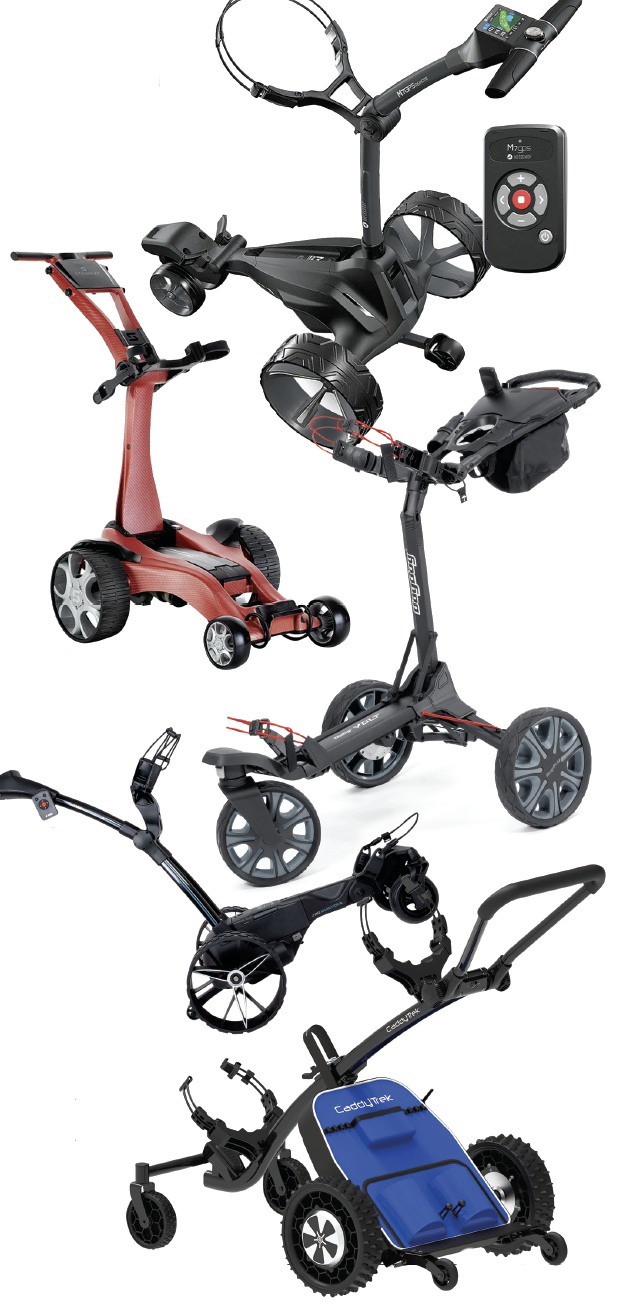
• Bag Boy’s Volt lightweight motorized push cart ($1,496) negotiates the course via remote control. At only 28.6 pounds, it can fold compactly in two steps and features nine speeds, plus a 36-hole battery.
• CaddyTrek R3X ($1,895) sports “Smart A.I. Vision Follow” technology that eliminates the need to carry a hand remote. It automatically keeps direction on track via a gyroscope and has a 36-hole battery.
• MGI Ai Navigator GPS+ ($2,099) has an integrated GPS system built into a high-res 4-inch color touchscreen with 40,000-plus courses worldwide built in. Gyroscope Straight Tracker technology ensures the electric push cart stays on track no matter the terrain.
• Motocaddy’s M7 GPS Remote Electric Caddy ($2,099) features quick and accurate GPS for 40,000-plus courses worldwide on a 3.5-inch touchscreen. It’s powered by a high-capacity “Click ‘N’ Connect” cable-free lithium battery that includes auto-disconnect and a pop-up charging port.
• Stewart Golf’s Q Follow Carbon Range trolley ($3,249) is lightweight and comes with a 36-hole battery. It follows golfers via remote – traversing hills with ease – and folds compactly in a snap.