With 11 golf courses across Northern Michigan, Boyne Golf literally covers a lot of ground. It was five years ago that the management team made the decision to focus on improving water usage and turf quality that has led to a better playing experience while increasing efficiency and saving money.
Josh Richter, PGA, the Senior Vice President for Golf Operations at Boyne, located in Petoskey, Michigan, oversees the golf maintenance operations across the courses. By rebuilding pump houses and installing new check valves, Boyne has noted an energy reduction between 10 and 15 percent on golf course irrigation. In addition, using USGA Moisture Meters and other technologies are helping Richter’s team use only as much water as is needed, and only in specific areas.
Richter says capital expenditures on Boyne’s irrigation systems and new technologies may not be visible to golfers, but the benefits certainly are.
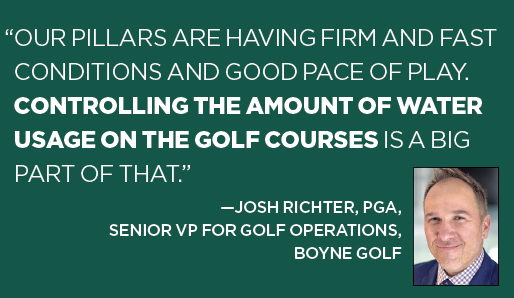
“Given how much play we have, our pillars are having firm and fast conditions and good pace of play. Controlling the amount of water usage on the golf courses is a big part of that,” says Richter, the 2025 Michigan PGA Golf Executive of the Year. “All our superintendents have USGA Moisture Meters so they can probe different areas of turf and we can be very specific about exactly how much water we’re putting out at any given time vs. just blindly watering everything on a set schedule.”
Richter’s team has also standardized its maintenance practices across the 11 courses to determine the amount of water different surfaces need based on conditions and the weather to keep courses in top shape throughout heavy play through a short northern season.
The result to Boyne’s irrigation upgrades: Energy and resource savings to the company’s bottom line, plus positive feedback from golfers. And, despite a late-season ice storm that caused extensive damage in the area, Boyne’s course conditions and environmental impact are improving year over year even as rounds played across its courses grew by 4 percent last year.
“We’ve hosted a number of tournaments recently, from an Epson Tour event and the state pro-am to an event for Michigan members of the GCSAA, and our improvements were reflected in a lot of comments about how the golf courses played,” Richter says. “The ball bounced and rolled in the fairways, and the greens were firm but receptive. Players talked about how good the turf felt under their feet, how nice it was to hit off of, and that the green speeds were fast. It lets us know that these courses are in great shape, and that our maintenance practices are working as we’d hoped.”
As a longtime PGA of America Professional, Richter doesn’t consider himself to be an expert on the environment. He has, however, learned much about the subject over the course of his career as he moved into executive management. Richter says his fellow PGA of America Members can improve their understanding of golf and the environment by being curious and asking to ride along with their superintendents from time to time.
“I’m not an expert – I know what I want the turf to look like, but I don’t necessarily understand how it gets there – but I have team members who are experts,” Richter says. “The encouragement I would give to any PGA of America Professional is to get in a golf car with your superintendent and take a ride around the course. Ask questions: Why does this look that way? What should I be watching for when I’m on the course? Have a conversation that improves your understanding.
“Look, we’re the front of the house. The more cohesion we have with the back of the house, then the more you can help educate your members and guests about why things look and play a certain way, and it can help you be proactive if you’re having a challenge or need to explain a budget item to ownership. It really benefits your operation overall, and that’s why I think the most important relationship we have in this business is between PGA of America Professionals and our golf course superintendents.”