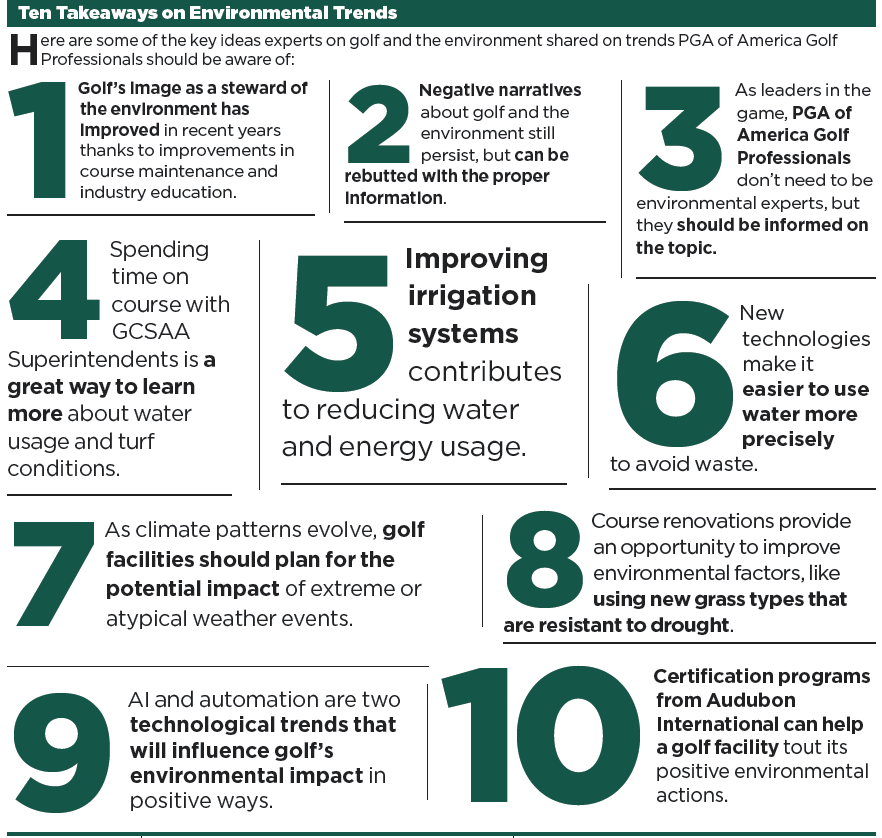
The game and business of golf have gone through numerous changes over the past five years, and the sport’s relationship to environmental issues is among them. Golf has long fought a battle against the misperception that it harms the environment, but advances in course management practices and technology have given facilities opportunities to improve their environmental footprints – and bottom lines – in new and sustainable ways.
Coupled with the influx of new players into the game, which makes golf less elitist and more of a healthy outdoor activity for millions of people, and governmental lobbying efforts by the PGA of America and the Golf Course Superintendents Association of America (GCSAA), the sport’s environmental perception is improving.
At the same time, there are ongoing and potentially disruptive challenges posed by the environment to golf facilities. Water availability in the western part of the U.S. is perhaps the highest profile threat to courses, as dry conditions and stringent regulations on water use lead to competition for resources between agriculture, homeowners and golf facilities. In the east and north, strong storms and changing weather patterns have caused damage and disruption to a number of golf facilities, while coastal courses are surveying the potential loss of land should ocean levels continue to rise.
In all, there are significant challenges and opportunities for golf facilities to understand in today’s environmental trends. And PGA of America Golf Professionals can play a significant role in helping their customers, communities and legislators understand the many good things golf does on environmental issues – and helping their facilities plan for the future.
As PGA of America President Don Rea Jr. says, PGA of America Professionals don’t need to become experts on the environment. They do, however, need to know how to discuss the subject as leaders at their facilities, and to partner with their superintendents to make sure their courses are responsible stewards of the land.
“All of us in golf have an understanding that the environment has a major impact on our business and our livelihoods,” says Rea, a PGA of America Master Professional. “I think it’s incumbent on us as PGA of America Members to work with the 20,000 GCSAA Superintendents out there to make sure that everybody knows our story, because when it comes to the environment, it’s a good story. We are stewards of efficient water and land usage. We maintain green spaces that are good for people and habitats for wildlife.
“What I’m hearing from Members across the country is, ‘Hey, we need to pay more attention to this, and I need to learn a little bit more about it so I can speak intelligently about the environment and golf’s place in it.’ And it boils down to spreading the message that golf is actually good for the environment.”
GCSAA CEO Rhett Evans agrees that the good news about golf and the environment is real, yet acknowledges that other narratives still exist.
“For those who the industry has been able to reach, there’s an increased understanding of how much golf courses can benefit the communities in which they exist, including providing environmental benefits,” Evans says. “The golf industry has worked hard to shed light on the story of golf courses providing benefits such as wildlife and pollinator habits, storm water management, serving as a natural water filter and providing a cooling effect to neighboring surrounds in urban and suburban areas.
“However, for every positive story shared, sensationalized news stories about chemicals or water can cause fear and move the needle in the other direction for a wide audience. Only six percent of an average 18-hole golf course is intensively managed, but that doesn’t make headlines. Unfortunately, the negative stories, even when not substantiated, are easy to believe and can hurt the perception of the game.”