By Don Jozwiak, Senior Editor
At its core, the PGA of America is and always will be aN AFFABLE organization – a group working together to grow the game and the business of golf. And something every PGA of America Member knows is that no one truly succeeds in golf on their own.
Almost every great story in the game starts with a circle of connection: a coach who believed in a young player, a mentor who opened a door, a friend who sparked a love for competition, or a fellow PGA of America Professional who shared advice at just the right moment.
For the more than 30,000 PGA of America Members and Associates who make their careers in golf, that same truth holds. Each career path is unique, but every one of them is shaped by the people met along the way – colleagues, students, employers, mentors and friends. Those connections form the backbone of a career and often create opportunities that hard work alone can’t uncover.
That’s the real power of networking in the golf industry as a PGA of America Golf Professional: learning, sharing and growing through the relationships you build.
PGA of America Vice President Nathan Charnes learned the importance of networking firsthand when he moved to the Gateway PGA Section as a young golf professional in 2004.
“When I moved to St. Louis and tried to establish myself in a new Section, I quickly realized that you can’t go it alone,” says Charnes, the PGA General Manager and Director of Golf at WingHaven Country Club in O’Fallon, Missouri. “I was just getting my career going, and not being from that area, I saw how important it would be to build a network.”
Charnes set about building relationships using opportunities available to all PGA of America Golf Professionals: going to Section meetings, playing in events, volunteering for Chapter and Section committees and getting to know his peers at area golf facilities. Over time, that circle of networking expanded to include club members, area businesspeople and PGA of America Members from throughout the Gateway PGA Section, where Charnes became a board member before getting into governance at the national level.
A decade after moving to the Gateway PGA Section, Charnes found a reason to expand his network even more when the general manager position at WingHaven came open. He was interested and intimidated, and Charnes leaned into advice and expertise from new and existing members of his network to bolster his knowledge and prepare himself for the challenge.
“I wanted the general manager role, but I knew I had no idea what I was really getting into,” Charnes recalls. “So many of the PGA Professionals I knew were head professionals like me, so I started reaching out to golf professionals who were experts in different areas, like food & beverage and merchandising. Then I started networking with members at the club who were successful in areas like sales and management, which brought perspectives from outside of the PGA of America umbrella.
I spent a lot of time asking questions and picking people’s brains.”
Charnes’ secret weapon for building his network? Lunch invitations.
“I can’t tell you how many people I took out to lunch to learn more about what they did for a living, then work to connect the dots back to how that could help me be a good general manager,” Charnes says. “I learned the right questions to ask of myself and the areas I needed to improve, and I learned a lot about managing people outside of golf professionals. It opened up a lot of possibilities, and it put me in position to become a general manager.”
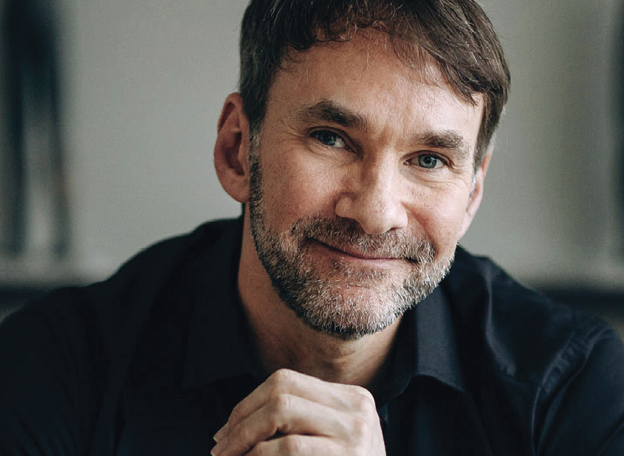
Charnes’ approach is echoed by networking expert Keith Ferrazzi, author of the bestselling book “Never Eat Alone: And Other Secrets to Success, One Relationship at a Time.” Sharing a meal is always a good way to build relationships, but Ferrazzi is also an advocate of the idea that networking – like mentoring – is a two-way street that works best when everyone benefits from the relationship.
“Every person you meet is an opportunity to change your life and theirs for the better,” Ferrazzi writes. “Connecting is the key to success, but connecting is useless unless you convert those connections into real relationships.”
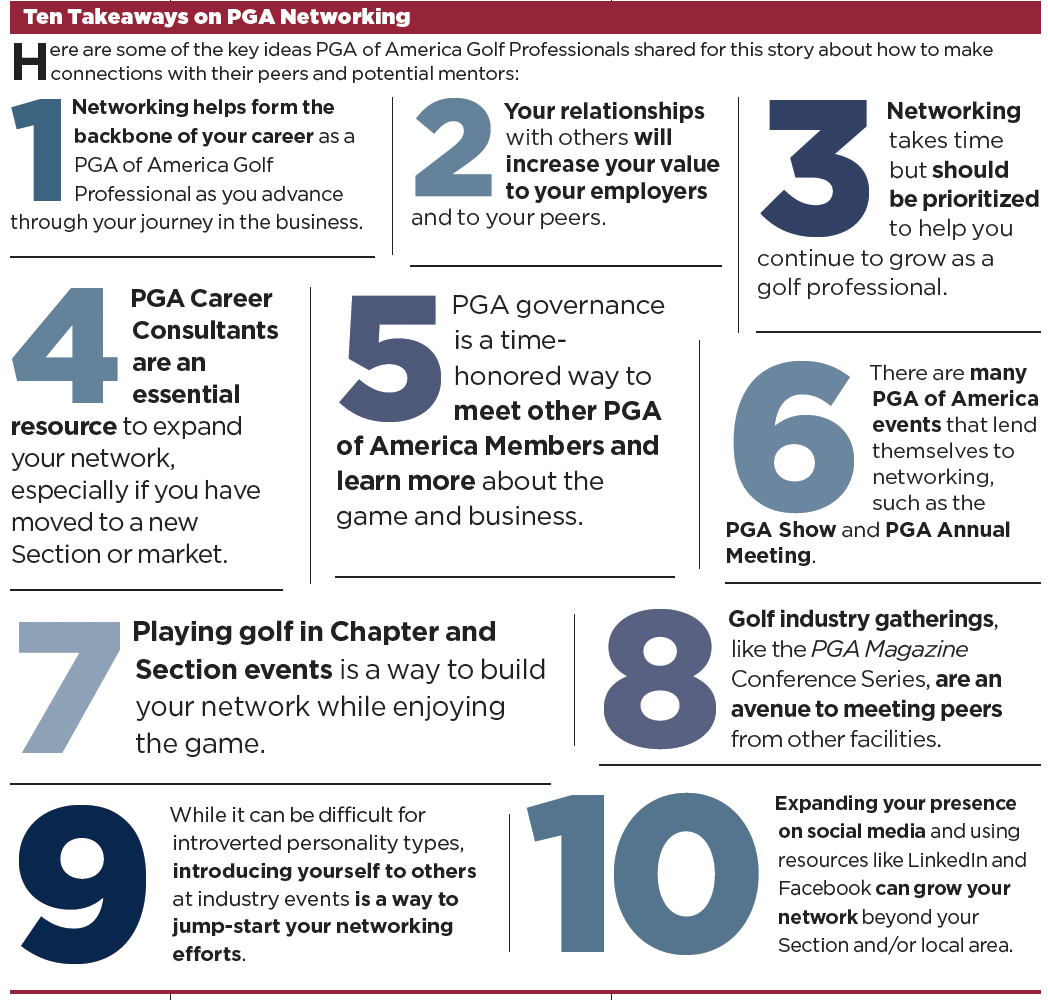
Ferrazzi suggests that the best time to start net working is right now – or, as he says often, “Build it before you need it.” Other top tips for networking from experts in business and relationships include:
• Be Consistent: Networking isn’t a one-time event, and ongoing follow-up is important.
• Take a Hybrid Approach: Take advantage of in-person and digital opportunities to connect with others.
• Offer Value: Show others that you’re aresource for them and they’ll be more likely todo the same for you.
• Be Selective: You don’t have to connect with everyone, but connecting with people with knowledge and connections that are valuable to you will pay dividends.
• Expand the Comfort Zone: Not everyone iscomfortable reaching out to others, especially introverts, but taking small steps and preparing by talking to an expert – like a PGA Career Consultant – can make the task much less daunting.
Charnes adds that a major advantage PGA ofAmerica Golf Professionals have is the sport’s built-in attitude of helpfulness: Golf professionals have a mentality of service to others, and that extends from helping golfers enjoy the game to sharing their knowledge with their peers. Charnes advises PGA of America Professionals to make the most of this mindset by blending old school face-to-face networking with technology-based tools for maximum relationship-building power.
“There are plenty of platforms where you can use technology to establish your network, like Linked In and Facebook,” Charnes says. “But don’t forget the established networking avenues like Section meetings, the PGA Show and the PGA Annual Meeting, all the great events PGA Magazine puts on, the access you have to our Career Consultants, even golf’s other governing bodies – it’s never been easier to build a network and maintain it, but you have to take it upon yourself.”
That sentiment is echoed by PGA of America Master Professional Mike O’Donnell, the Association’s Senior Director of Member & Section Operations. O’Donnell oversees the PGA of America’s 26 Career Consultants, who collectively serve as a built-in network for all golf professionals.
“As you progress in your career from an Associate through PGA of America Membership, you’ll need a network along the way, and we’re here to be part of that every step of the way,” O’Donnell says. “One of the biggest values we provide to PGA Members is helping them understand their career progression and navigating the skills and contacts they need, from becoming an assistant to becoming a general manager or whatever your goal may be.”
The PGA of America has made networking a key focus across its programs and communications. Using the resources available at the Section level and through PGA Career Consultants, O’Donnell says it’s possible to build a vibrant network that will be there when you need it most.
“Utilize the PGA of America platforms that are there for you, but also stay engaged with your peers by going to Section meetings and taking time to interact as much as your time allows,” O’Donnell says. “What’s available to golf professionals who stay engaged with their networks is phenomenal. If you have the desire and willingness to be curious and get to know people, you can enhance your career and your life in quite remarkable ways. And if you ever get stuck and don’t know where to turn, our team at PGA HQ and our Career Consultants are here to help you find other PGA of America Members who can be a resource.
“In any business you’ll find people who engage with others, and you’ll find people who don’t. When you take the time to engage, that’s when you find the significant impact that a network can make for you.”
Here are some of the most fruitful opportunities for networking that PGA of America Golf Professionals can use to build relationships:
• Participating in PGA of America governance — from Chapter boards to national committees — to engage with volunteer leaders and open doors to future leadership roles.
• Playing in Section and national events, which not only foster friendly competition but also strengthen camaraderie among peers.
• Attending flagship events like the PGA Show or the PGA Annual Meeting, where Members can meet fellow professionals, explore new business ideas and hear directly from leaders shaping the future of golf.
• Collaborating with a PGA Career Consultant, who can provide insights into employment trends, educational opportunities and strategies for achieving your next career goal.
• Leveraging your Membership access to major championships such as the PGA Championship or the Masters Tournament, where you can entertain members, observe world-class operations and interact with industry leaders.
• Traveling with members or guests on golf trips, which allows professionals to deepen relationships outside the club setting.
• Attending educational and networking events, such as PGA Magazine Conference Series gatherings, where professionals exchange ideas, share experiences and learn from one another.