BY DON JOZWIAK, SENIOR EDITOR, AND MATTHEW RUDY
Nick Biondi, PGA,Director of Instruction,Radley Run Country Club,West Chester, Pennsylvania
Once exotic devices like launch monitors and high-speed cameras are now instruction staples for PGA of America Coaches. With cutting edge technologies like 3D motion capture and AI-driven analysis now available on any modern smartphone, coaches and players have powerful new tools that can require learning some new language.
PGA of America Golf Professional Nick Biondi is using SportsboxAI to give students a deeper dive into the data behind their swing technique. The app compares a players’ 3D-measured swing with a giant database of others and makes suggestions about technical modifications. Biondi starts each student off with a primer on how to get the most out of the tool – and how to avoid getting confused.
“I teach a player how to see a 3D number and turn it into a feel they recognize on a 2D video,” says Biondi, who is based at Radley Run Country Club in West Chester, Pennsylvania. “Say their pelvis is two inches forward at impact instead of 4.5 inches. I’ll draw a line on the screen to represent it, and give them a good estimation of what that physically means in space – toward or away from the target, toward or away from the target line.”
The goal is the same as it is in any lesson from the past to the present day: to help a student create a feeling, even if it might not be one the coach feels the same way.
“I don’t look at any numbers, 2D or 3D, and compare them to things like tour averages right away,” says Biondi. “I’m trying to help players make their numbers predictable and consistent. When they can make them consistent, it’s a demonstration that I’m getting something useful across, and it becomes the basis for making an adjustment toward a new goal.”
Jessica Young, PGA Associate,Director of Junior Golf,The Golf Garage,Medford, Oregon
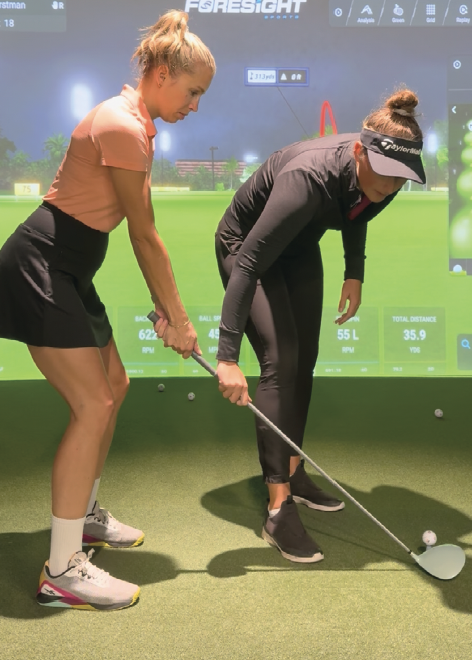
Watch a tour player practice pitch shots at an event early in the week and you’ll almost always see a launch monitor at work behind them. The purpose? To validate what the player feels with real data on carry and total distance. An amateur player can get a similar benefit working on a simulator.
“Many players do a poor job hitting their carry yardage on short game shots, so I use a simulator in a different way,” says PGA of America Associate Jessica Young, who is the Director of Junior Golf at The Golf Garage in Medford, Oregon. “I’ll turn the projector off but leave the simulator on.”
Young then asks students to hit what they think is a shot that travels a particular distance. After the swing, she switches on the screen to show them how their prediction matched (or mismatched) reality.
“I’ll ask them to hit it 30 yards, and almost without fail it will go 20 or 45, and they’ll turn to me and go, ‘What?’ Then I turn on the projector and they’ll say, ‘Wow,’ further proving how off their feel was.”
It’s perfect practice for off-season bad weather, or for a facility where there isn’t much short game practice space. Juniors respond to it especially well thanks to the gamification element, “and it really opened up the kids’ eyes for carry yardages,” says Young. “Hitting your landing spot properly is a skill needed multiple times a round, and it’s transferred nicely to when we go outside and start hitting to real targets.”
Kevin Edwards, PGA,Director of Golf,Olde Homestead Golf Club,New Tripoli, Pennsylvania
Spending $600 in the chase for more driver distance might be a sexier big-ticket purchase, but most players will see more impact on their score – while spending less – by going through a scoring clubfitting.
“Most players have no idea about things like spin decay and the impact of fresh grooves on their wedges,” says Kevin Edwards, a three-time Philadelphia PGA Section Teacher of the Year and the PGA of America Director of Golf at Olde Homestead Golf Club in New Tripoli, Pennsylvania. “The kind of shaft you have in your wedges can make a difference in your performance, and a different kind of putter could fit your playing style better.”
Edwards administers a liberal wedge and putter demo program to give players a first-hand look at how more – and more consistent – spin and performance around the green opens up more scoring possibilities.
“The moment they see the spin and grab they wanted, it not only elicits a ‘I can’t believe how fast the ball stopped,’ it usually leads to a purchase, too,” says Edwards. “And the ‘oohs’ and ‘ahhs’ of their partners have led to them wedge buying, too.”