More than once as Brian Rolapp has spoken about his approach in his role as CEO of the PGA Tour, he has invoked the words of the late former NFL commissioner Paul Tagliabue.
“If it ain’t broke, fix it anyway,” Rolapp has said, channeling Tagliabue’s message that helped steer the NFL into its place as the dominant force in American sports.
Among the many reasons the PGA Tour chose Rolapp to navigate its future, he isn’t afraid to challenge conventional wisdom.
“Golf needed to hire somebody who had the ability, to put it simply, [to] walk and chew gum at the same time and to keep all these balls in the air. It’s not one thing you need to figure out. It’s 20 or 30 things that have to be brought together,” said Jeff Shell, president of Paramount, which owns CBS.
“For golf there is such an opportunity because of the explosion in popularity. It’s a really smart hire. They could have gone out and hired a golf expert. Instead, they hired a business media expert and somebody who is hungry. I can’t think of anyone better.”
Having spent 22 years as an NFL executive, becoming the league’s chief media and business officer, Rolapp accepted the new position of CEO of the PGA Tour last June, bringing with him the intention and opportunity to redefine professional golf’s version of the NFL.
It was a bold step by the tour and Rolapp.
For the tour, it meant bringing in an outsider, someone who didn’t grow up inside the game and, consequently, will be less likely to maintain the status quo. Rolapp doesn’t just bring a fresh set of eyes, he brings an impressive résumé heavy on foresight and innovation.
For Rolapp, who some still see as a potential successor to NFL commissioner Roger Goodell, it was the chance to apply his decades of experience to a successful organization that finds itself caught in the vortex of change, both within the game and with those on the outside looking in. He has said he is committed to streamlining and enhancing the tour product while honoring the traditions that have been built over decades.
It is an equation with multiple potential answers. It is Rolapp’s task to find the best answer and the path to get there.
For that reason, Rolapp is as compelling as Scottie Scheffler and Rory McIlroy as 2026 unfolds. He continues to do his due diligence more than six months in, working closely with commissioner Jay Monahan while seeking out lengthy conversations with players and partners as he leads the tour into a reimagined future.
Adam Scott, Jay Monahan and Brian Rolapp
Tracy Wilcox, PGA TOUR via Getty Images
“I have found him to be one step ahead when it comes to strategy. He will need to architect what will be the modern PGA Tour business and quietly shape how fans engage with the product at scale,” said Mark Shapiro, president and COO of TKO, a premium sports and entertainment company.
Rolapp has dropped hints about how he sees the future – his use of the word “scarcity” last year when asked about how the tour schedule may evolve prompted intense speculation – but he has yet to provide a detailed vision, suggesting the future competition committee headed by Tiger Woods will be heavily involved in crafting whatever comes next.
“He takes time to get to know people and what is important to them. If you have five different people with five different priorities, how can you find something that will weave those together so that all tides will rise? He’s really good at doing that,” said Renie Anderson, who worked with Rolapp for 20 years, most recently as executive vice president and chief revenue officer for the NFL.
“He does give a sense of trust which is helpful because it is genuine. You don’t feel like you’re [getting] a car salesman. … The Patrick Mahomes of media distribution negotiation, that’s what Brian was.”
Rolapp steered the process to bring Brooks Koepka back to the PGA Tour once the five-time major champion left LIV Golf and expressed an interest in returning to the tour. It was a decision with multiple layers, including an emotional component, and Rolapp brought the whole thing together in less than three weeks, earning almost universal praise for finding a solution that worked for everyone.
It offered a sense of Rolapp’s aggressive approach and his ability to bring together different constituencies to solve a complicated problem.
Rolapp, a 53-year-old graduate of Brigham Young University and Harvard Business School, is a married father of four and a devoted family man, regularly carving out time to be at home or at a son’s football game. He is a Mormon, doesn’t drink alcohol and longtime associates talk about his graciousness, his work-life balance and how he is content to leave the spotlight to others.
He knows his pop culture, whether it’s books, movies or music. Rolapp has been known to wade into the discussion about whether “Die Hard” is a Christmas movie and he is a good guitar player.
“Part of professional golf’s issue is it has grown up as a series of events, that happened to be on television, as opposed to how do you actually take those events, making them meaningful in their own right, but cobble them together in a competitive model, including with a postseason that you would all understand whether you’re a golf fan or a sports fan.”
brian rolapp
Rolapp and his wife Cindy have three boys (Drew, Will and Ben) and one daughter (Catherine). Will was a walk-on member of Michigan’s 2003 national championship team. The youngest, Ben, is a high school quarterback in Connecticut, where the Rolapps still have their home, though Brian is based now at the tour headquarters in Ponte Vedra Beach, where he has been spotted taking a few swings in the first-floor simulator before heading to his car at the end of a work day.
In his relatively few public comments since joining the tour, Rolapp has talked more conceptually than in specifics. What might a future schedule look like? How could every tournament become bigger and have more meaning? How could the schedule be retooled to feel more cohesive and bring more meaning to determining a season-long champion?
“Part of professional golf’s issue is it has grown up as a series of events, that happened to be on television, as opposed to how do you actually take those events, making them meaningful in their own right, but cobble them together in a competitive model, including with a postseason that you would all understand whether you’re a golf fan or a sports fan,” Rolapp said at the CNBC CEO Council Forum in November.
This comes at a time when the tour has reinvented itself. It now has a for-profit arm through PGA Tour Enterprises, and the Strategic Sports Group, which has invested $1.5 billion in the new entity, is heavily involved in deciding where its money goes and what comes next.
Rolapp may be relatively new to golf but he is no stranger to the big business of professional sports. Before joining the tour, Rolapp was in charge of the NFL’s commercial businesses, including its broadcasting and media rights, NFL Media, sponsorship, advertising sales and consumer products. He also led 32 Equity, the company that makes investments for the league and its 32 owners.
“If Brian wasn’t the smartest person at the NFL, he was in the top two,” and he was considered the best manager of people in the building, said an associate who worked closely with Rolapp at the NFL. The 32 team owners, a notoriously challenging group, liked and trusted Rolapp, the associate added.
He pushed the NFL’s Thursday night television package on Amazon Prime Video and saw the potential of expanding to other streaming platforms including Netflix. He was instrumental in the NFL’s partnership with Skydance Media, which develops sports-related content for various platforms.
By increasing viewership and interaction with fans, Rolapp understood, the value of the product was increased.
Talking with people who have worked with and alongside Rolapp, two familiar themes emerge: He has the ability to bring an understanding and sharp focus to big concepts and he is equally effective on the personal level.
“He has a gravitational pull that makes you want to give him your best ideas and he can naturally pull that out of you,” said David Jurenka, senior vice president of NFL Media.
There is an undeniable sense that Rolapp wants to fix things quickly and move with urgency.
At the PGA Tour, Rolapp has spent much of his time not just learning the landscape but making connections with the players. He reached out to dozens of them, often spending 90 minutes in person or on calls, quizzing them about their thoughts on the tour and where it can go.
Rolapp and Monahan, who will step down as commissioner at the end of this year, have offices near one another at the tour headquarters and are regularly seen talking to each other in the building. When Rolapp has met with tour employees, he has stressed transparency and accepts pushback on ideas.
“It’s a great deal that we don’t have a guy who’s just the next golf guy as our commissioner and CEO. He can fill the gap between how do we make this the most successful business possible and still be an elite sport. Time will tell,” tour veteran and broadcaster Kevin Kisner said.
At a tour policy board meeting at Sea Island in November, it was the first time Webb Simpson had been in the room with Rolapp during a policy board meeting.
“I was actually curious kind of how the day would go, and the feeling of how much input is he going to give? And I thought it was just the perfect amount,” Simpson said.
“I thought he had some really good ideas. I thought he was assertive and confident. But also we’ve got a room full of really smart people and great independent directors, great player directors, so he really listened as well.”
As head of the future competition committee, Tiger Woods leads the group that is helping craft the tour’s new vision. He was also on the committee that selected Rolapp to lead the tour.
“Brian’s been fantastic,” Woods said in December. “An amazing CEO, an amazing leader. What he’s done so far in a short time in his leadership skills and his personality and how he handles situations, his calmness, his thoughtfulness, his directness, transparency, all the things that we were looking for and we needed on the tour he has delivered in spades.”
Steve Bornstein, the former president and CEO of NFL Network who recruited Rolapp to the NFL from NBC, was struck by Rolapp’s uncommon combination of brains, ambition and integrity.
“He has the unique ability that many lose after they’ve had some success. He still listens,” Bornstein said.
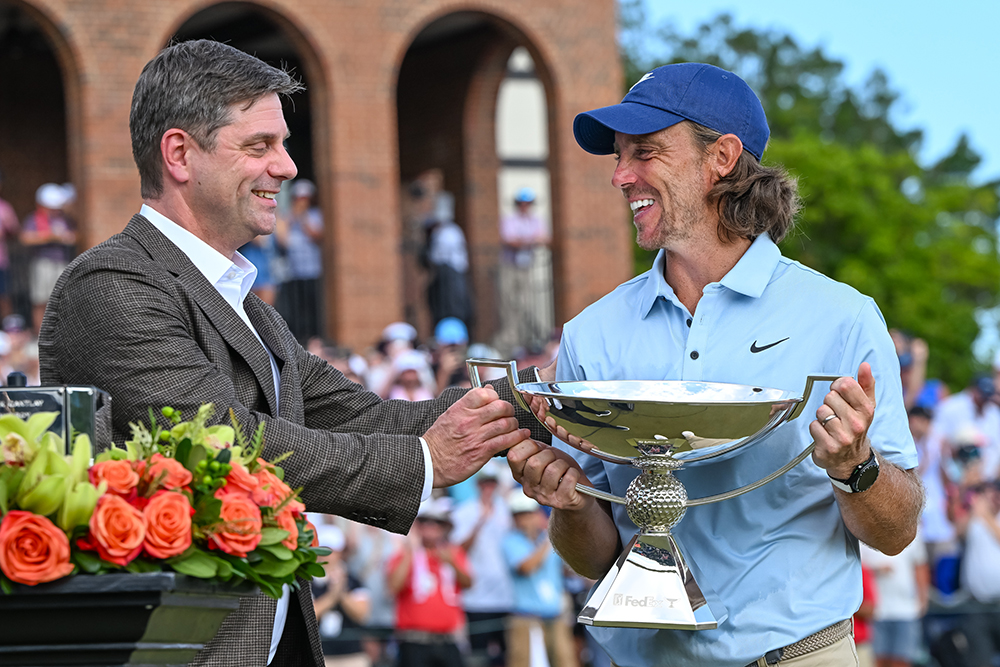
Brian Rolapp and Tommy Fleetwood
John Adams, Icon Sportswire via Getty Images
“He went into the tour with concepts he wanted to test. That’s what he’s doing right now. I don’t think he has the answer. That’s why he’s in the exploratory phase. He wants perspective he doesn’t have.”
Janet Nova worked as the NFL’s deputy general counsel when Rolapp was leading the league’s media rights negotiations that resulted in a 10-year deal worth more than $100 billion to the league, the deal spread across five separate transactions.
“It was like landing five planes at the same time,” Nova said. “He was instrumental in his strategic thinking and in his execution in being the architect of the deal and so getting each of them negotiated.”
There is no shortage of conjecture about what Rolapp’s vision for the PGA Tour entails. He mentioned three key components in his media session at the Tour Championship in August: Competitive parity, scarcity and simplicity. That means making every event matter, potentially reducing the number of tournaments and length of the schedule and, finally, creating a cleaner storyline through the season to the finale.
Some believe Rolapp prefers to wait until February to start future seasons and have them end before football takes over in September.
One line of thinking has the tour reducing the number of tournaments to fewer than 25, not including the majors. Others suggest that’s too aggressive and there are too many contractual obligations to make that happen in the immediate future, not to mention the reaction of the core audience conditioned to following PGA Tour golf almost year-round.
But Rolapp has a knack for getting where he wants to be.
Michael Rubin, the founder and CEO of Fanatics, the sportswear company that has a 10-year partnership with the NFL, found himself in a sometimes contentious negotiation with Rolapp regarding consumer products several years ago.
“I got pretty aggressive and testy trying to shake him and he was unflappable. I’m generally that way but Brian was eye on the prize. He didn’t let emotion get in the middle of it and he made sure to get to the right outcome for NFL fans and the league while doing it in a great way with me,” Rubin said.
“I kind of wanted to throw off his game. I was unable to.”
As 2026 dawns, Rolapp’s imprint on the PGA Tour will become more evident. He is smart enough to know what he doesn’t know and tends to fill those spots with people who can fill those voids.
Having spent more than two decades at the NFL, Rolapp has worked in one of the most respected and successful businesses in America with a reputation for molding leaders. Rolapp has a knack for leveraging the collective ability of a group to get to the best result.
“Brian is NFL trained which means he’s a business person first and a sports person second,” Shell said. “With all the stuff happening across our business, sports and non-sports, sports is at the epicenter of it and Brian has his hand on the pulse of everything.”
That pulse, the PGA Tour’s heartbeat, is guarded and guided by Rolapp now.
“Whether it’s expanding or shrinking what is working now, whether it’s less or more is unimportant. It’s more about thinking about making it better,” Bornstein said.
“He will respect the tradition. He’ll be sensitive to those things but asking questions and exploring different options will bring him to the best solution. That’s one of his superpowers.”
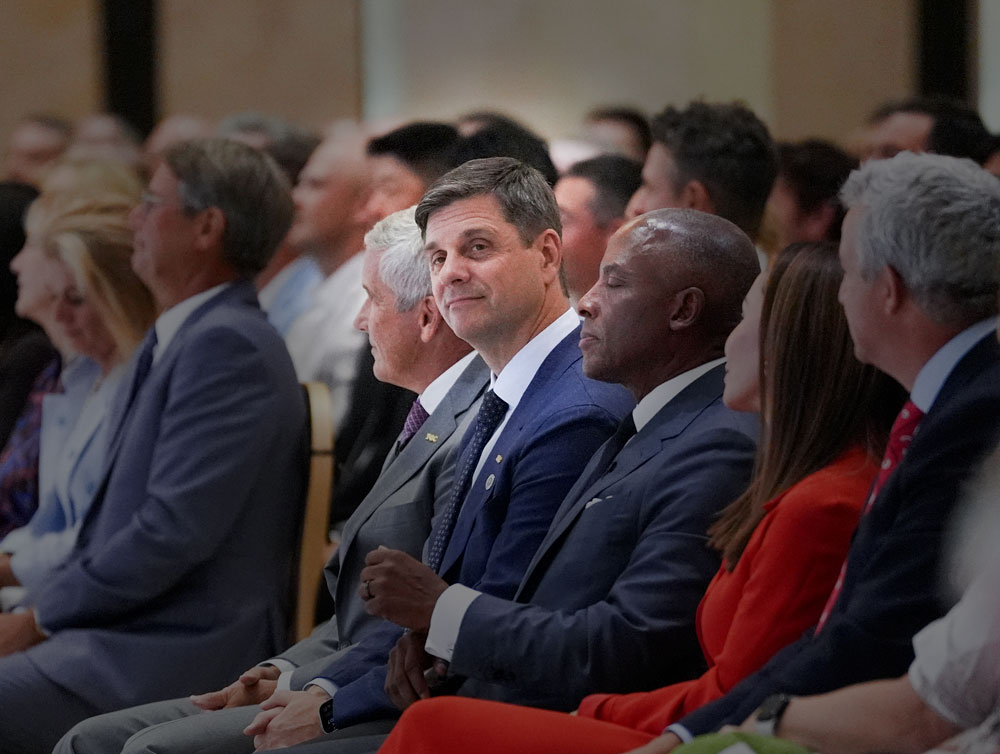
Top: Observers say Brian Rolapp brings listening to his leadership.
Darren Carroll, PGA of America via Getty Images