Every manager or dealer principal has a vision for how their service and parts departments should function. As a manager, you know what success looks like, how customers should be treated, and how work should flow. You may even communicate those goals during meetings or through performance targets.
But once the day begins, the reality of the service drive often tells a very different story. The results don’t match the plan. The numbers aren’t adding up. And the default response becomes frustration, usually aimed directly at the advisors and technicians.
Here’s the truth: your vision only matters if it’s backed by execution. Execution doesn’t fail because people don’t care. It fails because systems aren’t built to support the vision. You may be thinking ten steps ahead, but if your department is still operating with systems and policies that haven’t been updated or fully implemented in years or are working with outdated tools, you’re setting your team up for failure.
One of the most common issues we constantly see? Discounting. It’s a perfect example of how unclear rules and poor system programming can quietly drain profitability.
Before pointing fingers, it’s necessary to ask yourself a few critical questions:
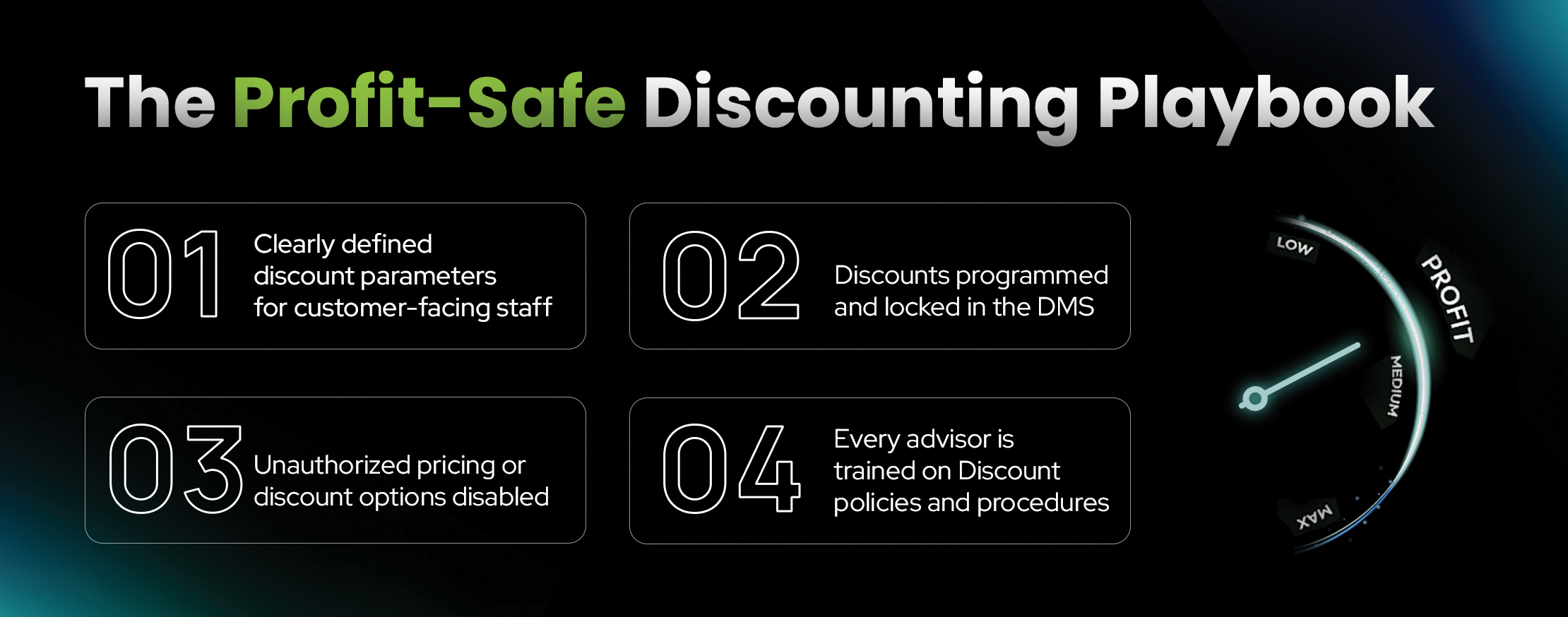
• Have you clearly defined discount parameters for customer-facing staff?
• Are those discounts actually programmed and locked in your DMS?
• Are all other unauthorized pricing or discount options disabled?
• Have you communicated your discount policy to every advisor through training?
Chances are, at least one of those pieces is missing. And if you’re being honest, possibly all of them are missing.
Discounts are just the tip of the iceberg. It’s time to delve into how billing and labor operations could be affecting your dealership.
Do your advisors have access to the right labor ops for every repair category? Or do they have a sea of generic, catch-all operations — what I call “Off Ramp” codes, that let them sidestep billing procedures entirely?
In many dealerships, advisors have access to thousands of labor ops, many of which were never cleaned up or standardized. As a result, they gravitate toward whatever gets the job done fastest, even if it bypasses key reporting metrics, undercuts profitability, or leads to inaccurate RO (Repair Order) documentation.
And again, it’s not because they’re lazy or careless. It’s because they don’t have the tools or structure they need to follow the intended process. They’re improvising, not undermining.
If we want service advisors to perform consistently, profitably, and by the book, we need to give them the infrastructure to do so. That means building a system that supports performance, rather than assuming it.
Here’s what that looks like:
1. Defined Discount Codes & Controls
Discount codes must be set to parameters of the dealership, and all unauthorized options removed from the DMS. If advisors have too much freedom, or worse, no direction, they will create their own processes. This is common due to the busy nature of the departments.
2. Structured Labor Operations
Every Repair Order should have a clear, categorized labor op assigned. These should be programmed with a group description that prompts advisors to ask specific questions and capture the customer’s verbatim answer. You don’t want pre-programmed vague codes like “Check Engine Light ON.” For top technician efficiency, you need specifics from the customer themselves, in detail.
3. Correct Labor Types
Customer Pay (CP), Warranty (WRO), Internal (INT), Fleet, Extended Warranty, etc. — with corresponding labor rates and parts markups automatically applied. When programmed correctly, this removes the need for manual price adjustments.
4. Automatic Fee Codes
From tire disposal to shop supplies and taxes, fee codes should be automatically triggered where appropriate. Manual entry opens the door to inconsistency, missed revenue, and even potential compliance risks.
If your dealership’s service department isn’t hitting its numbers, don’t start by blaming the advisors. Start by looking at the infrastructure. Are your systems clean, current, and configured to support your vision for your department? Or are you relying on a patchwork of outdated processes, knowledge, and half-built tools?
Advisors can only go as far as the systems allow them to. If the infrastructure isn’t supporting execution, even the most capable team will struggle to meet performance goals. The good news? With the right tools and programming in place, the path to profitability becomes a lot clearer.
To get your Fixed Ops Mojo back, the responsibility for profitability doesn’t begin at the advisor’s desk. It begins in the back office, with leadership, systems, and structure.
From there, it’s simple: inspect what you expect.
Joseph Minns the Head of FrogData’s Fixed Ops Operations. He is responsible for the Fixed Ops Platform, Consulting, Warranty Administration Services and Performance Consulting.
He has 34 years direct experience in Fixed Operations, with responsibilities that have spanned from a single point dealer, to over 800 employees in a single dealer group of 27 dealerships and 31 OEMs.
Joseph holds multiple OEM Master certifications in Service Management, Parts Management, Body Shop Management, Commercial Vehicle Management, and is a NADA Service Graduate. In his free time, he is a leader in the Boy Scouts, a lieutenant in the fire service, and certified underwater rescue diver.