Neal D. Shore, MD1; Gary Steinberg, MD2
1START Carolinas and AUC Urology Specialists, Myrtle Beach, South Carolina
2Rush University Department of Urology, Chicago, Illinois
KEYWORDS:
Non-muscle invasive bladder neoplasms; immune checkpoint inhibitors; immunotherapy; BCG vaccine
Abstract
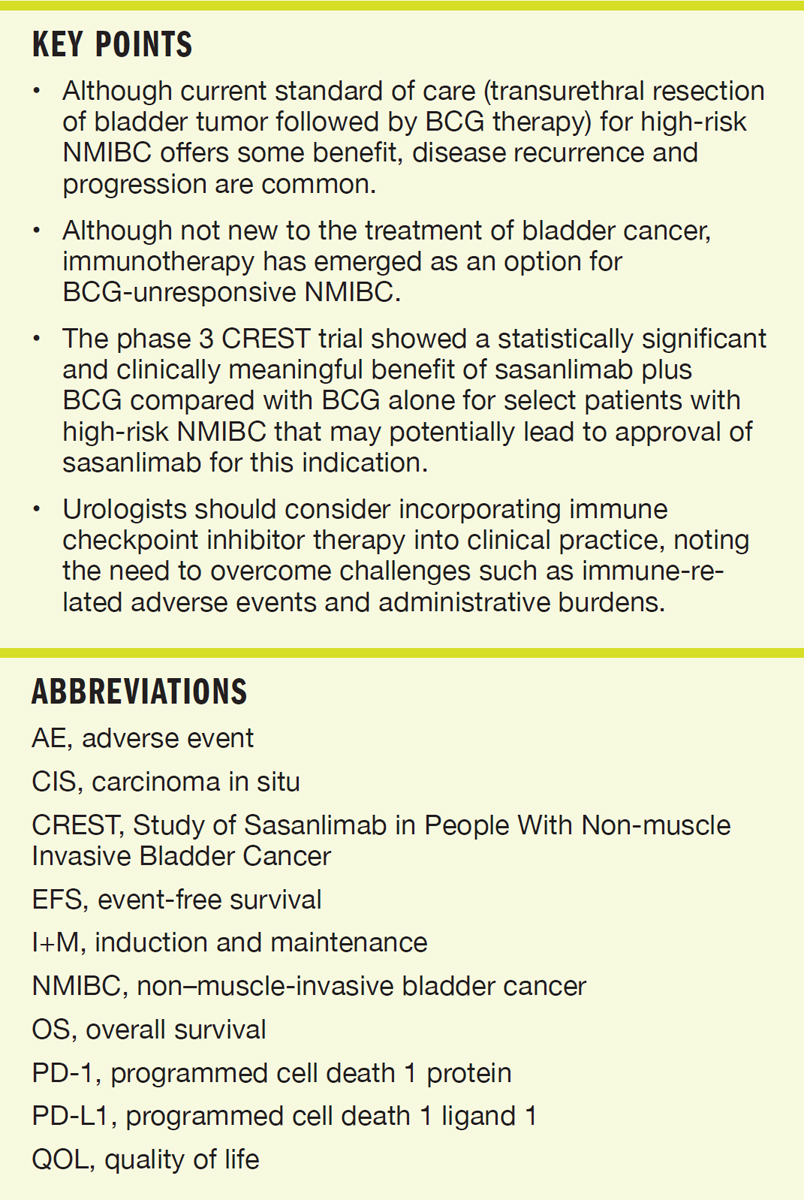
Background: The current standard of care for treating high-risk non–muscle-invasive bladder cancer (NMIBC) is transurethral resection of bladder tumor followed by BCG induction and maintenance (I+M) therapy. Although this treatment offers some benefit, disease recurrence and progression are common. Subsequent bladder-sparing treatments are limited, highlighting the need for new approaches.
Methods: Although not new to the treatment of bladder cancer, immunotherapy has emerged as an option for BCG-unresponsive NMIBC. Currently, the only immune checkpoint inhibitor with an indication for high-risk NMIBC is pembrolizumab, but new data may support the potential approval of sasanlimab for this disease.
Results: CREST was a phase 3 trial that evaluated sasanlimab combined with BCG compared with BCG (I+M and induction only) in prolonging event-free survival in patients with high-risk NMIBC. A total of 1055 patients were randomly assigned, and the risk of experiencing an event-free survival event was 32% lower in the sasanlimab plus BCG-I+M group than in the BCG-I+M group (stratified hazard ratio, 0.68 [95% CI, 0.49-0.94]; 1-sided P = .01). Median follow-up for overall survival in the population was 40.9 months, and median overall survival had not been reached for any arm. There was no difference in overall survival between treatment arms.
Conclusions: In BCG-naive high-risk NMIBC, results of CREST indicated a benefit of sasanlimab plus BCG-I+M compared with standard of care in prolonging event-free survival. Urologists should consider selectively incorporating immune checkpoint inhibitor therapy into clinical practice, noting the need to overcome challenges such as immune-related adverse events and administrative burdens.
As the sixth-most common cancer in the United States, bladder cancer poses a substantial burden to patients and the health care system, with an estimated 84 870 new cases and 17 420 deaths anticipated in 2025.1 A significant portion—approximately 75%—of bladder cancer is non–muscle-invasive bladder cancer (NMIBC) at diagnosis.2,3 Many patients with NMIBC may respond well to initial intravesical treatment but subsequently experience disease progression or recurrence and require further therapy. These second-line therapies, historically systemic therapy, radiation, or major surgery, typically are associated with substantial morbidity in older patients, leading to reduced quality of life (QOL).4,5 Some data suggest that patients first diagnosed with NMIBC that advances to muscleinvasive disease may have a worse prognosis than patients who present initially with muscle-invasive disease.6-8
Several guideline consortia stratify NMIBC into low-risk, intermediate-risk, and high-risk categories on the basis of clinical and pathologic factors indicative of disease severity and prognosis.9-12 Although no single risk classification system for NMIBC is internationally accepted, several have been suggested and published.9,11,13
High-risk NMIBC is defined as any high-grade tumor, carcinoma in situ (CIS), or BCG failure and aggressive variants of urothelial carcinoma.9,11,12 Compared with low-risk and intermediate-risk disease, high-risk NMIBC is associated with worse outcomes, poorer prognosis, higher cumulative care costs, and high rates of disease progression.5 Although intravesical BCG remains a cornerstone of therapy for high-risk NMIBC, BCG failure and shortages emphasize the need for alternative treatment options.14 Radical cystectomy remains the criterion standard for BCG-unresponsive NMIBC, but this procedure is highly invasive and carries clinically significant morbidity.14
A newer classification of very high-risk NMIBC has been suggested by the European Association of Urology guidelines.15,16 This risk stratification scheme suggests that very high-risk NMIBC includes 3 additional risk factors: no CIS, CIS plus 1 additional risk factor, or the presence of lymphovascular invasion.15,16 In these patients, immediate radical cystectomy may be considered as an alternative to intravesical BCG.15,16
The current standard of care for treating high-risk NMIBC is transurethral resection of bladder tumor followed by BCG induction and maintenance (I+M) therapy.9,12 The standard schedule for BCG is induction dosing once weekly for 6 weeks, then maintenance therapy for up to 3 years.
Although standard-of-care treatment for high-risk NMIBC is successful in most patients, disease recurrence and progression occur and lead to both disease-related and treatment-related toxic effects.9,12 Thus, new approaches to preserve a functional bladder while demonstrating good tolerability and minimal impact on health-related QOL are needed.9,17
Clinical trials have evaluated immune checkpoint inhibitors in BCG-naive and post-BCG NMIBC settings, leading to the approval of the only immune checkpoint inhibitor currently approved for NMIBC, pembrolizumab, based on positive results from a phase 2 trial.18,19 A strong rationale supports the use of immune checkpoint inhibitors in combination with BCG. Increased programmed cell death 1 ligand 1 (PD-L1) expression is associated with exposure to BCG in preclinical models and tumors from patients with high-risk NMIBC.20 This enhanced PD-L1 expression may contribute to the immune escape mechanism in bladder cancer cells with BCG-only treatment.21 Therefore, combining BCG with PD-L1/programmed cell death 1 protein (PD-1) inhibition through immune checkpoint inhibitors may improve the therapeutic efficacy of NMIBC treatment, as demonstrated in several preclinical trials.20,22-24
The investigational immune checkpoint inhibitor sasanlimab is a humanized monoclonal antibody specific for human PD-1 that blocks the interaction between PD-1 and PD-L1/PD-L2.17 Phase 1 data indicated durable antitumor activity and a manageable safety profile in advanced or metastatic solid tumors, providing a basis for late-stage trials in NMIBC.25 These early data and mechanisms of immune escape in bladder cancer provide rationale for further study of sasanlimab in NMIBC, leading to the phase 3 Study of Sasanlimab in People With Non-muscle Invasive Bladder Cancer (CREST) trial (ClinicalTrials.gov identifier NCT04165317).17
The objective of the CREST trial was to evaluate sasanlimab combined with BCG compared with BCG only in prolonging event-free survival (EFS) in patients with high-risk NMIBC.17
Patients eligible for CREST were adults with BCG-naive high-risk NMIBC (HGTa, CIS, or T1).17 Participants were required to have a complete resection of Ta/T1 papillary disease, the most recent transurethral resection of bladder tumor, within 12 weeks before random assignment. Patients were excluded if there was evidence of muscle-invasive, locally advanced, or metastatic urothelial carcinoma or if they had concurrent extravesical urothelial carcinoma.17
Patients were randomly assigned 1:1:1 to sasanlimab with BCG I+M (arm A), sasanlimab with BCG induction only (BCG-I; arm B), or BCG-I+M only (arm C).17 Sasanlimab was administered subcutaneously in a 2-mL prefilled syringe on the first day of each 4-week cycle and continued up to 25 cycles. BCG induction was administered via intravesical instillation as a single dose once a week for 6 consecutive weeks. For patients with persistence of CIS and high-grade Ta after induction, reinduction with BCG was allowed.17
The primary end point of CREST was investigator-assessed EFS for arm A vs arm C, which was designated as time from randomization to disease progression, recurrence of high-grade disease, persistence of CIS, or death from any cause.17 Secondary end points included investigator-assessed EFS for arm B vs arm C and overall survival (OS) for arms A and B vs arm C, investigator-assessed complete response, duration of complete response, safety, and health-related QOL patient-reported outcomes.17
A total of 1055 patients with BCG-naive high-risk NMIBC were randomly assigned to arm A (n = 352), arm B (n = 352), or arm C (n = 351) between January 2020 and November 2021.17 Baseline demographic and disease characteristics were similar among the 3 arms and representative of the larger high-risk NMIBC patient population (Table 1).17 The median duration of sasanlimab was 80.3 weeks (range, 4.0-103.9 weeks) in arm A and 84.8 weeks (range, 4.0-104.4 weeks) in arm B. Completion of 25 cycles of sasanlimab treatment was 46.3% in arm A and 45.7% in arm B, and the most common reason for discontinuation was adverse events (AEs; 31.8% in arm A and 25.0% in arm B).17 The median duration of BCG-I+M was 98.1 weeks (range, 2.0-125.1 weeks) and 18.0 doses in arm A and 98.9 weeks (range, 2.0-110.0 weeks) and 21.0 doses in arm C. BCG-I+M treatment completion at 2 years was 48.6% in arm A and 57.8% in arm C, and the most common reasons for discontinuation of BCG maintenance were AEs in arm A (21.9%) and lack of efficacy in arm C (15.4%).17
For the primary end point, EFS was 32% lower in arm A compared with arm C (stratified hazard ratio, 0.68 [95% CI, 0.49-0.94]; 1-sided P = .01) (Figure 1A).17 Median follow-up for the overall population was 36.3 months for EFS, and median EFS was not reached in any arm. The probability of being event free at 36 months was 82.1% for arm A and 74.8% for arm C. The EFS was not significantly different for arm B vs arm C (stratified hazard ratio, 1.16; 95% CI, 0.87-1.55; 1-sided P = .84) (Figure 1B).17 The results of EFS analyses were consistent among the intentionto-treat populations and all prespecified subgroups, which include stratifications for geographic regions and tumor stage at random assignment.17 Notably, patients with CIS or T1 disease at random assignment in arm A had significantly improved EFS rates compared with the same populations in arm C (Figures 2 and 3).17
Figure 1. Analysis of EFS in the intention-to-treat population for sasanlimab plus BCG-I+M vs BCG-I+M and sasanlimab plus BCG-I vs BCG-I+M. For EFS, an event was defined as the first of recurrence of high-grade disease, progression of disease, persistence of CIS (for patients with CIS at random assignment), or death from any cause. (A) Kaplan-Meier estimates of EFS for sasanlimab + BCG-I+M vs BCG-I+M, by treatment arm, in the intention-to-treat population. The dashed lines indicate EFS at 24 months and 36 months. Abbreviations: CIS, carcinoma in situ; EFS, event-free survival; I+M, induction and maintenance. Reproduced from Shore ND, et al. Nat Med. 2025, doi:10.1038/s41591-025-03738-z, under Creative Commons Attribution-NonCommercial-NoDerivatives 4.0 International License (https://creativecommons.org/licenses/by-nc-nd/4.0/legalcode.en).
The median follow-up for OS in the overall population was 40.9 months, and the median OS had not been reached for any arm. No difference in OS was observed between arms (Figure 4).17 For patients with CIS at random assignment, the complete response rate was 89.9% in arm A and 85.2% in arm C.17 Patient-reported health-related QOL was assessed using the European Organisation for Research and Treatment of Cancer Core Quality of Life Questionnaire, with a difference of 10 or more points considered a clinically meaningful difference.
The mean (SD) change in score from baseline to the end of treatment was –5.7 (21.3) points for arm A and –1.0 (19.7) point for arm C, indicating a non–clinically meaningful difference between the arms.17
Treatment-related AEs in CREST occurred in 87.1% of patients in arm A, 79.0% in arm B, and 70.2% in arm C (Table 2).17 Immune-related AEs of any grade occurred in 42.6% of patients in arm A and 46.8% of patients in arm B. Immune-related AEs that were grade 3 or higher occurred in 15.7% of patients in arm A and 14.1% of patients in arm B. In arm A, 19.7% of patients received systemic corticosteroids, and 20.1% of patients in arm B received systemic corticosteroids.17
In patients with BCG-naive high-risk NMIBC, results of CREST indicate a statistically significant and clinically meaningful benefit of sasanlimab plus BCG-I+M compared with standard of care (BCG-I+M alone) in prolonging EFS, particularly for patients with CIS or T1 tumors.17 If approved for this indication, sasanlimab may present a new treatment option that can delay high-grade disease recurrence and progression, meeting an unmet need to improve these outcomes in individuals with high-risk NMIBC.
Figure 2. Analysis of EFS in patients with CIS at random assignment (with or without papillary tumors) in the CREST trial. For EFS, an event was defined as the first of recurrence of high-grade disease, progression of disease, persistence of CIS (for patients with CIS at random assignment), or death from any cause. Kaplan-Meier estimates of EFS, by treatment arm. The dashed line indicates EFS at 36 months. Abbreviations: CIS, carcinoma in situ; EFS, event-free survival; I+M, induction and maintenance. Reproduced from Shore ND, et al. Nat Med. 2025, doi:10.1038/s41591-025-03738-z, under Creative Commons Attribution-NonCommercial-NoDerivatives 4.0 International License (https://creativecommons.org/licenses/by-nc-nd/4.0/legalcode.en).
Results of CREST also suggest durable disease control in participants who received sasanlimab plus BCG-I+M, a notable improvement considering the limited bladder-sparing therapeutic options that currently exist after CIS recurrence.17 The safety profiles of sasanlimab and BCG in CREST were consistent with known AEs for each agent. Urologists should consider the risk-benefit ratio of adding sasanlimab (if approved) to BCG in clinical practice based on patients’ ability to tolerate these AEs. Quality of life was also maintained in CREST, and patients may prefer the subcutaneous route of administration for sasanlimab to the intravenous administration of some other immunotherapies.17 This option may offer greater convenience to patients and improved efficiency for clinic implementation.
Figure 3. Analysis of EFS in patients with T1 tumor (with or without CIS) in the CREST trial. For EFS, an event was defined as the first of recurrence of high-grade disease, progression of disease, persistence of CIS (for patients with CIS at random assignment), or death from any cause. Kaplan-Meier estimates of EFS by treatment arm. The dashed line indicates EFS at 36 months. Abbreviations: CIS, carcinoma in situ; EFS, event-free survival; I+M, induction and maintenance. Reproduced from Shore ND, et al. Nat Med. 2025, doi:10.1038/s41591-025-03738-z, under Creative Commons Attribution-NonCommercial-NoDerivatives 4.0 International License (https://creativecommons.org/licenses/by-nc-nd/4.0/legalcode.en).
Limitations of CREST included its open-label design and the low number of deaths observed at the time of the OS interim analysis.
Urologists were among the pioneers in immunotherapy use, including BCG treatment for bladder cancer starting in the 1980s and the immunotherapy sipuleucel-T, which was approved in 2010 for patients with asymptomatic or minimally symptomatic metastatic castration-resistant prostate cancer.26,27 Although urologists have decades of experience with certain types of immunotherapy, many are still unsure about incorporating immune checkpoint inhibitors, including those with evidence in NMIBC, into their practices.28 As highlighted in CREST, the advent of immunotherapy for treating urologic cancers has accelerated. Although some urologists have fully embraced prescribing immune checkpoint inhibitor therapies and advocate that urologists should use these agents, some are undecided, and others are still hesitant to prescribe them.26,28-30
Figure 4. Analysis of OS in the intention-to-treat population. (A) Kaplan-Meier estimates of OS for sasanlimab plus BCG-I+M vs BCG-I+M. Abbreviations: OS, overall survival; I+M, induction and maintenance. Reproduced from Shore ND, et al. Nat Med. 2025, doi:10.1038/s41591-025-03738-z, under Creative Commons Attribution-NonCommercial-NoDerivatives 4.0 International License (https://creativecommons.org/licenses/by-nc-nd/4.0/legalcode.en).
Immune-related AEs remain a substantial barrier to the use of immune checkpoint inhibitors in clinical practice.31-33 Although these agents are generally well tolerated compared with aggressive cytotoxic regimens, they have a unique set of AEs that often require a different approach than the AEs typically associated with chemotherapy.32,33 In the CREST trial, the most common immune-related AEs overall were thyroid disorders and rash, while the most common grade 3/4 immune-related AE was immune-related hepatitis.17 Grade 5 immune-related AEs did not occur in any patients in arm A and occurred in 1 patient in arm B (myocarditis).17 These rates of immune-related AEs are consistent with or lower than those observed with other immunotherapies across various cancers.33 By improving familiarity with these AEs, including how to identify and manage them, urologists can increase confidence and better assess the benefits of disease-free survival vs the risks of autoimmune disorders.
Regardless of urologists’ individual perspectives on the incorporation of immunotherapy into urology practice, administrative burdens can complicate the process of establishing an immunotherapy program. Particularly for private groups outside a hospital setting, operational challenges can be a barrier given high drug costs, relatively small margins, and the typical practice of buying drugs first and billing the patient’s insurance later.27 When immunotherapies are prescribed for US Food and Drug Administration–approved indications, however, there is typically little difficulty receiving reimbursement.27 As urologists become more familiar with immunotherapies for urologic cancers, including NMIBC, clinic implementation will become more feasible, allowing patients the opportunity to receive these practice-changing treatments.
The phase 3 CREST study showed a statistically significant benefit of subcutaneous sasanlimab plus BCG-I+M over BCG-I+M only (standard of care) in patients with BCG-naive high-risk NMIBC. Although not yet approved by the Food and Drug Administration, sasanlimab may offer an opportunity to intensify traditional treatment in select patients with a favorable risk-benefit ratio. With the continued advancement of immunotherapy in urology practice, urologists are encouraged to consider methods of implementing these therapies to offer patients the most appropriate option for their clinical situation.
Siegel RL, Kratzer TB, Giaquinto AN, Sung H, Jemal A. Cancer statistics, 2025. CA A Cancer J Clinicians. 2025;75(1):10-45. doi:10.3322/caac.21871
Contieri R, Soloway MS, Gontero P, et al. Deintensification of treatment for low-grade bladder tumors: a collaborative review by the International Bladder Cancer Group (IBCG). Eur Urol Oncol. 2025;8(1):179-189. doi:10.1016/j.euo.2024.08.001
Bray F, Laversanne M, Sung H, et al. Global cancer statistics 2022: GLOBOCAN estimates of incidence and mortality worldwide for 36 cancers in 185 countries. CA Cancer J Clinic. 2024;74(3):229-263. doi:10.3322/caac.21834
National Cancer Institute Surveillance, Epidemiology, and End Results Program. Cancer Stat Facts: Bladder cancer. National Cancer Institute Surveillance, Epidemiology, and End Results Program. Accessed August 12, 2025. https://seer.cancer.gov/statfacts/html/urinb.html
Grabe-Heyne K, Henne C, Mariappan P, Geiges G, Pöhlmann J, Pollock RF. Intermediate and high-risk non-muscle-invasive bladder cancer: an overview of epidemiology, burden, and unmet needs. Front Oncol. 2023;13:1170124. doi:10.3389/fonc.2023.1170124
Schrier BP, Hollander MP, Van Rhijn BWG, Kiemeney LALM, Alfred Witjes J. Prognosis of muscle-invasive bladder cancer: difference between primary and progressive tumours and implications for therapy. Eur Urol. 2004;45(3):292-296. doi:10.1016/j.eururo.2003.10.006
Breau RH, Karnes RJ, Farmer SA, et al. Progression to detrusor muscle invasion during urothelial carcinoma surveillance is associated with poor prognosis. BJU Int. 2014;113(6):900-906. doi:10.1111/bju.12403
van den Bosch S, Alfred Witjes J. Long-term cancer-specific survival in patients with high-risk, non–muscle-invasive bladder cancer and tumour progression: a systematic review. Eur Urol. 2011;60(3):493-500. doi:10.1016/j.eururo.2011.05.045
Gontero P, Birtle A, Compérat E, et al. EAU guidelines on non-muscle-invasive bladder cancer (TaT1 and CIS). European Association of Urology. March 2025. Accessed March 25, 2025. https://d56bochluxqnz.cloudfront.net/documents/full-guideline/EAU-Guidelines-on-Non-muscle-invasive-Bladder-Cancer-2025.pdf
National Comprehensive Cancer Network. NCCN Clinical Practice Guidelines in Oncology (NCCN Guidelines®). Bladder cancer. Version 1.2025. March 25, 2025. Accessed March 25, 2025. https://www.nccn.org/professionals/physician_gls/pdf/bladder.pdf
National Institute for Health and Care Excellence. Bladder cancer: diagnosis and management. NICE guideline, NG2. National Institute for Health and Care Excellence Updated July 12, 2024. Accessed March 25, 2025. https://www.nice.org.uk/guidance/ng2
Holzbeierlein JM, Bixler BR, Buckley DI, et al. Diagnosis and treatment of non-muscle invasive bladder cancer: AUA/SUO guideline: 2024 amendment. J Urol. 2024;211(4):533-538. doi:10.1097/JU.0000000000003846
Chang SS, Boorjian SA, Chou R, et al. Diagnosis and treatment of non-muscle invasive bladder cancer: AUA/SUO guideline. J Urol. 2016;196(4):1021-1029. doi:10.1016/j.juro.2016.06.049
Wiesen B, Hargis P, Flores H, Kukreja J. Updated review on novel therapies and ongoing clinical trials for highrisk non-muscle invasive bladder cancer. Front Oncol. 2025;15:1519428. doi:10.3389/fonc.2025.1519428
Babjuk M, Burger M, Capoun O, et al. European Association of Urology Guidelines on non–muscle-invasive bladder cancer (Ta, T1, and carcinoma in situ). Eur Urol. 2022;81(1):75-94. doi:10.1016/j.eururo.2021.08.010
Pijpers OM, van Hoogstraten LMC, Remmers S, et al. Risk of progression in patients with primary T1 high grade non-muscle invasive bladder cancer—a contemporary cohort. Eur Urol Oncol. 2025;8(2):249-252. doi:10.1016/j.euo.2024.09.006
Shore ND, Powles TB, Bedke J, et al. Sasanlimab plus BCG in BCG-naive, high-risk non-muscle invasive bladder cancer: the randomized phase 3 CREST trial. Nat Med. 2025;31(8):2806-2814. doi:10.1038/s41591-025-03738-z
Audisio A, Buttigliero C, Delcuratolo MD, et al. New perspectives in the medical treatment of non-muscle-invasive bladder cancer: immune checkpoint inhibitors and beyond. Cells. 2022;11(3):357. doi:10.3390/cells11030357
Balar AV, Kamat AM, Kulkarni GS, et al. Pembrolizumab monotherapy for the treatment of high-risk nonmuscle-invasive bladder cancer unresponsive to BCG (KEYNOTE-057): an open-label, single-arm, multicentre, phase 2 study. Lancet Oncol. 2021;22(7):919-930. doi:10.1016/S1470-2045(21)00147-9
Maas M, Hilsendecker A, Pertoll A, et al. PD-L1 expression in high-risk non-muscle-invasive bladder cancer is influenced by intravesical Bacillus Calmette-Guérin (BCG) therapy. Cancers (Basel). 2024;16(7):1356. doi:10.3390/cancers16071356
Cui JW, Li Y, Yang Y, et al. Tumor immunotherapy resistance: revealing the mechanism of PD-1/PD-L1-mediated tumor immune escape. Biomed Pharmacother. 2024;171:116203. doi:10.1016/j.biopha.2024.116203
Inman BA, Sebo TJ, Frigola X, et al. PD-L1 (B7-H1) expression by urothelial carcinoma of the bladder and BCG-induced granulomata: associations with localized stage progression. Cancer. 2007;109(8):1499-1505. doi:10.1002/cncr.22588
Hashizume A, Umemoto S, Yokose T, et al. Enhanced expression of PD-L1 in non-muscle-invasive bladder cancer after treatment with Bacillus Calmette-Guerin. Oncotarget. 2018;9(75):34066-34078. doi:10.18632/oncotarget.26122
Wang Y, Liu J, Yang X, et al. Bacillus Calmette-Guérin and anti-PD-L1 combination therapy boosts immune response against bladder cancer. Onco Targets Ther. 2018;11:2891-2899. doi:10.2147/OTT.S165840
Johnson ML, Braiteh F, Grilley-Olson JE, et al. Assessment of subcutaneous vs intravenous administration of anti-PD-1 antibody PF-06801591 in patients with advanced solid tumors: a phase 1 dose-escalation trial. JAMA Oncol. 2019;5(7):999-1007. doi:10.1001/jamaoncol.2019.0836
May A, Roustio L, Hamilton ZA. The role of immunotherapy in urologic cancers. Mo Med. 2020;117(2):127-132.
Hilton L. How urology groups can incorporate immunotherapy treatments into their practice. Urology Times Journal. January 7, 2021. Accessed August 13, 2025. https://www.urologytimes.com/view/how-urology-groups-can-incorporate-immunotherapy-treatments-into-their-practice
Harris J. Does immuno-oncology therapy have a larger role in the urology clinic? OncLive. June 21, 2019. Accessed August 13, 2025. https://www.onclive.com/view/does-immunooncology-therapy-have-a-larger-role-in-the-urology-clinic
Şenoğlu Y, Şahin B. Immunotherapy applications in urology. J Urol Surg. 2025;12(2)63-71. doi:10.4274/jus.galenos.2025.2024-11-9
Zang PD, Angeles A, Dorff TB, Pal SK, Gupta S. Immunooncology advances in genitourinary cancers. Am Soc Clin Oncol Educ Book. 2024;44(2):e430428. doi:10.1200/EDBK_430428
Stratton K. Urologists will need training in immuno-oncology adverse events. OncLive. June 22, 2019. Accessed August 20, 2025. https://www.onclive.com/view/urologists-will-needtraining-in-immunooncology-adverse-events
Brahmer JR, Lacchetti C, Schneider BJ, et al. Management of immune-related adverse events in patients treated with immune checkpoint inhibitor therapy: American Society of Clinical Oncology clinical practice guideline. J Clin Oncol. 2018;36(17):1714-1768. doi:10.1200/JCO.2017.77.6385
Schneider BJ, Naidoo J, Santomasso BD, et al. Management of immune-related adverse events in patients treated with immune checkpoint inhibitor therapy: ASCO guideline update. J Clin Oncol. 2021;39(36):4073-4126. doi:10.1200/JCO.21.01440
Published: October 5, 2025.
Conflict of Interest Disclosures: N.D.S. is a consultant for Accord, Alessa, Amgen, Antev, Arquer, Asieris, Astellas, AstraZeneca, Aura Biosciences, Bayer, Bioprotect, Bristol Myers Squibb, CG Oncology, Clarity, Dendreon, Exact Imaging, Ferring, Fize Medical, Glytherix, Invitae, Janssen, Lantheus, Lilly, Mdxhealth, Merck, Minomic, Myriad, Novartis, Photocure, PlatformQ, Pfizer, Preview, Promaxo, Propella, Protara, Sanofi Genzyme, Siemens, Specialty Networks, Sumitomo, Telix, Tolmar, Tutelix, and UroGen. G.S. is a member of clinical trial protocol committees for Bristol Myers Squibb, CG Oncology, EnGene Bio, Fidia, Janssen, Merck, Pfizer, and Seagen; is or has been a scientific advisor or consultant within the past 12 months for Astellas, AstraZeneca, Aura Biosciences, Bristol Myers Squibb, CG Oncology, EnGene Bio, Fidia, ImmVira, Merck, Pfizer, PhotoCure, Tyra Biosciences, UroViu, and Vesica Health; and has equity stock/options in CG Oncology, EnGene Bio, and ImmVira.
Funding/Support: Funding for this article was provided by Pfizer.
Author Contributions: All authors had the final responsibility for the decision to submit for publication.
Data Availability Statement: There were no proprietary data used in the development of this review article. All materials used to prepare the manuscript are cited within the text and reference list.
Acknowledgments: The authors would like to thank Austin Ulrich, PharmD, BCACP, of Dragonfly Editorial for medical writing assistance in preparing the manuscript.
Citation: Shore ND, Steinberg G. Sasanlimab, an emerging immunotherapy for non–muscle-invasive bladder cancer: review of the phase 3 CREST trial. Rev Urol. 2025;24(3):e63-e75.
Corresponding author: Neal D. Shore, MD, Associated Medical Professionals, START Carolinas, 823 82nd Pkwy, Suite B, Myrtle Beach, SC 29572 (nshore@auclinics.com)