Shelby N. Harper, MD1; Golnaz Venkatraman, PharmD2; Bradley C. Gill, MD, MS1
1Department of Urology, Glickman Urological & Kidney Institute, Cleveland Clinic, Cleveland, Ohio
2 Boston Scientific Corporation, Minnetonka, Minnesota
KEYWORDS:
Prostatic neoplasms; prostatic hyperplasia; laser therapy
Abstract
Background: A quandary urologists face is management of bladder outlet obstruction (BOO) in patients with concomitant prostate cancer. The literature shows that photoselective vaporization of the prostate using the Green-Light XPS Laser Therapy System (Boston Scientific Corporation) has successfully treated BOO in these patients, although a comprehensive analysis of this ablative therapy is lacking. A detailed assessment of the safety and effectiveness of photovaporization in improving urinary symptoms in patients with BOO and prostate cancer was completed.
Methods: A systematic review (January 1, 2001, to January 24, 2024) of Embase and MEDLINE articles on photovaporization to treat BOO in patients with prostate cancer was performed. Outcomes of International Prostate Symptom Score, quality of life, maximum urinary flow, and adverse events were examined.
Results: The review included 8 articles (6 on advanced prostate cancer, 2 on low-risk prostate cancer) across 333 patients with confirmed prostate cancer before photovaporization. Improvements from baseline in International Prostate Symptom Score and quality of life exceeded minimal clinically important differences at various time points, and maximum urinary flow improved from baseline. Common adverse events included hematuria, dysuria, and failed trial of voiding. The studies varied in how they reported prostate cancer outcomes, but cancer-specific outcomes were in line with those expected in patients with prostate cancer.
Conclusions: Aggregate data suggest that photovaporization is safe and effective in treating BOO in patients with prostate cancer. Changes in screening recommendations have increased the number of men diagnosed with prostate cancer, potentially increasing the need to treat lower urinary tract symptoms in these men using a safe, reliable approach.
Beyond benign prostatic hyperplasia (BPH), prostate cancer is one of several etiologies of bladder outlet obstruction (BOO) that often result in lower urinary tract symptoms (LUTS).1 After the US Preventive Services Task Force recommended against routine prostate-specific antigen screening for men older than 75 years of age in 2008 and for all men in 2012, rates of advanced stage prostate cancer increased.2 Because the incidence of BOO from all causes increases with age,3 the greater prevalence of malignancy underlies the increasingly common challenge of managing LUTS in patients with concomitant prostate cancer.
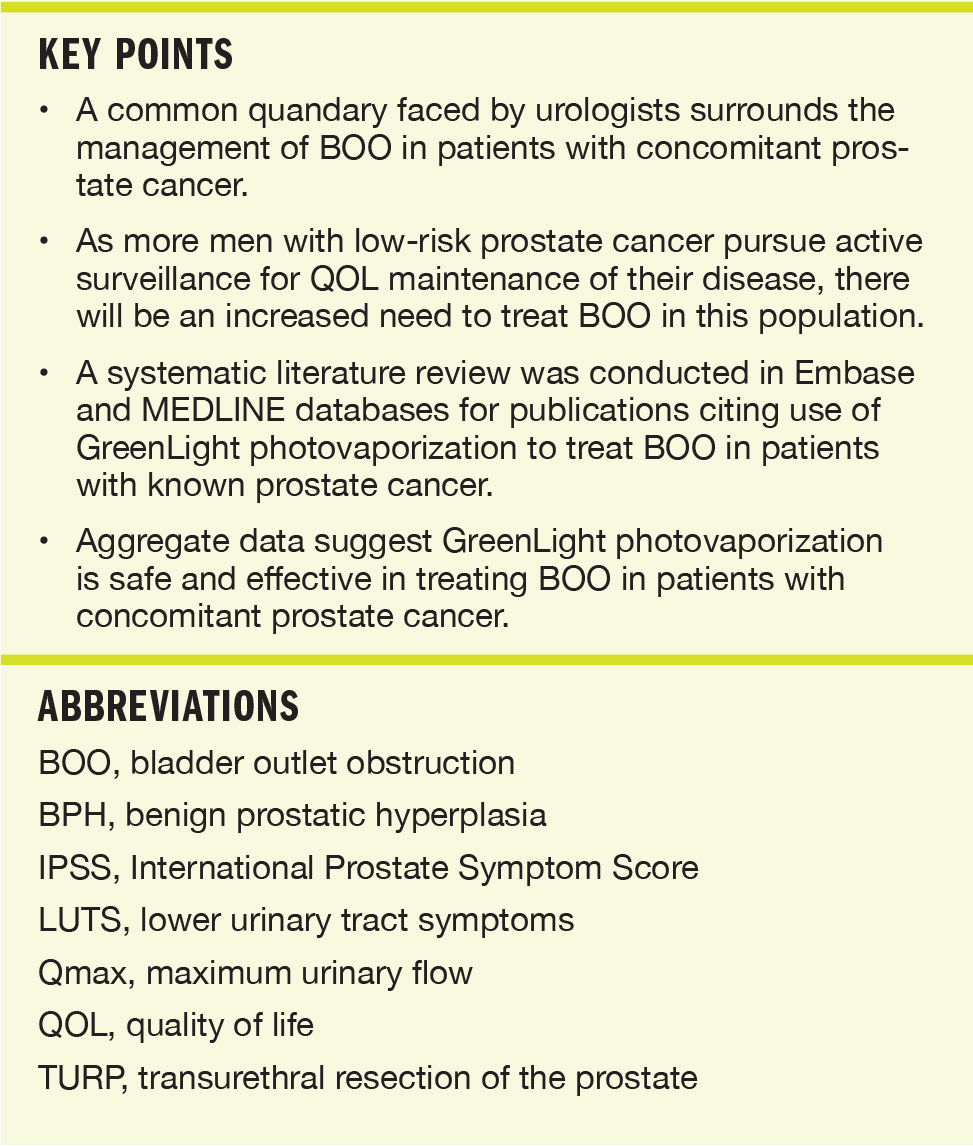
Although urologists employ several endoscopic techniques to treat BOO, relatively few studies have investigated the ways in which these modalities treat BOO in patients with concomitant prostate cancer. Multiple publications have, however, reported on photoselective vaporization of the prostate using the GreenLight XPS Laser Therapy System (Boston Scientific Corporation) to treat LUTS in patients with BOO and prostate cancer. This review analyzed the existing literature for the safety and effectiveness of photovaporization in improving urinary symptoms in this population as well as for reported prostate cancer outcomes.
A systematic literature review was conducted on the Embase and MEDLINE databases for publications citing use of photovaporization to treat BOO in patients with known prostate cancer. Two search periods were covered in the systematic literature review: January 1, 2001, to January 24, 2024, and January 22, 2024, to January 29, 2025, with the second search period updating the project with more current literature in preparation for publication. Boolean logic was applied for literature search terms of prostate cancer, greenlight, bladder obstruction, prostate hypertrophy, and photoselective vaporization of the prostate. Articles were included if they met the following patient, intervention, comparison, and outcome criteria:
Population. Men with BOO, LUTS, or BPH and preexisting prostate cancer (not prostate cancer incidentally found during or after surgery)
Intervention. Treated with photovaporization (180-W, 120-W, or 80-W configurations) to relieve LUTS
Comparator. Not required for inclusion, but comparisons with other transurethral surgeries were considered
Outcomes. Bladder outlet obstruction treatment effectiveness outcomes of International Prostate Symptoms Score (IPSS), quality of life (QOL), maximum urinary flow rate (Qmax), postvoid residual urine, any complications, and oncologic outcomes
Study design. Any prospective or retrospective cohort studies, prospective comparative studies, and randomized controlled trials
A total of 159 references were found between the 2 literature searches; 97 references were excluded during a review at the title or abstract level, and 54 references were excluded during a review at the full text level, resulting in 8 articles meeting inclusion criteria. Per the International Medical Device Regulators Forum Medical Device Clinical Evaluation Working Group’s N56FINAL:2019 document,4 all included articles were appraised as level 3 evidence because the GreenLight system was used off label. Exclusionary reasoning included not reporting use of GreenLight XPS photovaporization and prostate cancer as well as the absence of analyzable results (eg, combined therapies without stratified data, patients with BPH and prostate cancer included and combined without stratified data). A full list of exclusionary reasons can be found in Supplement 1. The Preferred Reporting Items for Systematic Reviews and Meta-Analyses figure for inclusion and exclusion can be found in Figure 1. Effectiveness outcomes of IPSS, QOL, and Qmax were compared with minimal clinically important differences for BPH treatment (Table 1).
The systematic literature review identified 8 articles in which GreenLight photovaporization was used to treat BOO or BPH in a total of 333 patients with prostate cancer confirmed before the photovaporization procedure. Of the 8 articles chosen, 5 examined patients with advanced prostate cancer (N = 169 patients),5-9 2 examined patients with low-risk prostate cancer (N = 121 patients),10,11 and 1 article did not specify the grade of prostate cancer (N = 43 patients).12 Four articles that used GreenLight photovaporization to treat BOO resulting from advanced prostate cancer referred to the photovaporization procedure as “palliative PVP.”5-8 In 2 articles, a modified photovaporization technique was used to perform GreenLight surgery for BPH in patients with prostate cancer; Kumar et al9 performed “channel PVP” and Peigne et al11 performed “minimal channel PVP.” The channel photovaporization procedure involves vaporizing prostate tissue until a wide channel is formed, providing an unobstructed view of the bladder from the verumontanum.9
Per Table 2, point change in IPSS, percentage change IPSS, point change in QOL, change in Qmax (mL/s), and change in postvoid residual urine (mL) from baseline to multiple follow-up time points demonstrated improvement across studies. All the reported changes from baseline in IPSS, QOL, and Qmax exceeded respective minimal clinically important differences.
Across the 8 articles, urologic complications were as expected following transurethral resection of the prostate (TURP). The most common adverse events included dysuria, hematuria, and failed trial of voiding. The full range of adverse events and rates for photovaporization cohort studies is presented in Table 3.
Two articles performed comparative analysis of photovaporization vs TURP for the treatment of BOO in patients with advanced prostate cancer (Table 4).5,9 Comparable rates of Clavien-Dindo grades I, II, IIIa, and IIIb complications between photovaporization and TURP were observed by Altay et al.5 Urethral stricture was, however, much higher in the TURP group, and failure of initial voiding trial was higher in the photovaporization group. Insufficient prostate debulking in the photovaporization group was listed as a possible cause of the higher failure of initial voiding trial.5
Kumar et al9 found statistically significantly lower perioperative blood loss, clot retention, need for postoperative irrigation, duration of postoperative irrigation, and catheterization time among patients who underwent channel photovaporization compared with channel TURP. There were, however, no statistically significant differences between patients who underwent channel photovaporization and patients who underwent channel TURP for other complications (Table 4).9
Prostate cancer outcomes were reported in multiple ways (Tables 5 and 6), and patients’ preoperative cancer stages ranged from low risk under active surveillance to advanced disease (Tables 3 and 4). Reported prostate cancer–related outcomes included death from castration-resistant prostate cancer 38 months after photovaporization,7 death from prostate cancer before last follow-up (60 months after photovaporization),12 tissue regrowth requiring repeat photovaporization or catheterization,10 reoperation because of cancer progression,11 metastasis,5,9 and progression to hormone-refractory carcinoma.9
In contrast, the literature reported a low incidence of prostate cancer progression and high progressionfree survival probability, even in patients who had been on active surveillance for a median of 4.0 years before photovaporization.10 The observed progression rates also did not differ from those of patients under active surveillance at the investigating institution, Memorial Sloan Kettering Cancer Center, who did not undergo photovaporization (24% at 5 years, 36% at 10 years, and 41% at 15 years).10,13
Photoselective vaporization of the prostate was also noted as enabling patients to have subsequent cancer treatments that may not have been feasible before. Jibara et al10 reported that 6 of 7 patients with prostate cancer progression after photovaporization were able to undergo subsequent radiation therapy, which would have been unlikely before photovaporization because of the patients’ large prostate size and high IPSS, which are associated with urinary retention and other unfavorable outcomes of radiation treatment.10 Peigne et al11 similarly observed that 96% of patients with low-risk or intermediate-risk prostate cancer and obstructive LUTS experienced statistically significant improvement in LUTS after undergoing photovaporization, allowing them to undergo subsequent brachytherapy for prostate cancer.
Patients with concomitant BOO and prostate cancer who undergo GreenLight photovaporization experience expected improvements in urinary function, including IPSS, QOL, and Qmax, that exceed minimal clinically important differences. Most adverse events reported after GreenLight photovaporization were urologic, in line with those observed in patients undergoing GreenLight photovaporization without concomitant prostate cancer, and did not appear to worsen prostate cancer outcomes. Compared with TURP, GreenLight photovaporization showed similar rates of Clavien-Dindo grade complications, but urethral stricture was more common after TURP, while failure of initial voiding trials was more likely in some patients who underwent photovaporization.5 Channel photovaporization in patients with advanced prostate cancer resulted in statistically significantly lower rates of perioperative blood loss, clot retention, need for and duration of postoperative bladder irrigation, and catheterization duration compared with channel TURP; other complication rates did not differ between cohorts.9
The limited number of articles reporting prostate cancer–specific outcomes underscores the intent of the procedures studied—that is, to address BOO and LUTS, not to treat prostate cancer. The populations analyzed in this review are diverse, including men with low-risk disease on active surveillance and men with locally advanced and/or metastatic disease undergoing palliative treatment for malignant obstruction. Per the American Cancer Society, the 5-year relative survival rate of patients with distant (ie, advanced) or metastatic prostate cancer is only 32%.14 It is therefore expected that some patients with prostate cancer included in these studies would die from prostate cancer during long-term follow-up. GreenLight photovaporization in patients with BOO and concomitant prostate cancer can nevertheless provide symptomatic relief of LUTS and enable subsequent prostate cancer treatment (eg, with radiation or brachytherapy).10,11
In addition to GreenLight photovaporization, urologists have used a variety of other endoscopic treatment options, such as TURP and Holmium laser enucleation of the prostate, to manage BOO in the population with prostate cancer. How best to treat a patient with BOO and concomitant prostate cancer with the currently available technologies is an ongoing dialogue but is also an area in great need of investigation, as evidenced by the limited literature available on the topic.
Elsaqa and Tayeb15 recently reviewed current literature on endoscopic modalities (Holmium laser enucleation of the prostate, photovaporization, and TURP) for managing BOO and LUTS in patients with prostate cancer who were either on active surveillance or had advanced disease. They concluded that endoscopic management appeared safe and did not confer a negative oncologic impact.15 They further noted that palliative treatment in patients with advanced prostate cancer was safe and provided better overall QOL.15
In addition, a National Surgical Quality Improvement Program database analysis compared men with and without prostate cancer who underwent TURP, photovaporization, and Holmium laser enucleation of the prostate and found that patients with prostate cancer experienced longer surgical times and hospitalizations and were more likely to receive blood transfusions but did not have other inferior outcomes, which likely reflects the impact of locally advanced prostate cancers and more challenging surgeries in the prostate cancer cohort. This assumption, however, was not assessed.16 Transfusions were nonetheless statistically significantly less common in the photovaporization group (0.3%) than in the TURP procedure group (1.1%; P < .001).16 Waterjet ablation (Aquablation [PROCEPT BioRobotics Corporation]) has also appeared to be a safe endoscopic option for treating LUTS in patients on active surveillance.17
Procedural treatment of men with prostate cancer is often viewed with a theoretical concern for tumor cell dissemination, whether through direct spread or hematologically through the unroofing of prostatic venous channels. GreenLight photovaporization is theorized to be a safer endoscopic treatment option for BOO with respect to the risk of tumor dissemination because it vaporizes tissue and produces a coagulation layer, sealing vessels, and less commonly causes large venous channels to be left unroofed.6,9 Rigorous prospective comparative analyses of different endoscopic treatment modalities in this population are not available, likely limited by existing prostate cancer labeling contraindications, which means that definitive conclusions regarding the safety and oncologic impacts are lacking at this time.
The limitations of this study include its retrospective nature, the limited number of relevant publications analyzed, and nonstandard reporting of oncologic outcomes after transurethral surgery in the literature. This is, however, the first systematic review of GreenLight photovaporization to treat BOO in patients with prostate cancer, and the aggregate data suggest that GreenLight photovaporization is safe and effective in this population. Additional research on the use of GreenLight photovaporization to alleviate LUTS as a result of BOO in patients with prostate cancer is needed.
This is the first systematic review of GreenLight photovaporization in patients with prostate cancer. The findings suggest that GreenLight photovaporization is safe and effective in treating LUTS in patients with prostate cancer, ranging from patients managing their disease with active surveillance to patients requiring palliation from malignant obstruction resulting from locally advanced disease. The incidence of prostate cancer and LUTS from BPH increases with age. As more men with low-risk prostate cancers are pursuing active surveillance to manage their conditions and preserve QOL, there will be a need to maintain their QOL through their prostate conditions by treating BOO in this growing segment of the population. Future research on the use of GreenLight photovaporization to alleviate LUTS in patients in all stages of prostate cancer is warranted.
Lower urinary tract symptoms in men: management. National Institute for Health and Care Excellence; 2015. NICE Clinical Guidelines, No. 97. Accessed May 23, 2025. https://www.ncbi.nlm.nih.gov/books/NBK553261
Jemal A, Culp MB, Ma J, Islami F, Fedewa SA. Prostate cancer incidence 5 years after US Preventive Services Task Force recommendations against screening. J Natl Cancer Inst. 2021;113(1):64-71. doi:10.1093/jnci/djaa068
Egan KB. The epidemiology of benign prostatic hyperplasia associated with lower urinary tract symptoms: prevalence and incident rates. Urol Clin North Am. 2016;43(3):289-297. doi:10.1016/j.ucl.2016.04.001
Medical Device Clinical Evaluation Working Group. International Medical Device Regulators Forum Clinical Evaluation. Document No. IMDRF MDCE WG/N56Final:2019. 2019. Accessed June 10, 2025. https://www.imdrf.org/sites/default/files/docs/imdrf/final/technical/imdrf-tech-191010-mdce-n56.pdf
Altay B, Erkurt B, Kiremit MC, Horuz R, Guzelburc V, Albayrak S. A comparison of 120 W laser photoselective vaporization versus transurethral resection of the prostate for bladder outlet obstruction by prostate cancer. Urol Int. 2015;94(3):326-329. doi:10.1159/000366209
Chen D, Xue B, Shan Y, Yang D, Sun C, Gao J. GreenLight HPS 120-W laser photoselective vaporization of the prostate as early therapy for acute urinary retention in advanced prostate cancer patients. Lasers Med Sci. 2013;28(5):1339-1344. doi:10.1007/s10103-012-1252-7
Cheng YT, Chiang PH, Chen YT, Hsu CC, Chuang YC. Efficacy and safety of photoselective vaporization of the prostate in patients with prostatic obstruction induced by advanced prostate cancer. Asian J Surg. 2011;34(3):135-139. doi:10.1016/j.asjsur.2011.08.007
Jin C, Xu YM, Fu Q, Gu B. Photoselective laser vaporization of the prostate in the treatment of bladder outlet obstruction in advanced-stage prostate cancer: a single-center experience. J Endourol. 2012;26(10):1314-1318. doi:10.1089/end.2011.0675
Kumar N, Vasudeva P, Kumar A, Singh H, Sinha A. A prospective comparative study of channel photoselective vaporization of the prostate vs. channel transurethral resection of the prostate in patients with advanced prostate carcinoma. Minerva Urol Nefrol. 2016;68(4):330-336.
Jibara G, Sjoberg DD, Stearns GL, et al. Photoselective vaporization of the prostate in the management of lower urinary tract symptoms in prostate cancer patients on active surveillance. Urology. 2021;156:225-230. doi:10.1016/j.urology.2021.01.040
Peigne C, Fournier G, Dissaux G, et al. Minimal channel GreenLight photovaporization before permanent implant prostate brachytherapy for patients with obstructive symptoms: technically feasible and safe. Brachytherapy. 2021;20(1):50-57. doi:10.1016/j.brachy.2020.08.003
Liberale F, Muir GH, Walsh K, Krishnamoorthy R. GreenLight laser prostatectomy: a safe and effective treatment for bladder outlet obstruction by prostate cancer. BJU Int. 2011;107(5):772-776. doi:10.1111/j.1464-410X.2010.09584.x
Carlsson S, Benfante N, Alvim R, et al. Long-term outcomes of active surveillance for prostate cancer: the Memorial Sloan Kettering Cancer Center experience. J Urol. Jun 2020;203(6):1122-1127. doi:10.1097/ju.0000000000000713
Cancer facts & figures 2024. American Cancer Society. 2024. Accessed February 9, 2024. https://www.cancer.org/research/cancer-facts-statistics/all-cancer-facts-figures/2024-cancer-facts-figures.html
Elsaqa M, El Tayeb MM. The role of transurethral BPH surgeries in management of urinary symptoms in prostate cancer patients, narrative review. Curr Urol Rep. 2024;26(1):7. doi:10.1007/s11934-024-01229-1
Marchioni M, Primiceri G, Veccia A, et al. Transurethral prostate surgery in prostate cancer patients: a populationbased comparative analysis of complication and mortality rates. Asian J Urol. 2024;11(1):48-54. doi:10.1016/j.ajur.2022.05.008
Teoh JYC, Yuen SKK, Lau BSY, et al. Robotic waterjet resection for men with prostate cancer suffering from lower urinary tract symptoms. Urology. 2025;198:153-157. doi:10.1016/j.urology.2025.01.020
Sandhu JS, Bixler BR, Dahm P, et al. Management of lower urinary tract symptoms attributed to benign prostatic hyperplasia (BPH): AUA Guideline Amendment 2023. J Urol. 2024;211(1):11-19. doi:10.1097/JU.0000000000003698
US Food and Drug Administration. Non-clinical and clinical investigation of devices for the treatment of benign prostatic hyperplasia (BPH)—guidance for Industry and Food and Drug Administration staff. FDA-2020-D-1118. 2021. Accessed May 23, 2025. https://www.fda.gov/regulatory-information/search-fda-guidance-documents/non-clinical-and-clinical-investigation-devices-used-treatment-benign-prostatic-hyperplasia-bph
Lower urinary tract symptoms: evidence update March 2012. A summary of selected new evidence relevant to NICE Clinical Guideline 97 “The management of lower urinary tract symptoms in men” (2010). Evidence Update, No. 11. National Institute for Health and Clinical Excellence; 2012. Accessed May 23, 2025. https://www.ncbi.nlm.nih.gov/books/NBK552048/
The management of lower urinary tract symptoms in men [Internet]. National Clinical Guideline Centre (UK). Royal College of Physicians (UK); 2010. Accessed May 23, 2025. https://pubmed.ncbi.nlm.nih.gov/22319808/
Barry MJ, Cantor A, Roehrborn CG; CAMUS Study Group. Relationships among participant international prostate symptom score, benign prostatic hyperplasia impact index changes and global ratings of change in a trial of phytotherapy in men with lower urinary tract symptoms. J Urol. 2013;189(3):987-992. doi:10.1016/j.juro.2012.08.257
Published: June 23, 2025.
Conflict of Interest Disclosures: S. N. Harper has nothing to disclose. G. Venkatraman is an employee and stockholder with Boston Scientific Corporation. B. C. Gill is a consultant and investigator for Boston Scientific Corporation and Sumitomo Pharma Co, Ltd.
Funding/Support: None.
Author Contributions: S. N. Harper was responsible for conception and design, data analysis, data interpretation, drafting and writing, revision, and approval to submit for publication. G. Venkatraman was responsible for conception and design, data collection, data analysis, data interpretation, drafting and writing, revision, and approval to submit for publication. B. C. Gill: was responsible for conception and design, data analysis, data interpretation, drafting and writing, revision, and approval to submit for publication.
Data Availability Statement: All data sources are cited and publicly available.
Supplementary Material: Supplementary material is available at Reviews in Urology online
Citation: Harper SN, Venkatraman G, Gill BC. Urinary and cancer-specific outcomes from photovaporization of the prostate in the setting of prostate cancer: a systematic review. Rev Urol. 2025;24(2):e81-e94.
Corresponding author: Bradley C. Gill, MD, MS, Associate Professor of Urology, Glickman Urological & Kidney Institute, Cleveland Clinic, 9500 Euclid Ave, Cleveland, OH 44195 (gillb@ccf.org)