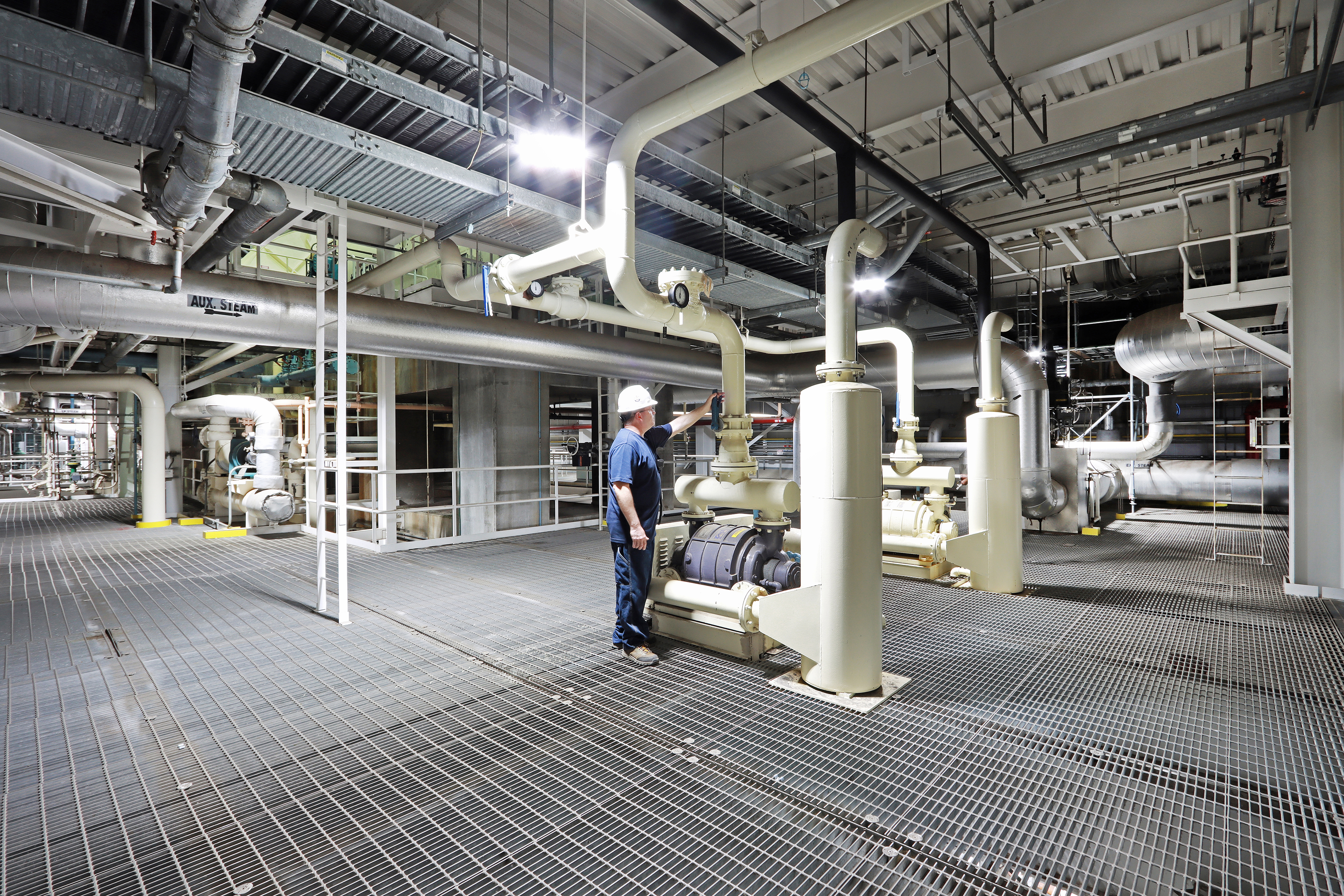
LEDs inside Independence Power Plant create a safer work environment.
Photos: Matt Turner/COMPOA
By now, nearly everyone is familiar with LEDs and likely have them throughout their homes. But while LED illumination is the dominant choice in residential and commercial applications, there are still some industrial plants that continue to use fluorescent and metal halide lighting.
The U.S. Department of Energy describes LEDs as a highly energy-efficient technology that uses at least 75% less energy and lasts up to 25 times longer than incandescent lighting. The energy savings is a direct result of traditional lighting losing a majority of energy as heat. LEDs, in contrast, only discharge about 5% of their energy as heat and convert 95% into light. The result is higher-quality, brighter lighting, and greater efficiency, which is good for company bottom lines and the environment.
For large industrial settings, however, there are even greater benefits in the form of enhanced worker safety. Upgrading facilities to modern LED lighting can actually lower the risk of accidents, injuries and fatalities. How? Consider these six benefits:
Improving visibility: Poor visibility is the leading cause of slips, trips, and falls. When overall illumination is increased, accident rates decrease significantly. Traditional high-pressure sodium fixtures often provide poor illumination, making it difficult for workers to spot hazards. However, LED fixtures produce brighter quality light that enables workers to avoid accidents.
Differentiating colors: The inability to distinguish colors is a tremendous safety risk. The poor color accuracy generated by high-intensity discharge (HID) lights, for example, can make it difficult to distinguish colors, which puts workers at risk of misinterpreting color cues on various warning placards or wiring, which is color-coded for safety reasons. LED lighting, in contrast, typically delivers a higher CRI, which makes it easier to distinguish colors.
Reducing risky maintenance work: The allegedly simple task of replacing light bulbs becomes riskier in industrial plants where crews must often work at high elevations, sometimes directly above dangerous production equipment. Since LEDs typically last at least three times longer than HID, less maintenance is required in these potentially dangerous situations. In addition, HID lighting emits high levels of unsafe UV radiation and contains mercury, which can be released as the result of accidental breakage. LEDs contain no hazardous materials. Plus, since they burn more efficiently, less energy is converted to heat, which makes LEDs cooler and safer to handle.
Encouraging alertness and reducing fatigue: The crisp white light of LEDs has been shown to improve alertness, which is especially important in applications involving shift work that is common in many industrial plants that run 24/7. By operating in conjunction with workers’ circadian rhythms and suppressing melatonin levels, the brighter LED lighting can help reduce fatigue, eye strain, headaches, and accidents that are common in environments with insufficient light.
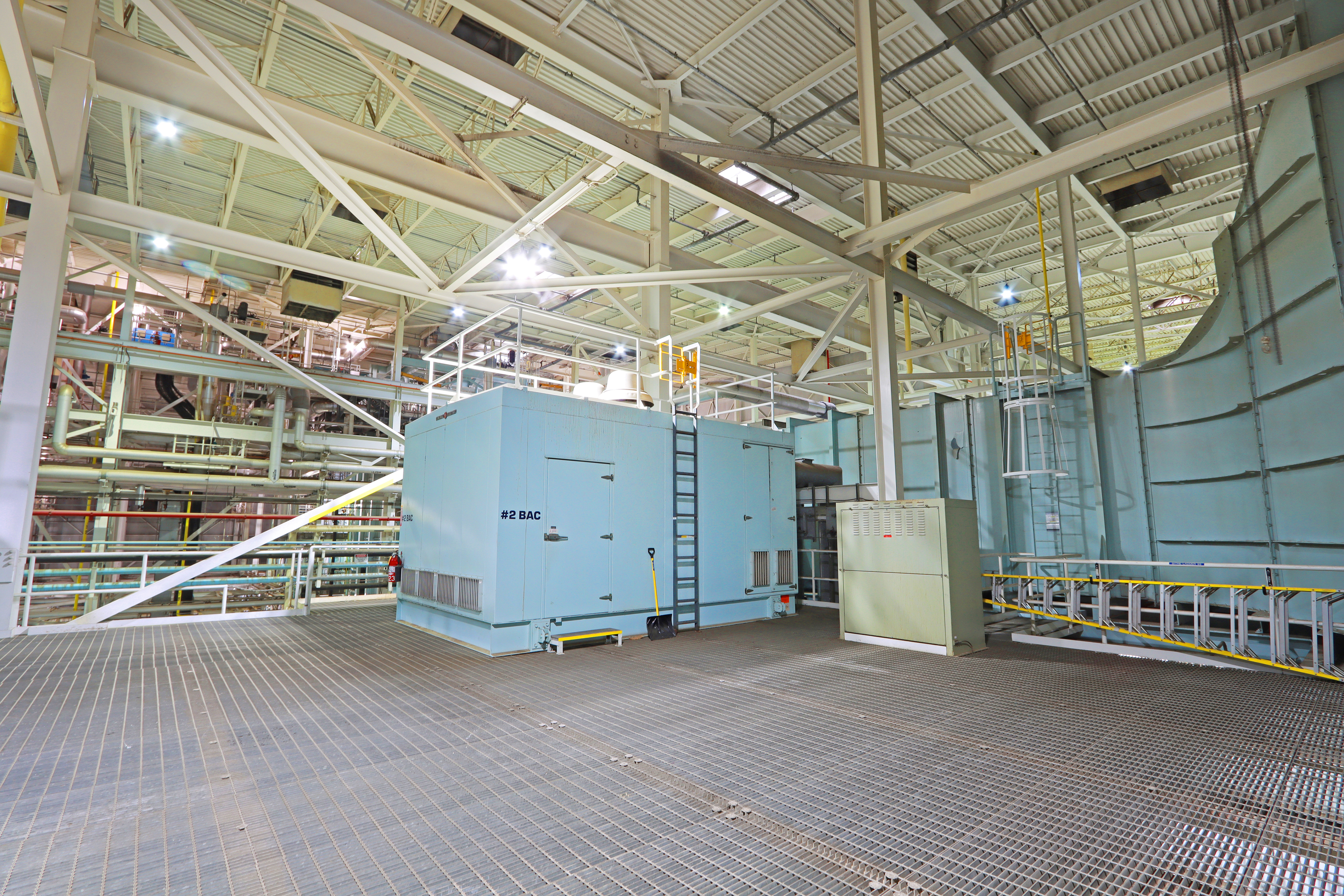
A view of Independence Power Plant’s upper mezzanine deck.
Among other benefits, LEDs can emit light in a range of colors in a specific direction, reducing the need for reflectors and diffusers that can trap light. This feature makes LEDs more efficient for many uses such as task lighting, which requires light focused in a specific direction.
Today’s LED systems often work in conjunction with advanced sensors and controls that, among other things, can sense occupancy levels and adjust light levels accordingly or set light levels by time of day. This results in major energy savings and also ensures adequate lighting in areas where employees are working in real time. Many of these controllers can be operated remotely via an app for added convenience.
Luminant, a subsidiary of Vistra, is one of the largest energy producers in the U.S. Its Independence Power Plant in Oswego, NY, turned to the latest LED technology when replacing fixtures within 83,700 sq ft of the general plant area, as well as in specialty locations around the facility’s water box, condenser, and oil purification skids.
The goal of the LED retrofit was twofold—to save energy and provide a safer, more conducive working environment. The previous fixtures were highly inefficient, with many being 400-W metal halide and nearly 30 years old. As a result of their advanced age, the fixtures required more maintenance than just re-lamping, including the replacement of ballasts and capacitors.
The plant established strict goals for the project, including brighter illumination, less maintenance time, and more kilowatt-hour savings. In addition, the team wanted to create a safer work environment, which involved addressing hard-to-reach fixtures that previously put people involved with re-lamping in an unsafe situation.
Hal Duell from Power-Flo Technologies in Syracuse, NY, was brought in to lead the lighting project, and he provided the plant with several different types of high bay fixtures to test, including LED UFO high bay fixtures. After thoroughly investigating several options, our team specified Wattage and Color CCT Selectable UFO High Bay fixtures from EarthTronics. The wattage-adjustable and color-selectable LED high bay fixture delivers energy savings by replacing up to 1,000-watt HID fixtures. It can be set at 150 or 240 W, producing up to 20,250 and 32,400 lumens, respectively. It also features color selection options of 3500K, 4000K, or 5000K with a high 80+ CRI providing enhanced visual acuity and a significant increase in footcandles on the facility floor. Following the installation of the new lighting, four different work areas around the plant were measured, and illuminance levels increased from 6 to 42 fc, 0 to 24 fc, 2 to 48 fc, and 2 to 86 fc.
To achieve energy savings, advanced network control sensors that can be managed remotely through an app were added to the UFO high bays. The sensors are set for 100% sensitivity, and full illumination is maintained for 30 minutes after the signal is triggered. After 30 minutes of no activity, the light output is reduced to 35% for an infinite amount of time until the sensor is triggered again.
By employing LED UFOs and sensors, the plant is saving more energy when the lights are running at a lower output until the high light levels are needed and triggered. For instance, the lights will be on six hours at 240 watts and 18 hours at 84 watts for areas that do not receive much traffic. This reduction in energy use translates into annual savings of over $14,000—and that doesn’t include the additional maintenance savings of no longer re-lamping. The projected savings over the 10-year warranted life of the product is approximately $145,000.
Worker injuries are not only financially costly, but they can also negatively impact employee morale. Total cost starts with the direct payments to cover medical and occupational rehabilitation expenses, but often more costly is the lost productivity resulting from injured workers being away from the jobsite. Such cost is exacerbated by the current labor shortage because when an employee misses work, there is either no one to serve as a replacement (and work doesn’t get completed) or other workers have to fill in by working longer shifts, which often leads to worker fatigue and a greater risk for workplace injuries.
The U.S. Bureau of Labor Statistics already lists manufacturing as one of the top three industries plagued by labor shortages. As a result, keeping employees working and free of injuries is certainly worth the investment of upgrading plant lighting, not to mention the additional energy savings the facility will realize.
the author | Bill Liberto is vice president of Sales for Commercial Accounts for EarthTronics. He is a member of AEIC/Electrical League of Ohio, NECA, NEMRA, and NAESCO.