Filtration: A Crucial Tool for Plastics Processors
It’s the last line of defense to screen out contaminants before products are made
Previous Article Next Article
By Mike Verespej
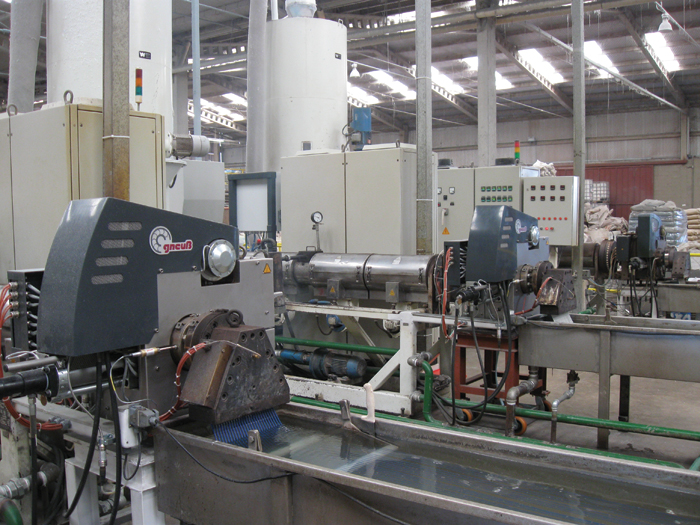
Several RSFgenius filtration systems from Gneuss in use in recycling lines
Several RSFgenius filtration systems from Gneuss in use in recycling lines
“At the SPE continuous compounding TopCon held in March 2014, presenters gave examples of how process-control tools are currently being used in compounding applications.”

A Maag filtration system opened up to display its “arched” screen filter
A Maag filtration system opened up to display its “arched” screen filter

The patented Nordson Kreyenborg V-type screen changer has an integrated self-cleaning function for recycling applications with medium- to high-viscosity materials for which economic filtration is required.
The patented Nordson Kreyenborg V-type screen changer has an integrated self-cleaning function for recycling applications with medium- to high-viscosity materials for which economic filtration is required.

Gneuss’s new fully-automatic and backflushing RSFgenius-M filtration system for highly contaminated materials
Gneuss’s new fully-automatic and backflushing RSFgenius-M filtration system for highly contaminated materials

Parkinson Technologies’ Key Filters KCH Continuous Hybrid Screen Changer model introduced at the K 2013 reportedly has double the filtration rate of the original KCH introduced at NPE 2012.
Parkinson Technologies’ Key Filters KCH Continuous Hybrid Screen Changer model introduced at the K 2013 reportedly has double the filtration rate of the original KCH introduced at NPE 2012.


Ettlinger’s current ERF250 product for filtering contamination from polyolefins, and, at right, the company’s “doublethroughput” ERF500 melt filter, said to be coming to the USA in August 2014
Ettlinger’s current ERF250 product for filtering contamination from polyolefins, and, at right, the company’s “doublethroughput” ERF500 melt filter, said to be coming to the USA in August 2014
The increased use of recycled resins, as well as plastic scrap from manufacturing, has turned filtration systems and screen changers from a necessary evil into a critical element of processes in plastics manufacturing.
“Processors, extruders, and compounders are increasingly using recycled resins to cut their raw materials costs because they see that there is not going to be any price relief in virgin resins,” says Kevin Tuttle, manager of global marketing for plastic extrusion at Nordson Xaloy in Hickory, North Carolina, USA.
“You have to minimize the contamination risk or it will negatively impact quality and productivity,” he says, “so they are looking at filtration systems to get rid of the contamination”—whether it be dirt, metals, paper products, or plastics that get mixed in with the plastic they want to use.
The same is true for the recyclers that turn bales of material back into pellets and flakes, even though they take out a lot of contaminants before the pelletizing or flake process, says Monika Gneuss, vice president of sales and marketing manager at Gneuss Inc. in Matthews, North Carolina.
“One of the trends is that the contamination rates [of incoming bales of plastic] are going up,” she says. “Recyclers are using dirtier materials because it is what they can get, and they need to clean it up. So people now realize that screen changers [and filtration systems] are critical elements of process regrind.
“We are selling a lot more backflush screen changers,” she adds. “It is the biggest investment someone can make, but it gives the end customer more flexibility to use recycled materials and materials that are more contaminat[ed] without it negatively affecting the process.”
Continuous Filtration
John Whaley, business manager for Key Filters products from Parkinson Technologies Inc. in Woonsocket, Rhode Island, USA, also sees companies making the shift toward melt filtration systems that run continuously.
“Prior to the last five years, filtration systems were viewed as a necessary evil,” says Whaley. “But now companies are starting to view them as a competitive advantage and an asset. They have started to look at the real cost of [temporarily] shutting down their process to change filters and realized that if they upgrade their melt filter to continuous operation, they can spent less money for raw materials and not have to shut down their process [for filter changes].”
The market has responded to the greater interest in filtration systems with a slew of new products in the last 3-5 years. Some have rotary and drum filters designed to filter more contaminants from melt. There are also continuous belt ribbon systems that always have a new area of filtration coming in from behind. Others have arched instead of square filters, increasing the filter space four-fold. And even more have double-piston filtration systems with as many as four screen cavities and automatic backflushing features that allow continuous operation. There is also an increasing number of dual-bolt automatic screen changers that allow companies to change filtration screens without any interruption of the production process.
“There has been an expansion of product offerings,” says Tuttle, whose company makes filters under the Nordson Kreyenborg brand name. “You are seeing two-piston screen changers, multiple screens within a single chamber, extended areas for filtration on screens, technology that is extending the life of screens, and power backflushes.”
What type of filtration system is best depends on the specific needs of a processor, compounder, or recycler; the type of product they are making; the type and amount of material they are using; and the level of contaminants they need to filter out.
“There is everything from simple low-cost solutions where you shut down the process temporarily and change screens, to highly automated systems,” says Harald Pohl, product manager of polymer filtration for Maag Pump Systems GmbH in Wettringen, Germany.
“You need to know the material you are using, its viscosity, the desired throughput, whether you need to filter out fines, and how the size of the screen will impact the pressure,” as the efficiency of the process often depends on the melt pressure behind the screen changer. “The finer your filter, the higher your pressure will be,” adds Pohl. “You have to size the screen changer for the best performance, best efficiency and the most cost effectiveness.”
Filter Types
Different types of filters have different advantages. There will be minimal pressure disruptions with a continuous filter with backflush capabilities, explains Tuttle, but those filters work best when a company is running a single material. With piston screen changers, you can run a broader specification of polymers, and polymers with a broader range of viscosity, he says.
In addition, when you select a screen changer or melt filtration system, adds Gneuss, you need to consider the cost of the screen elements, the potential for creation of off-grade product during screen changes, throughput variation, and the value of backflushing waste from self-cleaning systems.
You also have to look at the amount of contaminants you need to filter out, says Whaley, how fast a filter might get clogged, how fast a filter or screen can be changed, and whether changing a screen will cause a 30-second dip in quality, creating scrap you don’t want.
The type of application or product also impacts what type of filtration system and how much filtration you need to do, says Dana Darley, vice president and general manager of Process Control Corp. in Atlanta, Georgia. “Filters are more critical in extrusion than in molding, in thinner products like film or multi-layer products for food packaging, in fiber extrusion, or when companies make bottles or anything related to food packaging,” says Darley. “Those are the situations where you are going to have to filter finer to where the eye can’t see.”
Plastics industry consultant Tim Womer of TWWomer and Associates, LLC (Edinburg, Pennsylvania, USA) agrees. “You see the use of filtration primarily on thin sheet, thin film, and cast film. For example, if blown film gets too many contaminants in it, it will put a hole in the bubble. And companies that make cast film for touch screens and TVs can’t have any gels come through.”
A lot of it has to do with aesthetics, explains Womer. “You also see more and more companies doing sheet extrusion and pipe extrusion using filters because they run a large percentage of scrap. But when you are making a thick piece of material, filtration is usually not an issue.”
However, regardless of the product or application, the use of recycled plastics creates a greater need for filtration, particularly when companies use post-industrial scrap, says Darley. “They are always dirtier because of how often they are handled. It is off-line, off-spec material, and every time it is handled, there is the possibility of contamination.”
As a result, he says, “everyone is looking for filtration systems and screen changers with greater screen area to handle the increasing levels of contamination. Your melt filter or screen changer is your last line of defense.”
Whaley agrees: “With the increased use of recycled materials, everyone is looking to be able to filter further down the process area. They want less contaminants, larger filter areas.”
“K” Innovations
At the K 2013 trade fair in Germany this past October, Parkinson, for example, introduced an enhanced version of its Key Filters KCH Continuous Hybrid Screen Changer that doubles the filtration area of its two-year-old KCH product—designed for filtering lower viscosity and elastomeric materials.
“By making novel modifications to the shape of the flow passage, we were able to double the filtration area”—and provide more capacity and a more even distribution of the polymer flow, says Whaley. The key: changing from a round to a square breaker plate.
Meanwhile, Gneuss introduced four new screen-changer models, including its RSFgenius-M rotary filtration system. It has a screen area twice the size of the standard RSFgenius, enabling companies to process and backflush materials twice as fast. It’s aimed at recycling markets.
Similarly, Maag introduced at K its new CSC-BFX backflush screen changer, which is designed to clean contaminated screen surfaces with no adverse impact on the end product. And that introduction came just three months after Maag introduced its CSC-R line of products with pistons fitted with curved breaker plates, enabling 75% of the active piston area to serve as a filtration area. Maag claims that its arched filters provide higher throughput, higher filter fineness, and lower melt temperatures than flat screen changers four times larger.
Another innovation making its way into the U.S. market is the ERF250 melt filter from Ettlinger Kunststoffmaschinen GmbH in Konigsbrunn, Germany. The ERF 250—which has a capacity of 5,000 pounds/hour (2,270 kg/hr) and is designed to eliminate contaminants from polyolefins such as high-density polyethylene—has a rotary filter drum and a knife at the bottom inside the housing that continually scrapes the contaminants off the bottom as the drum rotates.
And this fall, Ettlinger will introduce into the U.S. market the ERF500, with two filter drums and twice the capacity, and the ECO, which will be able to run PET as the base material and filter out all other contaminants
“There is no flushing, no wiping, no dumping,” explains Mike Diletti, managing director of Ettlinger North America LP in Wheaton, Illinois. “The clean material passes through the 2 million-plus drum holes and the contaminated material stays on the drum. It enables you to use more highly contaminated material that previously was useless.”
Material Matters
“What’s driving the market is the worsening quality of materials,” adds Diletti. “Our system can handle ever decreasing levels of quality and use 100% of the filtration area. There is a very, very small amount of melt loss—typically 4-10 times less than with other screen changers.” He says companies that process PE film with paper labels are the biggest users of the ERF250, followed by companies that need to remove aluminum, PET, and paper from polyolefins.
One satisfied customer is KW Recycling (Troy, Alabama, USA), which currently uses 13 Ettlinger machines, and by year-end will have them on all of their 26 extrusion lines.
“They collect contaminants continuously, and the machine only has to be shut down for ten minutes when we change the scraper knives,” says Scott Saunders, general manager of KW Recycling. “It is a much more efficient process. We have significantly less contaminants getting through, waste less material, and have better throughput.”
It also has reduced KW’s operating costs, as well. “We now can have one operator running 6-7 machines,” says Saunders. “Before we had to have an operator at each machine to make sure the screens were changed properly.
Looking Forward
So what’s in the future for filtration equipment?
“Everyone is looking to improve their process,” says Tuttle. “So they are replacing discontinuous filtering systems with continuous filtering systems, and continuous filtering systems with backflush continuous systems, which are a step above continuous systems.
“Companies also want more screen area but in the same footprint,” he adds. “So we continue to add automated processes to backflush contaminants in our Nordson Kreyenborg filters, so you can use screens multiple times and longer. It is all about increasing productivity and decreasing costs.”
Pohl of Maag agrees. “Companies want to get more throughput out of their extruders. They want to know what we can do to size down the equipment to use less space, less energy, be more efficient, and still provide an enlarged screen space.”
That’s also the view of industry consultant Womer. “Companies are looking for uptime. They don’t want to upset their operating or manufacturing process [or] be making scrap for 15-30 minute stretches. That is why they are willing to pay a quarter-of-a-million dollars for an automatic continuous screen changer or a dual-belt ribbon screen changer. It may cost them more money upfront, but they save money in the long run.”