Estimated read time: 3 mins
We are always keen to help members reduce the risks they face and one area that causes concern is the interaction between dentist and patient when things have not gone to plan, or the patient expresses dissatisfaction. We are all human and things can and do go less well than intended. If these situations are handled well, then the matter may be resolved without escalation to others such as the Dental Council or to a claim. If not, then the issue can escalate unnecessarily with significant consequences for the member.
So, the journey a case may take is very often dependent upon the initial reaction of the practitioner when challenged and our aim is to help members try and manage such situations so that an early resolution can be found. For colleagues who experience a claim against them or a Dental Council investigation, the effect upon them can be devastating and long lasting.
Similarly, patients may report the process to have been stressful and unpleasant and if matters can be resolved by careful handling and management then such adversarial processes can be avoided – even if the patient still receives compensation – this can be achieved directly with the patient when the professional relationship is kept alive.
So, what can we do to minimise the risk of escalation and try to keep matters in house where the patient does not feel driven to approach others to further their complaint or claim?
The following text briefly introduces concepts that can help you navigate adverse outcomes for the best result, which are fully explored in our free online course “Navigating Adverse Outcomes”. I hope you find both to be of great value to your daily practice.
There are a wide variety of definitions applied to the terms that refer to an adverse outcome or state following dental care, but the one we tend to refer to is as follows:
“An adverse event or outcome is an unexpected and undesired incident which results in unintended harm to the patient and is related to the care provided to the patient rather than to the underlying medical or dental condition.” Committee on Clinical and Scientific Affairs – Canadian Dental Association, Apr 2010
Unfortunately, research shows that dentists are more prone to complaints than any other healthcare professional and the majority of those complaints do not involve and error on the part of the clinician.
When things have not gone to plan, dental regulators increasingly require patients receive open and empathetic explanations, with an in-depth analysis of the problem and a commitment to fix problems. These actions are important in that they:
Help patients recover psychologically
Demonstrate our role as a caring and ethical profession
Can influence whether or not the patient decides to take further action
If we understand what patients are trying to achieve by taking action and then what they want following an adverse outcome, then we can help avoid escalation.
We know that poor communication following a serious adverse outcome is a driver for patients to take further action, as well as the feeling of being abandoned. Patients who take action report that they do so to:
Discover what happened
Receive acknowledgement and apology and accountability
Correct deficient standards in care
Obtain compensation
In terms of what they want, it is:
Clear communication
Meaningful apologies
Honest and open explanations
Such communications are not easy and as healthcare workers, not usually trained in dealing with conflict, are usually way outside our personal comfort zones. Using models to progress through communication in a structured way can be of great help at what is often a most stressful time.
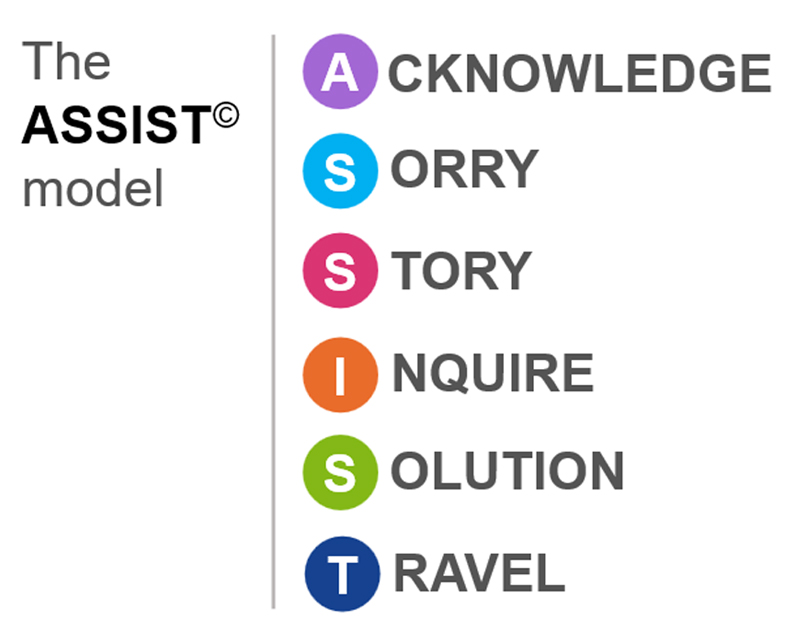
Dental Protection has described the ASSIST© model which can help members keep focussed on the patient’s needs, provide a framework for difficult communication and facilitate the necessary discussion. More information on the ASSIST© model and how it can be applied in practice is covered in our online course Navigating Adverse outcomes.
When such situations arise, our fight or flight response can push hard to kick in. Having a model to follow can be very helpful in reminding us what important tasks we need to attend to.
Please refer to our online learning for further details both on the ASSIST© model and other communication tools aimed at helping our members in daily practice.