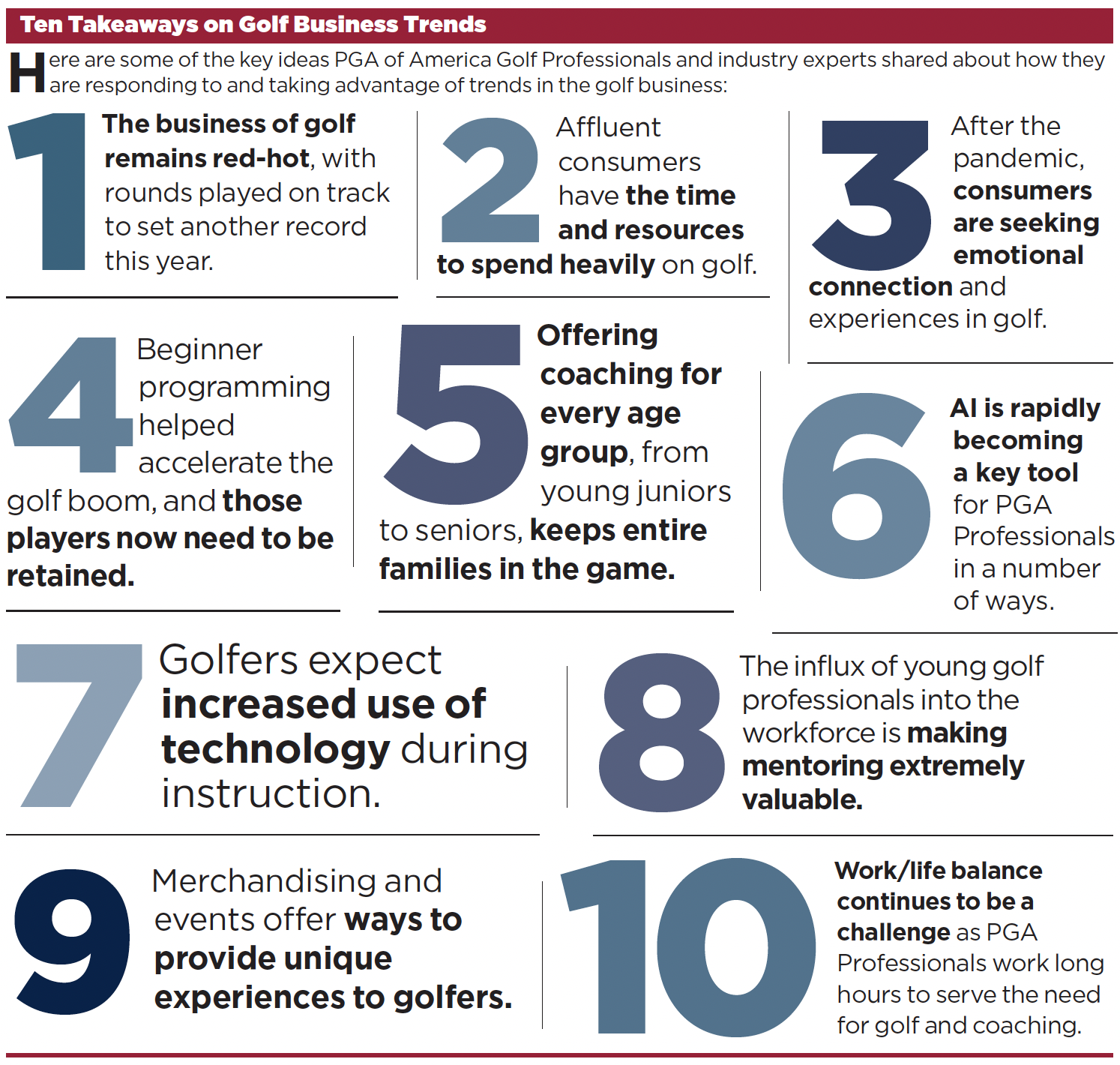
As the golf season finally winds down in the north and starts in earnest across the southern part of the country, the golf business finds itself in position to see yet another record year of participation in the sport. National Golf Foundation (NGF) data through mid-year shows rounds played nationally up 2.5 percent over 2025, which means it is highly likely golf is about to set a record for rounds played in the U.S. for the fifth time in the past six years. In terms of participation, NGF research showed more than 29 million people played the game on course in 2025, a number that climbs to 48.1 million when adding people who visited a range, played in a simulator or enjoyed a visit to a golf entertainment venue.
There’s a vast array of anecdotal evidence attesting to golf’s continued boom. New resort and private courses continue to come online, top golf destinations are booking tee times two years in advance and many private clubs continue to have full memberships and lengthy wait lists.
That is why, when looking at trends PGA of America Golf Professionals should be watching as 2027 grows ever closer – making moves that retain existing players and create great efficiency in operations are at the top of the list. Golf is a business that is driven economically by consumers, and the re search into their behavior speaks to why golf is booming – and how this current hot streak can be extended.
“Given where we’ve come from and where we’ve been over the last five-plus years, it’s a pretty unprecedented time for the industry,” says Jon Last, Founder and President of Sports & Leisure Research Group. “Generally speaking, it’s a great time to be in the industry. But it’s not without certain potential short- to long-term concerns. There’s really a dichotomy right now, where so many of the metrics people look at – rates and capacity and utilization – are in places they haven’t been before, and continue to move upward. But in a lot of our research with facility operators and consumers, there’s a reason to be a little cautious.”
The caution comes from what researchers call a “K-shaped” economy, where there is a growing divide between the haves and have-nots. Golf’s best customers are firmly in the “haves” column, meaning they’re doing well and have the time and discretionary income to spend more on dues, lessons, equipment and travel. That also means, however, that the game is becoming less accessible to some consumers as they feel the squeeze. Sports & Leisure Research Group’s data suggests a 10 percent rise in the feeling that economic realities are creating a greater gap between the wealthiest and poorest Americans over the course of this year.
Last points out, however, that an even bigger shift in consumer behavior is fueling the golf boom, and much of it comes from the lingering reaction to the coronavirus pandemic. Overall, people are more likely to spend money on pursuing their passions in the short term after seeing how the pandemic disrupted leisure opportunities.
Last calls this the “Four Es” of current consumer behavior, and each E shows an opportunity for PGA Professionals and their facilities:
• Emotional Connection – 47 percent of Americans feel “very lonely,” including 63 percent of those in the 35-44 age range. Golf provides an excellent way for people to find connections with other like-minded individuals.
• Experiences – Survey respondents that strongly agree with the statement “It’s important for my life to include a number of unique experiences” rose 14 percent in 2025 to 53 percent, with stronger agreement among younger adults. Golf at the local level and golf travel both offer the opportunity for exactly those experiences.
• Eagerness – People are not in the mood for delayed gratification. Respondents strongly agreeing “My life philosophy is more about living for today than it is about living for tomorrow” rose from 57 to 66 percent in 2025. This live-now attitude keys spending on activities like golf.
• Entitlement – Simply put, more people believe they are owed the opportunity to spend and engage with their favorite activities regardless of cost. For example, 80 percent of res pondents agree that they deserve a vacation, a number that rises to 87 percent for those under age 45. This means that many people don’t need to be convinced to spend money on activities like golf. In fact, they feel they deserve it.
“When you combine all these Es together, you’ve got a really good recipe for people pursuing the game of golf, particularly as it’s become more democratized and accessible,” Last says. “COVID brought this behavior on, and it’s combining with all the on-ramps that the golf business had created to bring people into the game, and that interest hasn’t abated.
“This means PGA Professionals have a really important opportunity now within the continuum of player affluence and player engagement to create those experiences. As the economy evolves, retaining younger people who’ve come into the game is going to be a critical factor as they move through their lifecycle.”
With these factors in mind, PGA Magazine talked with a number of award-winning PGA Professionals to learn more about the trends they’re seeing and the ways they’re working to retain golfers and provide the experiences they are seeking in an effort to ensure the health of the game for generations to come.
Trend: Coaching Programming for Retention
There have been and continue to be countless programs offered by PGA of America Golf Coaches to get new players into the game – which helped the sport’s readiness for the influx of new players that started in 2020 and 2021. In previous eras of golf expansion, such as the “Tiger Boom” of the late 1990s and early 2000s, a number of players tried the game, then retreated from the sport over time.
PGA Professionals who specialize in coaching and player development are learning from the past by creating ongoing programming that aims to retain new players for the long term.
“Programming-wise, I think it’s funny that a few years ago we had so many beginner programs and pipelines for getting people into the game that we didn’t put as much time into retention,” says Ryan Young, PGA Head Professional at Chambers Bay in Tacoma, Washington, and 2026 PGA of America Player Development Award winner. “We’re definitely working in the direction now to make sure there are more follow-up programs that keep new players engaged after their initial golf experiences.”
For Young and his staff, that has meant using the PGA Coach program to support golfers at every stage of their journey. Chambers Bay offers multiple levels of the retention-based programming, with group classes that offer multiple options to golfers – and makes scheduling easier for PGA Coaches, as well.
“Our class schedules are predetermined and priced right, and that consistency is a key – I have students who’ve restructured their work schedules so they can make the classes that work for them,” Young says. “It gives students constant contact with us, and it gives our coaches a regular schedule they can rely on, and those two things are driving success for us.”
A similar approach is working for Pam Elders, PGA Director of Instruction at Boca West Country Club in Boca Raton, Florida, and the 2025 PGA of America Player Development Award winner. She and her expanding team of coaches have launched a dozen new programs aimed at retention this season, with a changing demographic in mind.
“I’ve been here for 24 years, and I see the difference in our membership – it’s getting younger,” Elders says. “So many people are working remotely, and they can pop in and pop out if we have programming during the day.”
Elders is also aiming programming at her oldest and youngest students. For senior players who aren’t interested in intensive training, she’s offering on-course lessons to help them with game management and scoring, as well as multiple levels of group lessons. And many of those older members have grandchildren who are enjoying Boca West’s thriving junior program.
“We have a lot of older members and their kids are moving to the area to be closer to them, so suddenly we have all these grandchildren inside the gates,” Elders says. “We’re creating programming for the juniors and making a push, and there’s a lot of participation. It makes the grandparents so happy because they get to have the grandkids at the club with them, and it also has led to some of the families becoming second-generation members at the club. If we keep the grandkids happy with after-school programming, we’re going to see a lot of benefits.”
One of those benefits is the opportunity to get the entire family involved in the game, which leads to greater retention for all ages. 2026 PGA of America Youth Player Development Award winner Henry Stetina, PGA, points to the ongoing popularity of PGA Jr. League – with nearly 90,000 player registrations this year – as proof of the transformational power of junior golf.
“The PGA Jr. League format really helps build a unique sense of community, and it allows for more people to be connected to the game,” says Stetina, the Assistant Director of the PGA Golf Management Program at New Mexico State University in Las Cruces, New Mexico. “It brings a lot of life and energy to a golf facility, and it is wise for PGA Professionals to introduce their parents and grandparents to the game if they’re not already golfers. If you have follow-up programming for all ages, you can find greater revenue and greater profits, and you can introduce entirely new categories in your golf shop.”
Trend: AI and Technology Adoption
Artificial Intelligence is dominating headlines this year with a mixture of advances and concerns about the fast-moving technology. While golf has sometimes been slow to adopt new technologies, many PGA Professionals are not hesitating to make it part of their toolkit.
“My message to my fellow PGA Professionals is that you need to learn as much as you can about AI for your business, and understand that we’re in a place where everybody’s using it,” says Bernie Najar, PGA Director of Instruction at Caves Valley Golf Club in Owings Mills, Maryland, and the 2026 PGA of America Teacher & Coach of the Year. “That means when a player comes to the club, AI isn’t unfamiliar to them. It’s going to come up in conversation, and you need to be able to talk about it.”
There is concern among some instructors that AI-powered apps could replace PGA Coaches, but Najar doesn’t believe that’s the case.
“AI tools can’t replace the human, in-person experience – but that means we as coaches have to get better at those experiences to keep our students coming back,” Najar says. “If you can leverage AI to help you do your job better, whether that’s presenting better, being more organized or to create better communications, it’s a no-brainer.”
Many businesses are looking to AI-powered solutions to take over menial tasks and free staff to spend more time interacting with golfers. At Chambers Bay, Young sees a future with fewer staff members in the golf shop, but more PGA Professionals on the lesson tee and golf course.
“We’re going to start seeing golf shops be able to cut back on a couple employees who mainly answer phones or check people in – AI will handle your call center, and people will book tee times online, which a lot of our golfers already do,” Young says. “This means PGA Professionals can be teaching more, they can be on the course more. I think it might be a difficult transition for some people, but overall it’s going to be great for businesses and for golf.”
As with any technological disruption, AI is having some unintended consequences. The 2026 PGA of America Golf Professional of the Year, Brian A. Crowell, points to the ubiquitous use of AI as a writing tool as an annoyance in the hiring process.
“I don’t pay attention to cover letters or resumes anymore because they’re all written using AI,” says Crowell, the President of Bally’s Golf and General Manager Bally’s Golf Links at Ferry Point in Bronx, New York. “I only pay attention to references, and I follow up with them to learn something about applicants before I start interviews. This means I’m placing much more importance on the interview process, and I’ll do two rounds of interviews just so I can see how a person reacts in person when they’re not able to script their answers with AI.”
Trend: Coaching Technology Keeps Evolving
Speaking of technology, AI isn’t the only high-tech tool PGA Professionals are weaving into their coaching arsenal. Systems for monitoring launch conditions, body movement and ball flight continue to become mainstream and more affordable, making it easier to build a technologically rich teaching area on a realistic budget.
“What you can do now for under $20,000 is pretty incredible,” Najar says. “Golfers today expect you to have a technical knowledge of these systems because they’ve seen them online, and you don’t want to fall behind or not understand what’s coming.”
As a teacher, embracing new technology means learning new things. For Najar, his most recent upgrade has been a move to a markerless 3D motion system that provides in-depth information on the body during the swing without the need for a student to wear a special suit or any sort of markers.
As compelling as the technology was when he first tried it, Najar trusted a rule he follows with all new tools he brings into his studio – an approach he suggests others emulate. He doesn’t use new technology in a lesson until he’s fully learned to use it and knows it is reliable.
“I didn’t use the markerless 3D system until I’d captured 2,000 swings with it. I had it for three months before anybody saw it as part of a lesson,” Najar says. “One of the big mistakes people make is they get new tools and try to run them, then they don’t work quite right or the coach stumbles over the tech and the lesson grinds to a halt. I love integrating new technology, but you don’t want to waste a student’s time, so get to know your new tools inside and out and do your homework.
Najar thinks it is in the DNA of a PGA Coach to be curious about new technologies on the lesson tee, and he says that instinct is more important now than ever.
“It probably irritates some people who’ve been teaching a certain way for a long time, but technology’s not going anywhere – it’s here to stay, and the rate of change is massive,” Najar says. “Do not underestimate it or you’ll get left behind. You don’t have to be an expert in everything, but this isn’t just something that’s passing through. When a customer rolls in after watching some YouTube videos and wants you to measure their arc height and VSP when they’re chipping, you’d better be able to speak their language.
“And you know what? You’ll probably be a better coach for it because you’ll be able to blend your technical skills with your interpersonal skills. It’s a huge wave, and you’ll be able to ride it.”
Trend: Employment and Mentoring
The historic popularity of the game has also created an employment crunch in the golf business. Updates to the PGA Education program and strong work from the PGA Career Services recruitment team have helped restock the pipeline, and a new generation of young PGA of America Golf Professionals is joining the workforce.
This development has put a focus on mentoring a new wave of PGA Professionals in a way that helps them thrive and keeps them in the business throughout their career journey.
“It’s hard nowadays, because our time is taken up with so many different things, but you really need to be a leader and take time to interact with members of your staff and understand what they’re going through and what they need,” Crowell says. “One thing about technology is that it can seem impersonal. Instead of texting or emailing, I make it a point to pull aside my team members for 15–20 minutes – from department heads to hourly employees – talking with them with an empathetic approach.”
Crowell will ask employees questions about their departments, whether their job is meeting their personal expectations and asking what could be done differently. In addition to gaining valuable feedback and information, Crowell says this approach also builds relationships that keep employees engaged and retained.
“Taking an interest in your employees’ careers and lives builds a better team feeling and a different type of respect,” Crowell says. “It can make things start to click, and you won’t get to that place if you just keep your head in the sand as a leader.”
Crowell also encourages his PGA Professionals to network with their peers by playing in Section events and taking opportunities to visit other golf operations to get a first-hand look at how other facilities are run.
“It’s all about keeping your eyes open and getting a different perspective sometimes,” Crowell says. “You can learn an awful lot from attending that Section pro-am or going to play in a Monday tournament.”
The competition for PGA Professionals means creating a culture to retain them is critically important. As the General Manager at Newport Beach (California) Country Club, Robin Shelton, PGA, says that culture needs to be updated and improved at regular intervals.
“You have to build a culture people want to be a part of, and you have to continue to enhance it so people want to stay,” says Shelton, the 2026 PGA of America Professional Development Award winner. “We work very hard on our leadership development programs here, and we offer four different programs to help our teammates grow their careers.
“We show people they have a chance to develop as PGA Professionals and be promoted from within, and that makes this a place where people genuinely enjoy coming to work and, more importantly, that they enjoy who they work with.”
At New Mexico State, Stetina works every day with the next generation of PGA Professionals. He notes a major difference in the path many of them have taken to their place in golf.
“A lot of PGA Professionals were brought up in the game and played from a young age, probably at a pretty high level,” Stetina says. “Today we have some great, very interested students who have less golf experience – maybe they were introduced to the game in high school, maybe during the COVID years – but have really found a passion for it.”
Stetina finds these PGA Associates need a different kind of encouragement. He helps them find more playing opportunities, especially in tournament settings, and makes sure they are mentored by upperclassmen with stronger golf backgrounds.
“Once these students get acclimatized into golf, they really elevate their golf IQ in a hurry,” Stetina says. “Then they go out on an internship and have a huge jump in their experience, and they come back committed and ready to go.”
At Chambers Bay, Young has a system to engage and encourage young PGA Professionals when they come to work for him. He calls it the “next man up” approach, modeled after a football team’s approach to roster flexibility.
“When I took over as Head Professional, we also turned over the GM position, and it was kind of a shock how we didn’t have many procedures in place to handle turnover,” Young says. “So for our Associates and young Assistants, we make sure they get a taste of every part of the operation so if someone is out sick or needs to be away, they can feel like they can fill in. I tell them it’s not if, it’s when.
“It’s like the Seahawks – when Sam Darnold gets hurt, Drew Lock can come in and win the next two games as the backup QB. Doing that has encouraged our staff to feel included in the processes and be ready to take over when the time comes.”
Trend: Elevating Merchandising and Events
Just as golfers are becoming more educated and discerning about golf instruction and equipment, they’re also becoming more sophisticated consumers of golf apparel and accessories. Top merchandisers, like 2026 PGA of America Merchandiser of the Year for private facilities Chris Rowe, PGA, are working to take a more personalized approach to their merchandise mix and tournament and outings gifts.
Rowe, the General Manager at Whispering Pines Golf Club in Trinity, Texas, says he had an epiphany last year about what he carries in the golf shop.
“I was talking with my son, Dylan, who’s our PGA Head Professional, and I told him I had a new merchandising philosophy,” Rowe says. “It’s not what we want our members and guests to buy. Instead, it’s what we want our members to wear and use that represents our club.”
For Rowe, that change in philosophy meant eschewing closeouts or any brands that he felt didn’t represent the club’s reputation or the ideals of the family that owns Whispering Pines.
“It’s about integrity, and matching the brands with what this club means to its members,” Rowe says. “Maybe it means we miss out on some opportunities to make a little more money with closeouts, or to sell through an online shop instead of only in our golf shop. But what it also means is I trust in the logo and the quality of our golf course, and our members agree because they’re spending a lot of money on what we chose for them.”
Rowe’s favorite and most fun merchandising trend, however, is the creativity he and other PGA Professionals are putting into tournaments and outings. He and his staff dedicate their time at the PGA Show in Orlando each January to finding unique gifts and working with companies on creating memorable gift packages.
For example, he and his staff came up with a novel theme for this year’s Whispering Pines member-guest: What if it looked and felt like a rock concert? The Shootout at the Pines was reimagined, with each participant getting a concert-style T-shirt with a logo that wouldn’t look out of place at a Guns N’Roses concert, along with matching headcovers and a backstage pass to be worn through the open ing party. The team also created a high-energy opening video, and the party started with the song “Welcome to the Jungle” blasting from speakers.
“It goes from a tournament to an experience,” Rowe says. “This year, we even went beyond taking pictures of each foursome to hiring a video crew to come out and film each group on the course. We’ll send that to every group and include it in our newsletter – which is now a video, too – so everyone can enjoy it. It’s a really great way to recap a three-day event, and to make sure everyone’s excited to come back and do it again next year.”
Trend: Managing the Workload
One side effect of a golf boom that has lasted more than half a decade is the toll on the people who’ve powered it: PGA Professionals. More rounds played, lessons taught and merchandise sold has led to longer hours and less time off for many golf professionals, which puts a new premium on time management and creative staffing solutions.
“The sheer demand for golf is pretty cool, but it’s also changing the basics of the business,” Najar says. “When I got into the business in 1994, most golf courses were completely closed on Mondays, which was the day you’d play in Section events, or just get some rest. Now Mondays are for outings, or facilities are just open seven days. I do a lot of teaching on Mondays because that’s my ‘overflow’ day, and there’s always overflow right now.
“You’ve really got to understand how to manage your time so you can figure out what you need to do to keep paying attention to your customers and what they need.”
The increasing popularity of indoor simulators has lengthened the season at many clubs, and also lengthened the workday, as many are open well be yond daylight hours. And the demand for programming at all levels can also be a daunting challenge when coaches face burnout.
“I think we’re at a point where a lot of people are pretty tired,” Stetina says. “Seasons are long, the hours are long, and a lot of people are overworked. They might want to add more programming or new services, but they just don’t have the resources.”
Stetina says he’s encouraged by the number of facilities hiring PGA Professionals who focus on player development – scheduling and creating programming while acting as an additional instructor as needed.
“If you have someone who’s good with lesson programs and can do some clubfitting, that can be a really valuable role that pays for itself,” Stetina says. “It might require a change of the staff model at some facilities, but it could be good for business and help with work/life balance, too.”
Through all the shifting trends, challenges and opportunities present for today’s PGA Professionals, Crowell says now is the best time he can recall to be in the golf business.
“I think there are more doors open to us as PGA Professionals than ever before, and a wider audience for golf than ever before,” he explains. “If we’re careful and we sort of curate and create experiences in the game the right way, we are going to do wildly successful things in this industry.”