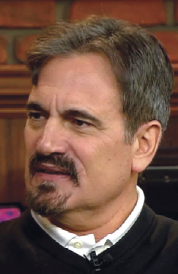
He grew up in a shot-and-a-beer town. His dad worked the graveyard shift at the wire mill, one of several factories on the lakefront. The blue-collar image was enhanced by signage at the city’s edge: Welcome to Waukegan, Bowling Capital of the Midwest.
Industrial labor and corner taverns as a backdrop, the kid got a golf club at age 2, shot 67 at 15, won the state’s biggest tournaments as an amateur and beat Tiger Woods twice on Sunday TV in 1996–97 while playing the PGA Tour full-time for almost two decades. All that led to a belated induction into the Illinois Golf Hall of Fame this October.
That is David Ogrin’s story, an improbable journey down the fairway less traveled in a white-collar game.
“Movie stuff,” says his longtime pal Tom Lehman, the British Open champion and former Ryder Cup captain.
Yet humble beginnings had keys contributing to success, like the 1996 Texas Open victory in his adopted hometown of San Antonio. His dad, Al “Boley” Ogrin, was a scratch golfer who played the game and mentored his kids after leaving work around 7 a.m. Mom, Bertha, was a park district o icial, enabling the family to play free golf at Bonnie Brook Golf Course. The parents didn’t make much money, but they created one of the Chicago area’s best golf families. It helped that David put in countless hours, day after day, from age 8 to 18. He was a one-track outlier before heading to Texas A&M and benefiting from year-round golf.
“Getting to play for free set him off on a trajectory that wouldn’t have happened otherwise,” says his sister Alicia, herself a high school state champion and a U.S. Women’s Open participant four times as an amateur.
While at Oklahoma State, Alicia learned of another advantage to their upbringing. A golf coach there would say he liked recruiting “blue-collar players because they work hard and don’t have a chip on their shoulders.”
A Tour rookie in 1983, Ogrin kept his card each of his first seven seasons. He did so again from 1993–97 thanks to slump-busting instruction from Jim Suttie, Dave Pelz and mental coach Chuck Hogan. Hence, another aberration: His best golf came between ages 38–39, when he joined the top 36 earners in consecutive years.
“He always studied the golf swing and had different ideas about it,” said Loren Roberts, eight times a Tour winner. Such talk doesn’t surprise Ogrin’s wife of 39 years, Sharon, who labels him an “outside-the-box thinker who comes at people from a different angle.”
Ogrin’s interests have involved five Cs: Christianity, children, Cubs, creativity and candor. “Creative and quirky,” Roberts said. “He’s always had a different humor.”
It follows that he named his only son Clark Addison after streets intersecting outside Wrigley Field. That he nicknamed Roberts the “Boss of the Moss” because of his putting prowess. That he stalked Tiger Woods down the fairway at Colonial, his hands held high as if clawing, mimicking a game he played with his four kids. That his only course design included three six-hole loops. Years after beating a rookie Woods by two strokes despite a final-round triple bogey at that ’96 Texas Open, Ogrin cracks, “I beat Tiger so badly he never came back to San Antonio.”
Two-time Tour winner Ted Schulz sees his victorious Chrysler team partner as a “candid, playful people person.” Lehman, once Ogrin’s traveling partner, calls him “extremely authentic. If anything, he’s as honest as the day is long.”
Sometimes bluntly. He once read a Greg Norman quote and suggested the Shark might be a “wimp”, later apologizing. The Tour fined him for being outspoken in a 1980s Golf Digest story.
Ogrin maintains his strengths were “not being terrible at anything” and being “good at what Bobby Jones and Ben Crenshaw called the key to golf: Turning three shots into two.”
These days he’s helping others turn into better golfers, dispensing such wisdom as “hit to the back-of-the-green yardage.” He became a full-time instructor in 2010, now operating his own academy in New Braunfels, Texas. He mainly teaches kids not yet out of high school and has helped several get college scholarships. In a sense, David Ogrin has gone full circle.
“The game has given me so much,” he said. “I am keenly aware of giving back, of having to rise up and assist the next generation in golf.”
Son of two factory workers, longtime golf writer Jeff Rude is an Evans Scholar out of Glen Flora Country Club, where he was David Ogrin’s caddie master in 1972.