Plug ‘n’ Prosper
Advances in robotic technology bode well for the productivity and profitability of injection molding
Previous Article Next Article
By Pat Toensmeier
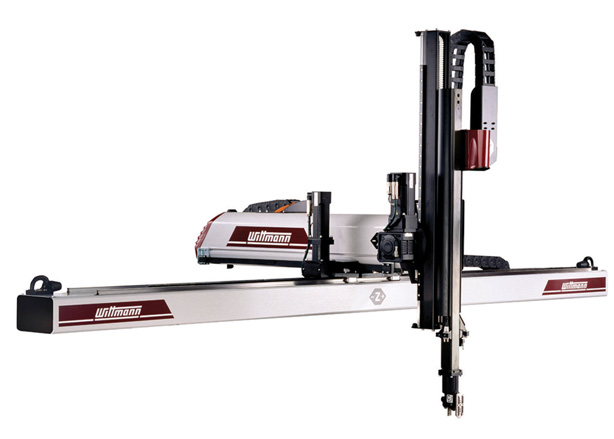
Wittmann Battenfeld offers a range of robots that can be integrated with the company’s Battenfeld injection machine controls (photo courtesy of Wittmann Battenfeld).
Wittmann Battenfeld offers a range of robots that can be integrated with the company’s Battenfeld injection machine controls (photo courtesy of Wittmann Battenfeld).
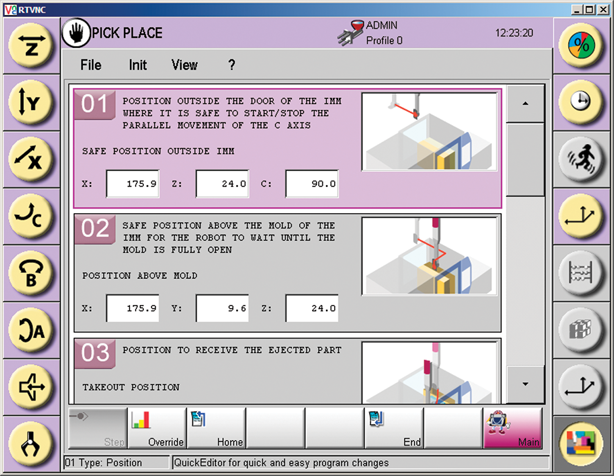
“Wizard” programming software from Wittmann Battenfeld walks operators through job setups, posing questions that let them develop robot commands (photo courtesy of Wittmann Battenfeld).
“Wizard” programming software from Wittmann Battenfeld walks operators through job setups, posing questions that let them develop robot commands (photo courtesy of Wittmann Battenfeld).
“ Ease of programming is a focus for us,” schaffner says. “We want to simplify it for the average guy on the plant floor.”

“The 6X Visual line of 6-axis robots from Sepro can be programmed with Cartesian coordinates familiar to molders, or with circular coordinates common to articulated robots (photo courtesy Sepro America).
“The 6X Visual line of 6-axis robots from Sepro can be programmed with Cartesian coordinates familiar to molders, or with circular coordinates common to articulated robots (photo courtesy Sepro America).
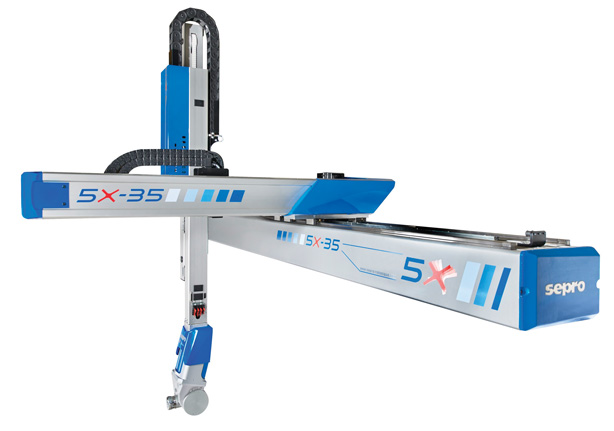
“Sepro’s 5-axis 5X robot line includes three models designed for complex part extraction and secondary operations (photo courtesy Sepro America).
“Sepro’s 5-axis 5X robot line includes three models designed for complex part extraction and secondary operations (photo courtesy Sepro America).
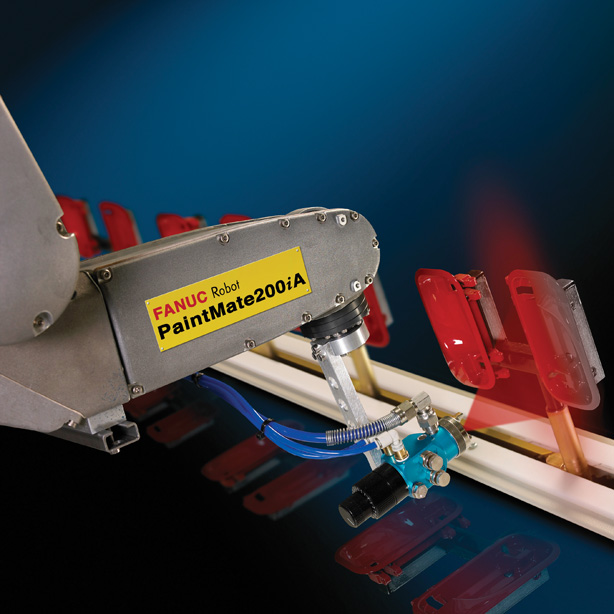
Automotive paint lines are a growing market for Fanuc’s versatile robots. Recent developments stress speed, precision pathways, and rapid changeovers (photo courtesy of Fanuc America).
Automotive paint lines are a growing market for Fanuc’s versatile robots. Recent developments stress speed, precision pathways, and rapid changeovers (photo courtesy of Fanuc America).
Robots are increasingly essential components of injection molding operations, no matter what level of volume, price point, or sophistication that parts represent. Low-end products benefit as much from robotics as high-end parts, owing to the advantages that automated part removal and handling provide in quality, repeatability, and minimal worker involvement.
This is especially true now, as OEMs and custom molders take a closer look at the real price of molding offshore and, in many cases, move operations back to ostensibly higher-cost areas such as North America and Western Europe, to better control quality, delivery, and associated costs.
There are still compelling economic reasons to produce some parts in Asia, Eastern Europe, and other low-cost areas. But Western manufacturers, especially in the USA, find that by making operations more efficient at home, they reduce production costs and eliminate the offshore price differential. As developments from a sampling of robot suppliers show, a key part of this effort involves robotics.
“Companies are evaluating all aspects of manufacturing, whether in the USA, Mexico, or China,” says Friedrich Kanz, president and CEO of Arburg Inc. “U.S. manufacturers must be more productive and cost-effective. They need more robots and automation to reduce labor and cut the per-piece cost of production to a competitive level.” (Kanz’s company designs 3-axis robots for use with its injection machines and also supplies 6-axis articulated-arm robots from Kuka Robotics Corp.)
Integrating Control
Advances in controls are making an almost iconic robot accessory obsolete—the pendant, a handheld device that operators use to program and operate robots.
Some OEMs are using open-architecture software to integrate robotic controls within the main controls of molding machines, meaning all actions are monitored and updated from the machine control screen. The result, says Tom Schaffner, national sales manager for robots at Wittmann Battenfeld Inc., is much faster and more precise integration of operations between molding machine and robot.
“We can do custom sequences we were never able to do before,” he says, referring to the company’s integration of its robotic controls within Battenfeld injection machines, which are part of the product line. Examples include partial mold openings, rotating platen control, and calculating the time it takes for mold opening to speed part extraction.
Wittmann Battenfeld, which makes a range of auxiliaries, plans to eventually integrate all of these controls within the main controls of Battenfeld machines, which range in size from 20 to 5,000 tons.
The company uses a new internally developed software program called Wizard, which walks an operator through the robot programming process by posing a series of questions, the answers to which build the program.
Once a robot is programmed for a job, the machine control saves it. When the job is scheduled to run again, all an operator does is install the mold, plug in a jumper wire from the mold to the machine control, and the right program is selected, which facilitates setup. There is no resetting of robot or machine parameters.
“Ease of programming is a focus for us,” Schaffner says. “We want to simplify it for the average guy on the plant floor.”
The company also offers custom automation capabilities for its robots, beginning with end-of-arm tooling and including its largest models. Custom capabilities permit such operations as ejecting multiple parts on the fly, which a robot captures with a special attachment. Schaffner says that Wittmann Battenfeld has a 68% share of the North American market for custom automation.
While the latest robots and controls help companies reduce labor costs, their design and operation also compensate for a lack of skilled personnel. “Plants used to have process engineers who took care of programming and other technical operations,” Schaffner remarks. “Now many shops have young workers without this background, so we try and simplify our systems for them.”
He adds that the Wittmann Battenfeld robotic control works best on Battenfeld machines, but can be integrated with other machine-makers’ controls.
Diverse Capabilities
With automation-rich molding markets such as automotive, packaging, and medical showing solid growth in the USA, robot manufacturers are looking as well at improving the versatility and flexibility of their equipment to meet productivity demands.
One example is Sepro America, whose products include 3, 5-, and 6-axis servo robots; an in-mold labeling (IML) system; and controls (Touch2 and the advanced Visual2 and Visual3) developed by the company for injection molding.
CEO Jean-Michel Renaudeau sees robots as vital to consistent, on-spec production. “Robots are capable of increasing the quality and productivity of operations, which is the primary goal of our customers,” he says.
Sepro has assembled a range of robots with broad functionality. As Renaudeau explains, “Customers want everything” when it comes to capabilities. “Our main focus is to provide flexibility.”
Products include the company’s fifth-generation S5 line, with three beam models and the Visual2 Cartesian control; the S5-15, for molding machines of 30-180 tons; the S5-25, for 120-450 tons; and the S5-35, for 350-800 tons. Each 3-axis model offers long strokes, large payload capacity, and multi-axis and multi-function part manipulation.
The Success line comprises five beam models—designated 7, 11, 22, 33, and 44—that operate on injection machines ranging from 20-1,000 tons. The 3-axis robots, which are operated with the Touch2 control, have servo drives on all three axes to deliver increased speed and precision to general-purpose molding.
For more advanced needs, including complex part extraction and secondary operations, Sepro supplies 5- and 6-axis robots in, respectively, the 5X and 6X Visual lines. The 5X line includes the 5X-15, for machines of 30-180 tons; the 5X-25, for 120-450 tons; and 5X-35, for 350-800 tons.
The 6X Visual line has five models with articulating arms that are designed for injection machines ranging from 20-4,000 tons. Each can be operated with the same Visual controls that are used with 3-axis robots. The 6X Visual robots are programmable with the Cartesian coordinates that molders are familiar with, or circular coordinates typically used with articulated robots.
Both lines were developed with Staübli Robotics. Staübli’s contributions include the 6X Visual line’s 6-axis design and the 2-axis servo wrist that characterizes the 5X line.
The in-mold labeling system, meanwhile, is the result of another partnership, with France-based IML specialist Machines Pagès. The equipment, for molding machines of 100-500 tons, includes a high-speed Sepro side-entry robot that applies flat or shaped labels from modular units developed by Machines Pagès. IML systems are operated with the Visual3 control.
Meeting Market Needs...for Color
Fanuc America Corp. has been making investments in its robots for automotive painting lines. In the process, the company demonstrates the degree of productivity, application versatility, labor reduction, material savings, and quality control that is achievable with advanced automation.
In a written response to emailed questions for this article, Fanuc representatives report that the North and South American automotive painting markets are growing. “Painting robots are used everywhere, from high-volume manufacturing of large fascia with 40 robot installations, to single-robot systems applying coatings to radio control knobs,” they state.
This growth brings demands from end-users that influence robot design and operation. Robots need to handle more colors to accommodate an expanding automotive palette; be equipped for flaming and application of waterborne coatings and other materials for finishing; and operate within smaller booths, as shops seek to decrease equipment footprints and reduce energy consumption.
Fanuc, whose models include the PaintMate200iA and the new mid-sized P-50iB line, is responding to these needs with such features as “piggable” return fluid-delivery systems to save paint; increased flow controls for higher application speeds; and advanced off-line capabilities for the PaintPRO express programming system that permit fast robot startup, short installation cycles, and rapid modification of programs.
Other new or recent features include enhanced on-arm controls; a variable robot-mounting capability for all systems, which enhances installation in a range of production settings and accommodates different part configurations; and greater integration of third-party application equipment interface capabilities. This last feature permits end-users to select a variety of application equipment packages from many suppliers.
Importantly, Fanuc added controllers that increase processing speed and expand multiple-arm control capability. These benefits are designed to improve application accuracy and optimize travel paths, and reduce the cost of operations.
An advanced networking feature, moreover, allows an operator to optimize an entire robotic paint process in real time from one location to keep a system operating at peak performance, Fanuc representatives say.
The company is also focusing on enhancements to real-time data collection and interpretation, to assure optimum system performance. A mobile app is available called IR Connect, which creates an interface for authorized users into an operating system via an Apple iPhone.
Robots have, in a relatively short time, advanced from repeatable, labor-saving tools to part of a networked system whose synergies with injection machines boost the performance and productivity of molding operations. Experts say that ongoing developments will broaden these benefits. They’ll possibly lead in the not-too-distant future to user-friendly, plant-wide networks that control operations—from unloading and storing railcar shipments of resins—to conveying, molding, extracting, and downstream handling of finished parts.
For now, robots are an important means to greater productivity and per-part cost reduction. The future beckons, though, and as recent developments demonstrate, the potential of robotics technology is boundless.