
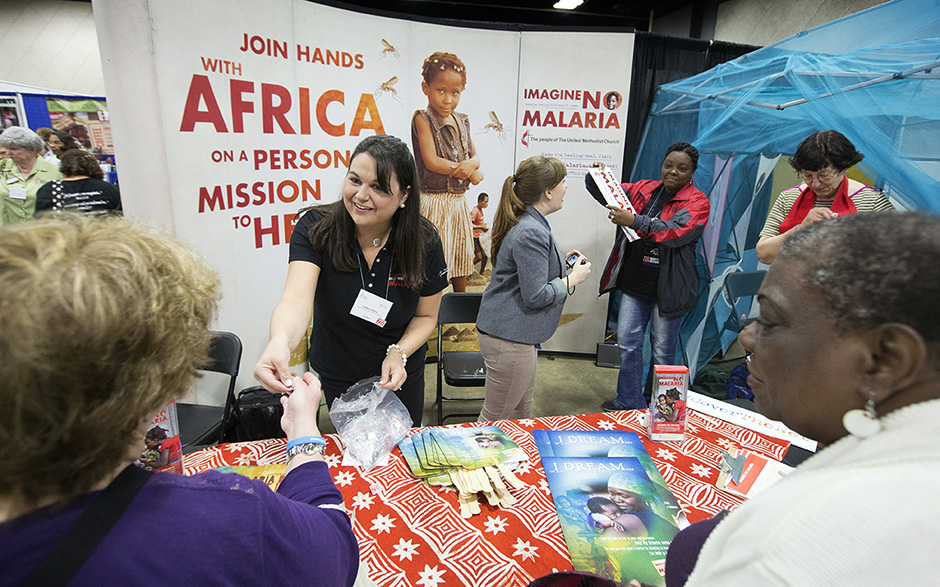
Imagine No Malaria staffer LeRae Collins greets visitors during the 2014 United Methodist Women’s Assembly.
UMNS/Mike DuBose
Imagine No Malaria staffer LeRae Collins greets visitors during the 2014 United Methodist Women’s Assembly.
UMNS/Mike DuBose
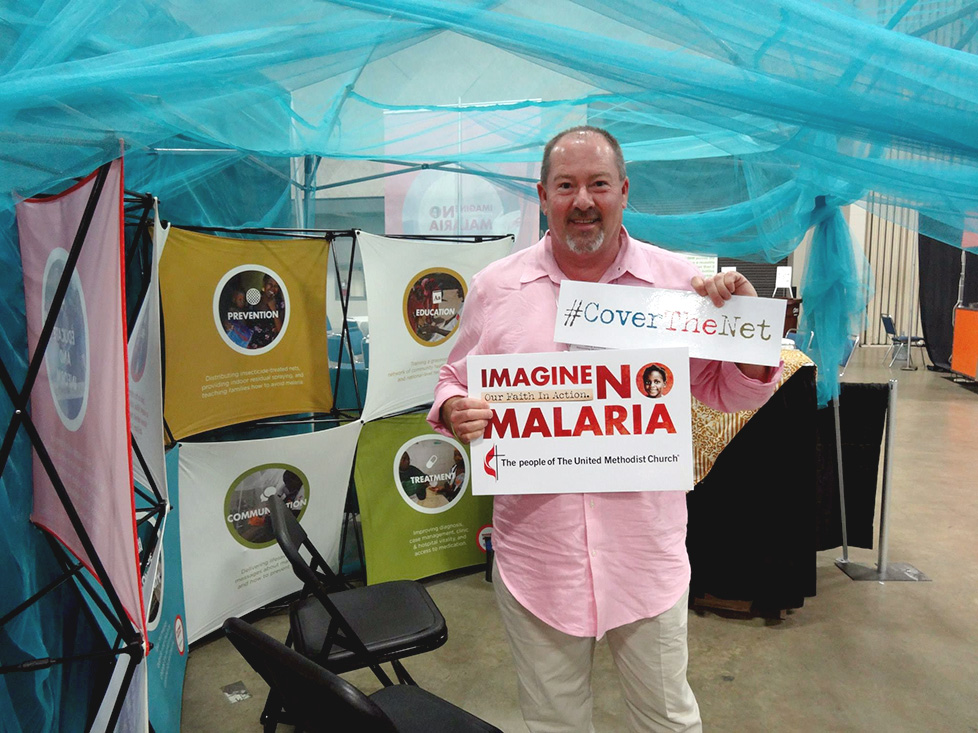
Rolly Loomis serves as field coordinator for Imagine No Malaria in the Desert-Southwest Conference.
COURTESY PHOTO
Rolly Loomis serves as field coordinator for Imagine No Malaria in the Desert-Southwest Conference.
COURTESY PHOTO
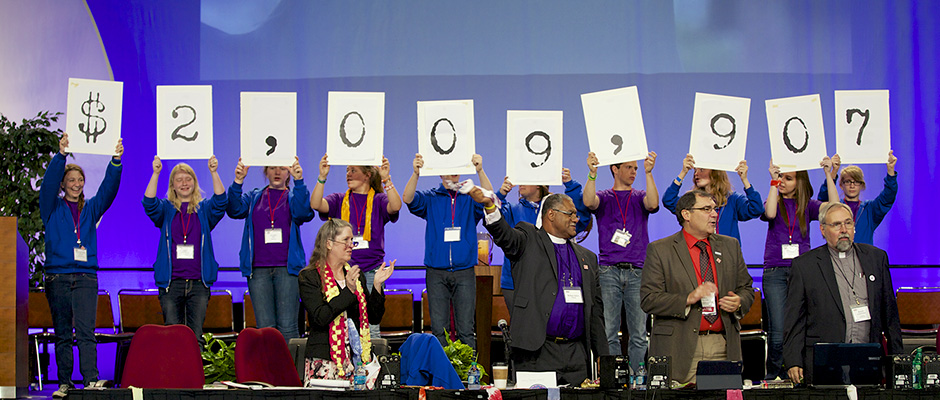
Members of the Iowa Annual Conference celebrate exceeding their goal of raising $2 million for Imagine No Malaria.
IOWA CONFERENCE
Members of the Iowa Annual Conference celebrate exceeding their goal of raising $2 million for Imagine No Malaria.
IOWA CONFERENCE
In the five years since the launch of Imagine No Malaria, the people of The United Methodist Church have raised more than $66 million (as of mid-June) to end death and suffering from malaria in sub-Saharan Africa.
Congregations of all sizes and people of all ages are among the grassroots fundraisers. On the front lines of the effort to reach the $75 million goal within the next year are Imagine No Malaria field coordinators, 29 well-trained men and women who travel within their annual conferences to inspire churches to set goals and to provide resources for reaching those goals.
For David and Sylvia Simpson, Imagine No Malaria field coordinators in the Baltimore-Washington Conference, the formula to meet their conference’s goal was simple: $10 per church attendee per year for three years. When the Simpsons took on the role to rally churches and laity to meet a $2.1 million goal, they found that the dreamers outnumbered the naysayers. With the conference campaign officially ending in September, the conference was on its way to exceeding its goal.
From volleyball tournaments to United Methodist Women lunches, the Simpsons have witnessed congregations and individuals taking action.
Nicolina Stine asked for donations to Imagine No Malaria for her sixth birthday, an idea that inspired others throughout the conference. By her seventh birthday, Stine had raised more than $2,000 for the campaign.
Stine’s idea caught on outside of the Baltimore-Washington Conference.
An 8-year-old girl in the Holston Conference also decided to donate her birthday money. When the girl’s mother questioned her daughter, the child replied, “My aunt told me to save it for something big, and this is something big,” said LeRae Collins as she recounted the story.
“Being able to share that story was something big for us,” Collins said, adding that many children throughout the conference donated birthday money to the campaign.
Collins, who works on the Imagine No Malaria team at United Methodist Communications, previously was the field coordinator for Holston.
“Imagine No Malaria showed Holston that we could dream a big dream and meet a God-sized goal. It also connected churches of all sizes and helped reignite missions in some congregations that maybe hadn’t been a part of something like this. We had a common goal, and everyone could participate.”
Leaving ‘a God-sized legacy’
Across the connection, conferences have shown evidence of the campaign’s key Bible verse, Ephesians 3:20: “God can do immeasurably more than we ask or imagine.”
Adlene Kufarimai, Imagine No Malaria field coordinator in the North Alabama Conference, recalls sitting with the mission team at a small-membership church in her conference discussing the church’s campaign goal. When the pastor suggested $24,000, some objected, saying the amount was too large and recommended a $4,000 goal instead. In the end, the committee went with the larger goal.
A few months later, Kufarimai answered the phone with an excited caller on the other end, announcing the church had exceeded its goal.
“They said they cannot do it, but at the end of the day, they raised more than $24,000,” she said.
One church first discussed a goal of $5,000, and then raised more than $50,000. A sidewalk Sunday school program with young children raised more than $500 in coins for Imagine No Malaria. These are but two of the churches in the Desert Southwest Conference that Rolly Loomis, field coordinator, can name whose members have exceeded expectations.
“It really is a miracle what is happening,” he said. “Someday, The United Methodist Church will be known as the church that helped wipe out malaria. That will be part of a God-sized legacy that we will all leave behind.”
In Iowa, Imagine No Malaria showed United Methodist connectionalism at its best, said Katie Dawson, field coordinator.
“When one church heard about what another church did, it inspired them to do something,” Dawson said. “And the global connection inspired me, too. In Iowa, we were able to be a part of something half a globe away. I was so inspired by stories coming out of the health boards (in Africa) about lives being transformed and people being trained.
“I realized in both places, we were training and empowering people. In some ways, it was about so much more than malaria,” she said, “which was a really good thing.”
Crystal Caviness is a public relations specialist at United Methodist Communications.