
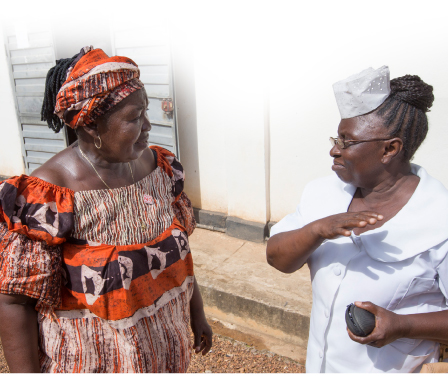
Mbalu Fonnie (right), then head nurse in the hemorrhagic fever ward at the government hospital in Kenema, Sierra Leone, is among the health care workers who have contracted Ebola and died. Here she briefs Beatrice Gbanga, medical and health coordinator for the United Methodist Church’s Imagine No Malaria campaign in Sierra Leone, on efforts to contain the Ebola virus.
UMNS/MIKE DUBOSE
“Wherever God’s people suffer in the world,” says Bishop Hope Morgan Ward, president of the General Board of Global Ministries, “The United Methodist Church is present.”
The biggest Ebola outbreak in recorded history is sweeping across Guinea, Liberia, Nigeria and Sierra Leone. The World Health Organization (WHO) reported in late August that more than 1,550 people had died from the disease. The death rate – up to 90 percent in some outbreaks – is also one of the highest of any infectious disease.
The United Methodist Church is responding with supplies, grant money and advocacy. Gifts to UMCOR International Disaster Response, Advance #982450, enable the United Methodist Committee on Relief to address Ebola and other emergencies.
According to WHO, Ebola first appeared in 1976 in two simultaneous outbreaks, in Nzara, Sudan, and Yambuku, Democratic Republic of Congo. The latter was in a village situated near the Ebola River, from which the disease takes its name.
Getting people to seek help is an ongoing concern because of misinformation and denial. Some hide from government officials and medical teams because they are afraid that if they go into quarantine, they will never see their loved ones again. Since the early symptoms of malaria and Ebola are so similar, many malaria patients are not getting treatment as they are afraid to go to healthcare facilities where they can be tested and treated.
“There is a lot of paranoia and distrust and people are staying in the villages and dying,” Dr. Vicki Morris says. “Every day, I look at the news reports and talk to contacts I have there, and the (Ebola) situation is much, much worse than what you are reading, especially the civil unrest.”
A member of Soapstone United Methodist Church in Raleigh, N.C., and an infectious disease specialist, Morris was in Foya, Liberia, from July 5 to Aug. 1. She planned to be there six weeks but was evacuated after only three weeks because of the beginning of civil unrest, which led President Ellen Johnson Sirleaf to quarantine neighborhoods and impose a curfew.
Morris told United Methodist News Service that she is concerned about Liberia and feels some type of military response is needed as a humanitarian mission at least to deliver supplies and provide security.
“It is beyond the capacity of the Liberian government or the Ministry of Health or even NGOs like The United Methodist Church,” she said. “There just aren’t enough public health people to respond.”
In an interview with United Methodist News Service in June, Mbalu Fonnie and Veronica Karoma talked about the panic they felt as nurses treating the first confirmed cases of Ebola in Sierra Leone at Kenema Government Hospital. Soon after the interview, both women also became Ebola patients. Fonnie died.
Ebola complicates malaria fight
Today, fighting malaria means fighting Ebola. Imagine No Malaria alone is not equipped to launch an emergency response to the Ebola epidemic, but United Methodists are part of a global denomination armed with the belief that the world is our parish. Imagine No Malaria supports programs in all four countries where Ebola is present, and the denomination’s comprehensive approach to fighting malaria has strengthened hospitals and health posts. United Methodist healthcare providers have been on the frontlines of the fight against Ebola.
“In the Ebola crisis, communication precedes prevention and treatment,” says the Rev. Larry Hollon, general secretary of United Methodist Communications, in a blog post. United Methodist Communications has provided two $10,000 crisis communications grants to the church in Liberia and Sierra Leone to support the fight against Ebola.
Through UMCOR, Sierra Leone and Liberia received grants for supplies, especially personal protective equipment like gloves and face masks. Protecting health workers is a huge priority because caring for Ebola patients puts them at high risk.
Many hospitals in West Africa shut their doors because they lacked safety gear to protect their staff. However, several United Methodist hospitals and health clinics have stayed open, thanks to support from UMCOR and missionary staff. Ganta United Methodist Hospital is near the border of Liberia and Guinea where the outbreak first occurred. The hospital is constructing a treatment unit specifically for Ebola.
Community awareness, education
“It is the only major facility open within a 100-mile radius,” wrote Dr. Wilfred S. Boayue, chair of the Liberia Annual Conference Health Board. “We keep reminding the staff to be very careful and use whatever protective gear they have to remain safe. In addition to their duties at the hospital, they have formed a task force to collaborate with the city and county government in community-awareness campaigns including messages on the local radio station.”
This type of communication is crucial, since Ebola was relatively unknown in West Africa before this outbreak. A big part of the fight against Ebola is a fight against fear. “If people don’t trust the government and the healthcare providers, they’re not going to get help,” said Shannon Trilli, UMCOR global health consultant.
Liberian Bishop John G. Innis encouraged “United Methodist pastors, district superintendents and Sunday school teachers [to] share the information about the Ebola virus with their local churches and districts.”
Bishop John K. Yambasu of Sierra Leone chairs the Religious Leaders Task Force on Ebola.
“Our major focus is teaching the people the practices of personal hygiene as the only effective and sustainable way of preventing the disease,” he says. He noted that 80 percent of Sierra Leoneans belong to a faith group. Because they often trust their faith leaders more than they trust their elected officials, faith groups will be key players in changing the public discourse. “We work towards increasing community awareness and education,” Yambasu says.
Ward encouraged prayer, study and giving to ease the crisis.
“There are three important ways to respond,” she says. “The first is to pray. Prayer is not the least we can do, but the most we can do. Second, let us learn. Let us learn about the dynamics in these places, learn about the culture, about the people, about our life in mission together, and third, let us give generously through The Advance of The United Methodist Church.
“Your gifts are making a difference in West Africa ... and in many, many other places around the world.”
Adapted from stories by Julia Frisbie, United Methodist Committee on Relief, and Kathy Gilbert, United Methodist Communications