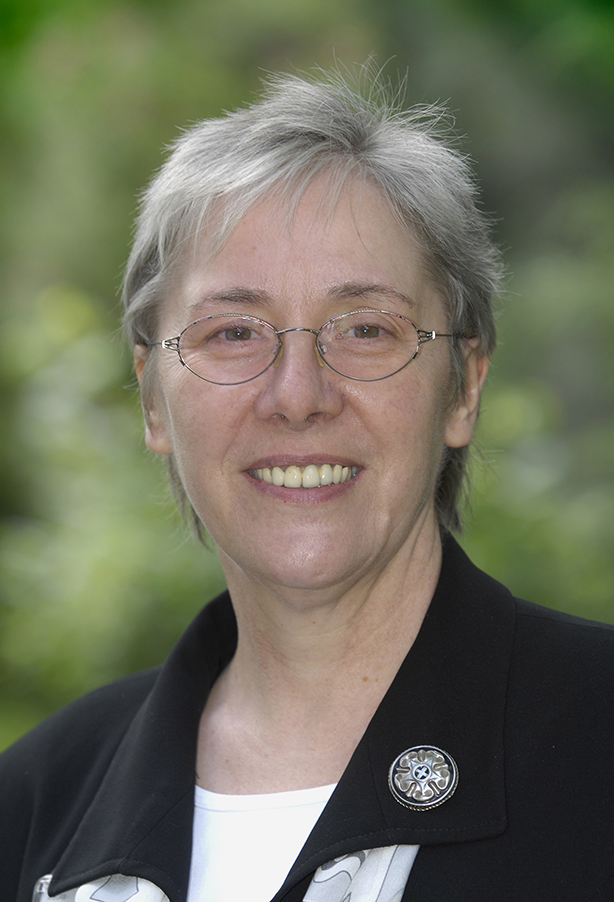
Sister Doris Horn
COURTESY PHOTO
“As a teen in my youth group, I was very shy and reserved. To pray openly seemed impossible,” remembers 62-year-old Sister Doris Horn. Meeting people, caring and serving one-on-one were more to her liking.
Now as the director of nursing in a Christian hospital in Muelheim in western Germany, she can only marvel at what God has done in her life. Her service included a 2009-13 term as president of the World Federation of Diakonia.
Finishing school at 17, Horn soon began nurses’ training. Although a youth leader told her, “You cannot serve God as a nurse because you have to work on Sunday,” Horn went ahead. She wanted to live her faith in the “center of life,” she says. She was convinced that serving God is much more than attending a Sunday service; it is everyday service.
At the time, Horn says, she felt called to serve as a nurse, but not as a deaconess. Little did she know that the municipal hospital where she would be trained had a contract with the “Evangelischer Diakonieverein Berlin-Zehlendorf e.V.” (The Evangelical Diaconal Association, a diaconal sisterhood).
Impressed by the work of the sisters, she became a “diaconal sister” one year after starting her nurses’ training.
The association was founded in 1894 to train women to serve professionally as equal partners in society. The training it oversaw emphasized both developing skills and service, and it shaped many professions: nursing, education, social work, counseling and so on. Always searching for the needs of the time, the focus now is work with people at the margins, for example, those with drug and other addictions.
Today, the association works at 21 locations in Germany and in six other countries. The sisterhood has approximately 2,000 members with more than 1,000 in active service and 500 members in training. Four hundred sisters are retired.
Membership is open to all women belonging to a church of the ecumenical Christian movement. Horn says a lively debate is taking place as to whether Roman Catholic women as well as men should become “sisters or brothers” of the sisterhood.
The sisters lived in communities until 1989, but today they lead independent lives, gathering regularly for meetings and dialogue on diaconal, spiritual and theological topics. They are identified only by the “diaconal rose” badge that they wear with pride as a sign of belonging to the sisterhood, Horn says.
Trained in several specialties, Horn worked in hospitals before The United Methodist Church in Germany in 1977 called her to serve three years as a nurse with a partner church in Nigeria.
“I never imagined I would be able to go abroad, being shy and insecure,” she says, still amazed at all that has happened, “but God knew me well.”
When she returned to Germany, she studied nursing management and teaching and then returned to Nigeria for another eight years. She helped develop a United Methodist rural health program and discovered quickly that diakonia (service) and management belong together. “You only can serve people when you manage finances, organization and education in a professional way,” Horn remembers.
Back in Germany in 1991, she completed her diaconal theological training at the Heimathaus (Heritage House) of the sisterhood and was consecrated into the ministry of the deaconate in 1992. Since then, she has worked as a leading sister and nursing director, first in Cologne and now in Muelheim. She is also an ambassador for the diaconal sisterhood and Christian ethics, serving seven healthcare institutions.
“God was always there, crossing my path with grace and mercy,” Horn says looking back on her life. “‘Crossroads of grace’ could be the title for my life story.”
The Rev. Klaus Ulrich Ruof is director of the Office for Media and Communication for The United Methodist Church in Germany.