In rural villages where textbooks are scarce or outdated, mobile technology can revolutionize education — and change lives — in developing nations.
By Joey Butler
In rural villages where textbooks are scarce or outdated, mobile technology can revolutionize education — and change lives — in developing nations.
By Joey Butler
In rural villages where textbooks are scarce or outdated, mobile technology can revolutionize education — and change lives — in developing nations.
By Joey Butler

Wayan Vota
UMNS/MIKE DUBOS
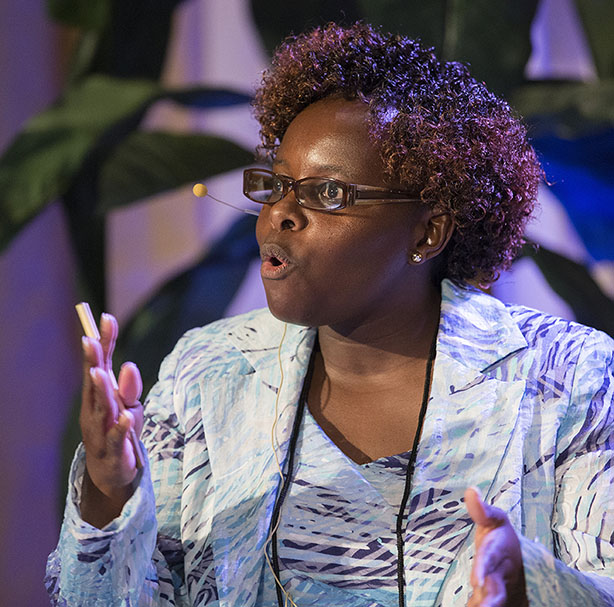
Priscilla Muzerengwa
UMNS/MIKE DUBOSE
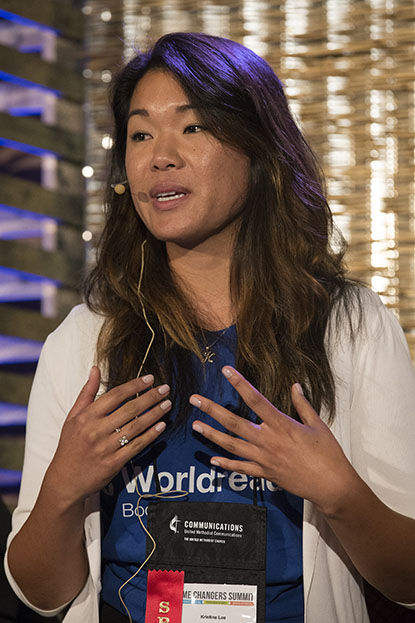
Kristina Lee
UMNS/MIKE DUBOSE
In a computer lab in Haiti, the Rev. Larry Hollon witnessed a young girl’s life change forever.
Hollon, general secretary of United Methodist Communications, was visiting the opening of a learning center for the Thomas Food Project in Haiti. Children who had never seen computers before were brought in. He noticed one young girl who seemed hesitant and unsure of what was happening. However, as the computer booted up, she grew more interested.
“This little girl leaned forward, tapped one key and saw the response on the screen, and at that moment ... she had experienced the world in a new way,” Hollon said. “This had opened up a world for her and her life would never be the same after that. It will be transformed by her ability now to access information and to reach out in new ways to get information that is valuable to her.”
Hollon shared this story in his remarks at the Game Changers Summit, a conference on information and communications technology for development (ICT4D) held in Nashville, Tenn., in September. As the denomination’s communications agency, United Methodist Communications has developed partnerships in the ICT4D world and encourages local churches to consider this involvement as another way to minister to those in need.
“We as a church often have access to people that are in rural villages. We can bring that technology to people at the end of the road and in the bush and equip them ... in new ways that are beneficial to the community,” Hollon said.
Technology is useful for a wide range of aid, including disaster relief and health care, but it is also vital as an educational tool in a developing nation. Due to the lack of consistent infrastructure for landlines, mobile phones are already commonplace in even the most remote village. According to estimates, more than 75 percent of the world has access to mobile technology, making it an ideal medium for education.
Wayan Vota, an ICT4D specialist and panelist at the Game Changers Summit, described being in a classroom in rural Kenya and asking students how many continents there are on the planet. “They said five: America, Europe, Russia, Asia and Africa. Australia is an island, no one lives on Antarctica and North and South America are one. We went to the Internet and found the correct answer,” he said.
In Vota’s eyes, using new technology is necessary for education in countries with few resources where textbooks are a rarity.
“How many books do you have in your house? In Kenya, there may be a Bible or Koran and that’s it. How can you learn and instill a love of reading if there aren’t any books? Through mobile, we can give them access to entire libraries.”
‘TICKET OUT OF THE SLUM’
Giving such access is the goal of organizations like Worldreader, which provides e-readers and a wealth of digitized content to students worldwide. Nearly 7,000 titles in Worldreader’s library are available in 41 different languages; 70 percent are African titles.
Kristina Lee, a partnership development manager with Worldreader, recently visited one of their partner schools, a girls’ school in one of the largest slums in Nairobi, Kenya.
“They’ve really been able to progress in their skills and their reading,” Lee said. “People wonder if people are going to steal the e-readers because it is such a poor community, but the coordinator there said no one steals them — they know it’s their ticket out of the slum.”
During her visit, Lee befriended a young woman named Dalifah, who had graduated from the program using e-readers. She earned a scholarship to a nearby university, and, in the interim before starting college, she is teaching others how to use e-readers.
“Just seeing her use this, it’s so intuitive to her; it has impacted her education and what will be her life,” Lee said.
A necessary tool
Imagine a medical student trying to perform surgery for the first time when all he or she knows about medicine was taught by textbook. In rural Africa, that is a potential reality.
Priscilla Muzerengwa, a communicator for the Zimbabwe East Conference and Game Changers panelist, said most rural schools lack labs, so students in biology or chemistry only have a textbook to explain complex life science to them.
“Now with digital content, it brings out everything in 3-D video form. You learn better in a more visual manner,” she added. “In the 21st century, information technology is not just a subject for study, but [also] a tool for education – as much as books or desks.”
James Lazarre, the project manager for the Thomas Food Project, said the ability to use technology in the classroom has made a world of difference. “Technology gives the opportunity to motivate the students. We believe we are setting the path for children in Haiti for a better future by using new technology.”
Thinking back to that little girl at the computer in Haiti, Hollon is certain the church’s involvement in ICT4D is ministry.
“My theology is that God intends for every person to flourish,” he said, “and when we empower people to have access to technology and information that they can use to improve their lives, we are fulfilling the call of God to be in the world and be a transformative presence in the world.”