Planning for Success
Celeste G. Kirschner, CAE
Chief Executive Officer, LUGPA
[Rev Urol. 2016;18(3):151-153 doi: 10.3909/riuLugpaNewsVol18No3]
© 2016 MedReviews®, LLC
Planning for Success
Celeste G. Kirschner, CAE
Chief Executive Officer, LUGPA
[Rev Urol. 2016;18(3):151-153 doi: 10.3909/riuLugpaNewsVol18No3]
© 2016 MedReviews®, LLC
Planning for Success
Celeste G. Kirschner, CAE
Chief Executive Officer, LUGPA
[Rev Urol. 2016;18(3):151-153 doi: 10.3909/riuLugpaNewsVol18No3]
© 2016 MedReviews®, LLC
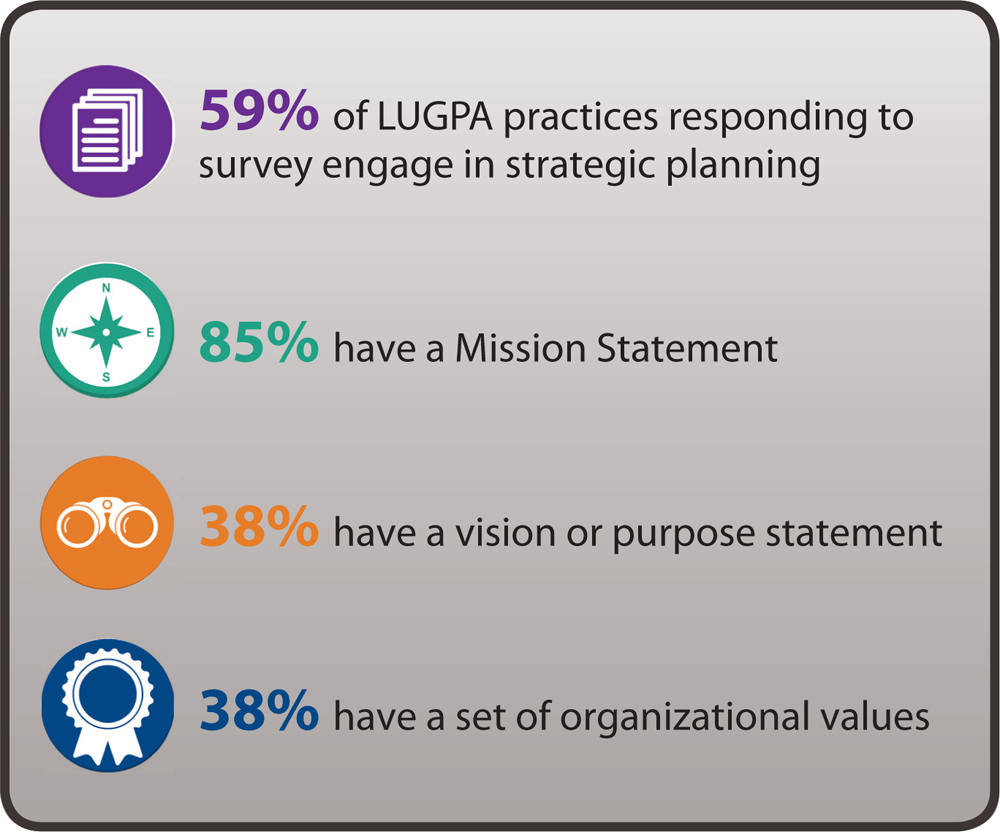
Figure 1. Strategic planning activities at LUGPA practices.
As I write this article, the LUGPA Board of Directors is readying for its upcoming strategic planning session to be held at its August meeting. The LUGPA Board is committed to the strategic planning process as we continue to navigate the uncharted waters of Medicare payment reform, the explosion of technology in the medical field, and the relentless challenges of contemporary medical practice. The LUGPA Board has embraced the mission to preserve and advance the independent practice of urology, and its strategic plan solidly reflects that mission.
Recently, at a series of new meetings—LUGPA’s Integrated Practice Forums—held around the country, we asked LUGPA leaders and administrators about their own strategic planning activities. The results indicated that 59% of the practices questioned engaged in a strategic planning process, whereas 41% did not. Interestingly, groups typically had a mission statement (86%) even if they did not regularly engage in strategic planning (Figure 1).
It is easy to understand why many physicians are not overly excited about strategic planning. It sounds like a good idea, but with all the daily challenges of running a practice it is hard enough to keep the doors open. Practice leaders who adopt this type of thinking, however, may continue to struggle to thrive in today’s changing environment. Both physicians and administrators must think about their own practices and how a strategic plan can help the group reach the next level, or even use the plan to better engage its clinical and administrative employees in achieving the practices’ goals.
Of course, strategy and culture are closely related. It is said that “culture eats strategy for lunch.” That is, without the right alignment of thinking among your leaders and key staff, all the plans and mission statements in the world won’t help you achieve your goals. With that in mind, you need to adapt your planning to fit what works for your organizational needs right now.
I’ve asked leaders from two LUGPA practices, Dr. Todd Cohen and Robert Baird, both of whom are experienced in strategic planning and operations, to weigh in with their thoughts on strategic planning for urology groups. Dr. Cohen provides a physician’s perspective on strategic planning, and Mr. Baird offers a urology practice administrator’s viewpoint.
Dr. Todd Cohen, a partner in the Carolina Urology Partners (located in North Carolina and South Carolina), echoes that strategy and culture are very closely related when developing a strategic plan. He and his partners have been working to create an ideal working culture for their 30-physician group since 2011, when they consolidated nine regional urology practices into one larger practice. “We had to build an atmosphere where loyalty to our new brand was principal. We simultaneously had to get physicians and staff acquainted with our new, consolidated practice as we introduced our strategic plan,” explained Cohen.
“Each of our previous, smaller, individual independent urology practices was familiar with doing business their own way, and we all had to put old processes behind us and adopt a new way to proceed. We all had to drink the same Kool-Aid, so to speak, for our business to be successful,” said Cohen.
Trust was embedded in the new entity’s strategic plan, as each of the previously individual practices were promised to be treated the same as others. Carolina Urology Partners’ strategic plan confirmed, in writing, that no previous practice would fare better than another. “Soon enough, we began working as a big team, we all achieved success, and, as a result, everybody won,” Cohen said.
Carolina Urology Partners’ strategic plan is also built on clear and constant communication. “Maintaining solid efficiencies is critical and, together, we worked hard to ensure that our processes were in unison. The only way to achieve commonality is to communicate to each other clearly and often. We achieved our plan’s communication goals via training and education, which helped staff find the fastest and most efficient procedures. If just one employee follows another path or procedure, it potentially can rock the entire boat,” Cohen explained.
The result was that income for all previously individual practices grew within the next year by following the new practice’s strategic plan—for Dr. Cohen, by more than 62%. “But the work is never done,” Dr. Cohen cautioned. “Strategic planning processes need constant review and regular quality and procedure checks. Fine tuning to the practice’s plan must take place on a regular basis,” he continued.
“Once my partners and I get comfortable with a process, we prepare for the next unknown element within the urology industry that will need to be incorporated into our strategic plan. Currently, we are preparing for the looming MACRA [Medicare Access and CHIP Reauthorization Act] changes.”
In addition to Dr. Cohen’s insightful perspective, we asked Robert Baird, Chief Executive Officer of the Dayton Physicians Network (Dayton, OH), to share details of the strategic planning process he coordinates at his multispecialty medical practice with 43 physicians and midlevel providers. Baird has been working on the practice’s strategic plan for several years and understands how critical a strategic plan is to his practice’s future in the midst of the numerous changes taking place in health care.
He and the group initially crafted the practice’s strategic plan by basing its skeleton on the practice’s mission statement. During the fine-tuning stage, he discovered the book Hardwiring Excellence, by Quint Studer.1 The book inspired Baird to incorporate five pillars to measure strategic success into his strategic plan. The pillars of Baird’s strategic plan are (1) Service, (2) Quality, (3) People, (4) Finance, and (5) Growth (see LUGPA’s Strategic Plan Tool Kit at http://lugpa.org/ for more information on these five pillars).
“The five pillars incorporated into our plan worked very well for our practice as we searched for solid categories to develop and measure success,” explained Baird. “I would recommend these categories to any practice that may be struggling with where to begin a strategic plan. Each pillar represents an essential area in which Dayton Physicians Network seeks to excel,” he continued.
“During the past 12 months, the plan has been paying off for the entire practice,” said Baird. Baird means, quite literally, that he awards staff members with monetary bonuses that the practice pays out for successes toward the plan’s goals.
“Monetary incentives have proven to be ideal drivers of our strategic goal achievement,” Baird noted. He, his administrative staff, and the board of directors set up and budget for financial incentives for all practice staff to meet each month. If they meet those goals, they receive bonuses in addition to their yearly salaries for working diligently to achieve the practice’s goals. “Monetary incentives make everyone win as we work together to achieve our strategic goals,” Baird explained.
“Commitment to the plan by staff is strong, because we acknowledge the contribution of each employee and reward his or her successful execution of the strategic plan with a bonus. If we fall short of our goals, no bonuses are awarded and we review the strategic plan to determine why we didn’t meet our goals. Then, after problem solving and listening to staff feedback, we try again to accomplish the goals,” he explained. “Freedom to provide feedback makes staff feel valued and truly part of the plan,” he added.
To Baird, patient satisfaction is a significant driver of his group’s strategic plan, “Because it is the satisfied patient who will return to our practice, refer other patients to our practice, and, ultimately, help us grow patient volume and income. Because our strategic plan has been in place, our patient satisfaction has significantly increased. We constantly work on improving patient satisfaction and frequently meet to measure results,” he explained.
“We survey every patient who is seen at our practice and seriously consider every survey answer. We work to improve upon any area that our patients do not consider excellent. One improvement begets another and initiates a chain of successes. It is rewarding to see the momentum swing in our favor,” Baird concluded.
The Strategic Plan Tool Kit is available on our Association’s website to assist LUGPA members in their practice’s strategic planning processes. Please visit http://lugpa.org/, review the tool kit, and consider utilizing some of these valuable resources as part of your independent urology practice’s strategic planning process. Independent urology groups interested in learning more about LUGPA or applying for membership will find the application on our website. 
Reference
- Studer Q. Hardwiring Excellence: Purpose, Worthwhile Work, Making a Difference. Pensacola, FL: Fire Starter Publishing; 2004.