There’s no real gain to anyone other than our ability to design for sharper pricing and that our folks know what the consumers in their markets want.
You’re always keeping your mind on market trends, shifts and changes.
Despite more distribution channels than ever, Casual Classics Furniture Group’s 57 retail members operate with confidence by communicating with each other and knowing their customers’ demands.
Selling exclusive products was an early objective when Buzz Homsy shared the concerns he faced at the California Backyard retail chain with his nephew, David Ghiz, then an owner of the Paddock Pools, Patios and Spas chain in Arizona and Nevada, and the late Jim Bowen of Lighthouse Pools in Cleveland, Ohio. The three veteran casual furniture retailers, with a combined 43 stores, recognized common business challenges and joined forces in 2001 to found Casual Classics Furniture Group.
At that time, they were responding to competition from growing mass merchants like Home Depot, Costco and Sam’s Club. As those retail giants grew larger, the smaller independents realized they couldn’t provide the volume needed to support their suppliers and feared they would be priced out of the market.
“If you stand back and look at the confusion in the marketplace, you can understand why a buyers group made sense,” said Homsy, director of the casual furniture industry’s largest member-owned buying/design cooperative.
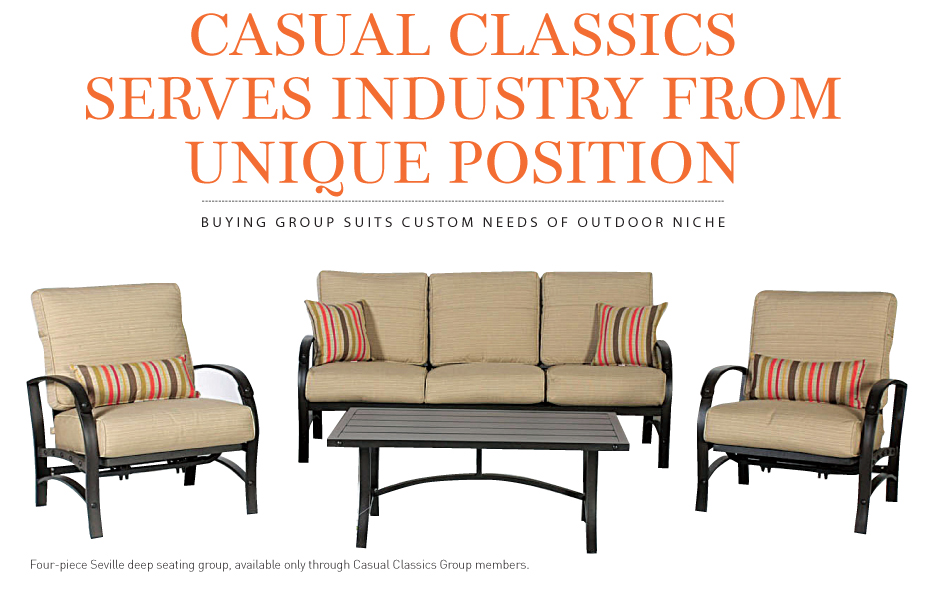
The trio was able to leverage the buying power of a member-owned group and keep product affordable for their consumers. In addition, they wanted to design and develop unique products to sell under an exclusive label. Although all three were importing then from Canada, they decided to reach out to China.
After a couple of trips to China, the buying group was making its own designs. By late 2002, they were able to get Casual Classics’ products branded for the 2003 season and an ownership contract was developed to protect members.
“Between 2002 and 2006, the consortium bloomed,” Homsy said. “We moved from three owners to 18 by 2003; by 2006, we were 36 strong. Between 2006 and now, we grew to 57 members.” That membership has included more than 250 stores throughout the United States, Puerto Rico and Canada.
“We have some markets that we’re not represented in; there are six of them,” Homsy said. “As soon as we go into those territories, we’ll button it up.”
“Our product line is unique to us with its own brand name,” he said. “It’s great because the market is flooded with brand names in too many different places.”
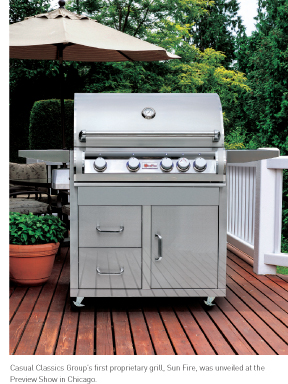
One of Casual Classics’ latest introductions is its first proprietary grill. Made of stainless steel with doors, drawers, LED lighting and a lifetime warranty on the burners, it’s available only through the group’s members.
Two years ago, industry veteran Jim Tillona joined Casual Classics as director of marketing resources, bringing retail experience with Namco, a 40-store patio and pool chain in the Northeast from Maine to Maryland. He also has years of manufacturing experience as the former president of Shadetrends/Avanti. His experience sourcing and developing product in China only added to the benefits of the buying group.
“I think the actual process doesn’t change,” Tillona said. “The first thing you have to know is really: Who is your customer? And then you back into it from that aspect. Having the relationship with the factories is probably the easiest part in that. We’re fortunate to have a fair number of manufacturers who are good at what they do and getting better all the time.”
Homsy said, “We are translating what our retail owner is requesting from us. We get input from our members, comparable across North America, so our product is made to fit anywhere that we market. We know before we bring it to market that we’re right.”
Identifying a specific target consumer is the challenge because of the group’s diversified members, Tillona said. “We have specialty, pool and patio, garden center, home centers, department stores … and everybody’s target is a little different from each other – there are high-end, medium- and low-end. We’ve got to be broad enough that we’re offering the membership enough products to make it significant for them to be a member, which I think we do.”
“We talk to our membership because we’re working for them,” Tillona added. “It’s imperative that we know that we’re developing and looking for the right product at the right prices for them.”
Homsy agreed. “What makes our job interesting and unique is the fact that we have a dichotomy of owners,” he said. “Right now, the advantage to our folks is that each one owns 1/57 of the whole. There’s no real gain to anyone other than our ability to design for sharper pricing and that our folks know what the consumers in their markets want. Our benefit is in the margin that our folks make on the product. Our job is to prepare and have product. Our focus is to sense the market direction.”
To stay on top of that direction, Tillona said, “You’re always keeping your mind on market trends, shifts and changes.”
Knowledge about the market and its growing distribution channels are among the main reasons retailers would want to be a member, Tillona said. “Because how else are you going to fight? How are you going to maneuver your way through this maze to be successful? I think being a member of the group is one of many answers. The group is going to afford you some great advantages, one of which is national branding.
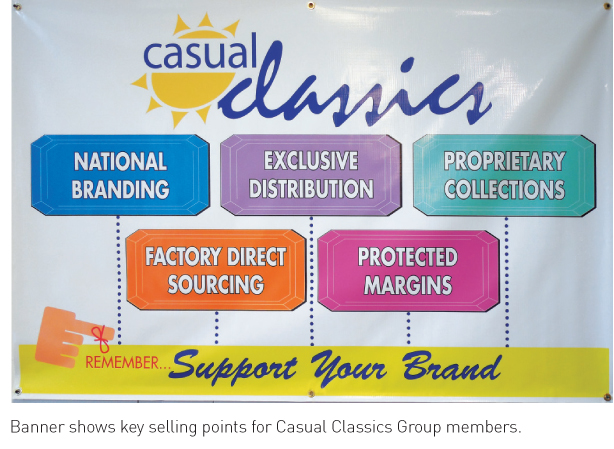
“National branding affords you the opportunity to put merchandise on your floor that really can’t be shopped everywhere at any time,” Tillona added. “So that gives you some protection. And the membership gives you exclusive distribution in a territory, so you’re not stepping over each other to sell the same goods in the same market. And in many of the cases, the vendors that we’re working with are developing proprietary collections that are only offered to CCG members. We’re also sourcing them. That’s where I spend most of my time, sourcing offshore so you’re bringing in factory-direct merchandise to them. When you add all that up, you shake it up and what comes out is you’re putting gross profit margin in at the bottom line. Isn’t that the goal, really?”
Homsy noted Tillona’s vast knowledge of sourcing has brought an extra advantage to Casual Classics members. “Our audience is unique because we’re more than just a buying group. We’re an owner-owned design and build cooperative. It’s a perfect marriage.”
“Our line is priced for value and it’s attractive to anyone,” he said. “It’s up to our salespeople to explain to customers that this product is designed, field proven and going to work for them as long as they want to own it – and then they can give it to their grandchildren. The brand is unique to our members. You can’t get it from anyone else.”
Homsy recalled industry icon Sam Mallin’s words, “Don’t forget this business starts with the sunshine and ends with the calendar.”
While admitting that truth, Homsy looked ahead with the expectation that Casual Classics will “gear up for 2015 and we’ll develop more of the winners. I think the bottom line is there’s too much of the same stuff, that’s why Casual Classics is in rock solid position. We’re truly unique in the world, there’s nobody that does what we do.” 