
Sally is expecting her first baby, and recently went online to buy a crib. When it arrived, the crib was damaged.
Sally was disappointed but thought she could exchange it at the store. She went to the company’s Website and realized there were no retail stores in her area.
Worse, there was no phone support number to call, only a returns page that said she would have to ship it back at her own expense. Angry, she filled out the ‘Contact Us’ form and received an automated reply saying someone would contact her. When no one did, she went on Facebook and complained to her friends.
In today’s consumer-empowered marketplace, you cannot afford situations like Sally’s. Your contact center agents must be available— and equipped with the knowledge they need to handle customer issues quickly and efficiently.
However, with the explosion of new channels—Web, social, and mobile— many companies lack the tools and processes required to empower their employees to deliver great customer experiences. Organizations struggle with static, siloed knowledge systems that not only provide redundant, often inaccurate information, but are costly to maintain.
There is another way. Companies that have invested in creating a Transformational State of Knowledge are delivering great customer experiences, which translate into sustainable growth and profitability.
To achieve transformational knowledge, companies must be able to:
1. Establish a Single Knowledge Base across Channels, including Social
Consolidate your customer data into one single source of truth and make it available to agents and customers across Web, mobile, and social channels. Tie knowledge to analytics and key performance indicators (KPIs) to present valuable content and address information gaps. This new level of visibility makes it easy for agents to:
- Update knowledge
- Identify potential customer issues
- Provide fast, accurate resolution
Driven by market demand for enhanced self-help services and internal demand for efficient productivity improvements, TELUS transformed its customer and employee support systems, taking its existing 50+ separate knowledge repositories and establishing one central cross-channel knowledge base. With over 12.3 million customer connections and 35,000 employees, this solution not only helped raise efficiency and reduce the cost-per-call by almost 50%, but it also improved the quality of the customer support TELUS was able to provide. “Rarely do you see a single technology solution have success with so many independent departments within one company. RightNow’s self-help capabilities have streamlined our contact center operations and helped improve employee engagement”, said Ross Guthrie, Operations Manager on the Enterprise Service Desk at TELUS.
2. Understand Customer Intent and Empower Agents with an Effective Workspace
Help your agents understand customer intent by giving them a 360-degree view of the customer’s history, value tier, and current inquiry context.
Then empower agents with a unified workspace that leads them to the most efficient resolution path with skills-based routing, automated workflow, and guided assistance. Predictive analytics also enable agents to offer relevant products and services, transforming service calls into sales opportunities.
KLM Airlines combines Web search intent with the customer’s complete profile, to route inquiries to the channel that will best serve the customer’s needs—and the company’s goals. For example, a high-value customer may be routed to a chat or phone agent, while a low-value one may be directed to a Web FAQ. This transformational knowledge approach has helped KLM Airlines increase online conversions by 30% annually.
3. Adapt with Social Knowledge to Leverage Crowd-Sourced Wisdom and Customer Advocacy
Social media has evolved Knowledge Management from static data residing in a structured database to dynamic, unstructured data created in every social interaction. As a result, you must monitor customers’ social conversations on Facebook, Twitter, and other sites to analyze sentiment and prioritize and respond to service issues.
You also need to host social support and innovation communities to answer customer inquiries and capture feedback to improve products and services. Managing these communities requires putting decision rules in place about when to handle questions within the community versus routing them to an agent.
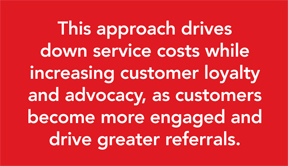
The advantage of social communities is that many questions can be addressed through peer-to-peer support—crowd-sourced wisdom. This approach drives down service costs while increasing customer loyalty and advocacy, as customers become more engaged and drive greater referrals.
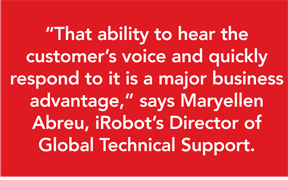
iRobot uses social knowledge to provide exceptional service, often turning unhappy customers into powerful brand advocates. The company monitors and prioritizes customer social interactions and hosts social support and innovation communities where customers find information, interact with each other, and provide feedback on new product ideas.
Summary
Investing in the creation of a Transformational State of Knowledge builds a defensible advantage in delivering great customer experiences. Those experiences lead to sustainable growth and profitability by driving customer acquisition, customer retention, and operational efficiency.

Why Oracle?
Oracle offers the most comprehensive customer service and knowledge management solutions, enabling your agents to deliver consistent, relevant answers across touchpoints, drive new efficiencies, and build stronger customer relationships.
To learn more, visit oracle.com/rightnow