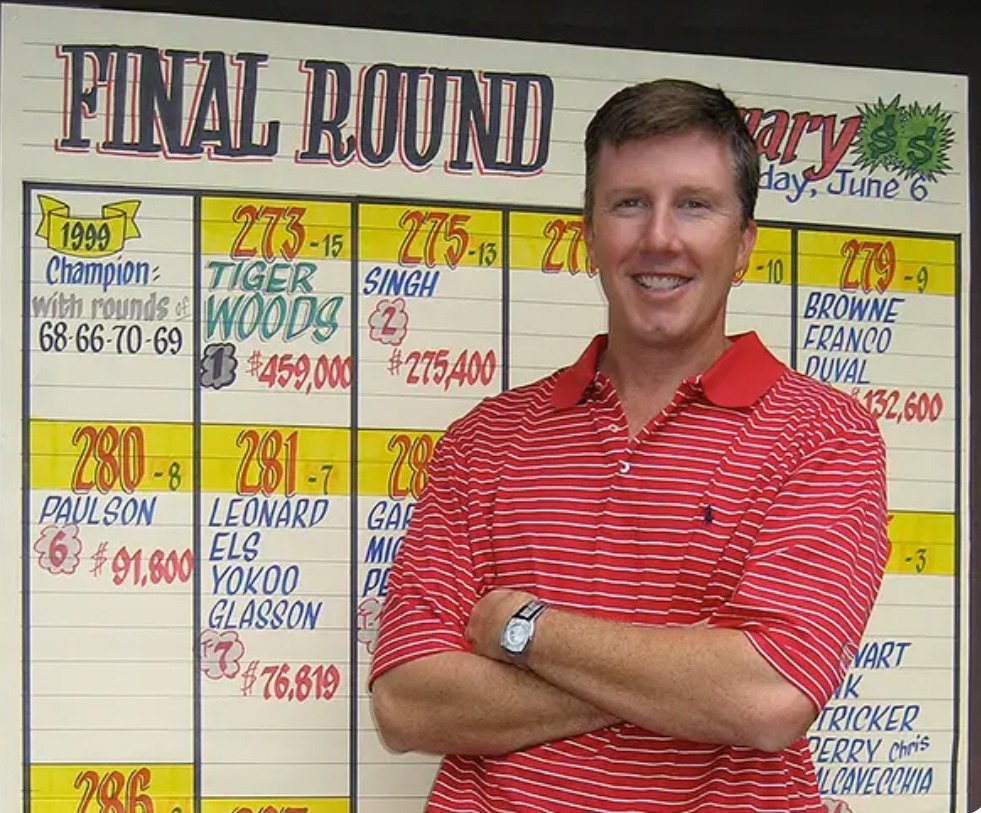
Casey Jones at the 1999 Memorial Tournament.
COURTESY CASEY JONES
Some things disappear and we forget the simple pleasures they provided. The rhythmic sound of metal spikes on a sidewalk. The satisfaction of using ball washers at every tee box. The communal joy of gathering around as calligraphers posted the latest tournament scores.
Calligraphy is a vanishing art form in golf. There’s an old joke that the two most important skills for being a club professional are calligraphy and folding shirts. Only the latter still matters (and increasingly less so in our online shopping world). Digital leaderboards on courses and the ability of every golfer to pull up Golf Genius or PGATour.com on the phones in their pockets has rendered the once-essential calligraphy scoreboards obsolete.
And golf is a little less beautiful because of it.
No two calligraphers are the same. … What they all share is consistency and uniformity, which made them mesmerizing to watch in action and preferably easy to read up on the wall.
Casey Jones knows this as well as anyone. The 57-year-old Georgian spent decades traveling around the country putting his perfect penmanship skills to use for the USGA and all the professional tours, producing the unfolding magic that were calligraphy boards – meshing his love of golf and natural talent as an artist into a fulfilling career. “Have pens, will travel,” was Jones’ motto.
Calligraphy isn’t a font like Helvetica, Calibri or Times New Roman. The word calligraphy, from ancient Greek, simply means “beautiful writing.” As kids we were once all judged as relative calligraphers by our elementary school teachers. It was called penmanship – the art or skill of writing by hand. If you’ve looked at your own or your kids’ handwriting, you know it’s largely a lost art/skill, indeed.
No two calligraphers are the same. They each have their own style, from ornate old-world scripts to shadow effects to simple, clean block characters. What they all share is consistency and uniformity, which made them mesmerizing to watch in action and preferably easy to read up on the wall.
“The outdoor boards at pro tournaments, you’d have hundreds of people out there looking at them,” Jones said of calligraphy’s heyday.
Calligraphy boards go back in some form or another about a century in the game and became kind of ubiquitous in the 1950s. Jones started doing calligraphy boards at men’s, women’s, juniors’ and seniors’ events and press rooms in the 1990s – one of a couple handfuls of artists who made a living traveling around golf doing it. In around 2003, Jones could see the handwriting on the wall and transitioned into a full-time role with PGA Tour operations as a scoring official. The calligraphy boards persisted in certain places for another decade or so into the mid-2010s before tournaments started deeming them an unnecessary expense as digital options overtook all of our lives in real time.
Casey Jones at the 1999 Memorial Tournament.
COURTESY CASEY JONES
“Those calligraphy boards were an integral part of everything for so long, and now they’re just obsolete,” Jones said. “It’s kind of a shame but that’s just how technology has changed the way we get information.”
Some places still keep up the calligraphy board tradition, largely for old times’ sake. Jones still does it each year for the TaylorMade Invitational at Pebble Beach in player hospitality and the Honors Course in Tennessee called upon him to draw the big outside calligraphy scoreboards for the 2024 U.S. Senior Amateur and this year’s U.S. Women’s Amateur. “They don’t have to do it, but they know me and have the setup and it just adds a little nostalgic value to the tournament,” Jones said.
Jones is trying to capitalize on that nostalgia and his unique skill as an artist by keeping a classic element of golf storytelling alive as a side hustle. For years, players he got to know on tour or the clubs he worked for would want keepsakes to immortalize their various accomplishments or historic events with a piece of calligraphy art Jones gave them that they could display. With Casey Jones Golf (caseyjonesgolf.com), he now creates hand-drawn personalized artwork commemorating big moments for clients – hole-in-one keepsakes, tournament scorecards, match-play brackets or team accomplishments.
“If tour pros want this stuff, then the everyday golfer might love it, too,” said Jones, who retired from the PGA Tour in 2024 and started focusing on building his golf art business. “The guy who won his club championship or made his first hole-in-one or set a course record or broke 100 for the first time; I draw a mock-up of a calligraphy board and frame it so they can hang it on their wall and tell the story of one of their special moments.”
Metal spikes and ball washers may never come back in style, but hail to the “scoreboard guy” who is fighting to keep the tradition of storytelling through golf calligraphy alive one client at a time.
Scott Michaux
Top Illustration: Casey Jones