Wait. What'd you say?
Circling back on bold, brash (and occasionally false) statements.
BY CAYSEY WELTON
Wait. What'd you say?
Circling back on bold, brash (and occasionally false) statements.
BY CAYSEY WELTON
Wait. What'd you say?
Circling back on bold, brash (and occasionally false) statements.
BY CAYSEY WELTON
Sometimes people say things they wish they could take back, while other times they deliver carefully crafted sound bites that play well at first, but don’t hold up. Acknowledging hindsight is 20/20, here are a few highlights of the latter.
I Do Not Think It Means What You Think It Means
At the end of 2014 The New Republic became fodder for countless news pieces. It seemed the wheels had finally come off of Chris Hughes’s refurbished bus, despite bringing in Guy Vidra to reroute the company’s direction.
Vidra told Politico, “It is absolutely absurd to suggest that I would come to this institution to do anything other than leverage what we do here to bring it to a larger and more engaged audience.” True maybe, but his intentions were overshadowed.
Not only did TNR make plans to move its D.C. operation to New York, but it also started making notable executive changes, which led to a staff exodus—especially after Vidra’s now infamous pledge in a memo to make TNR a “vertically integrated digital media company."
Ripp-ed Apart?
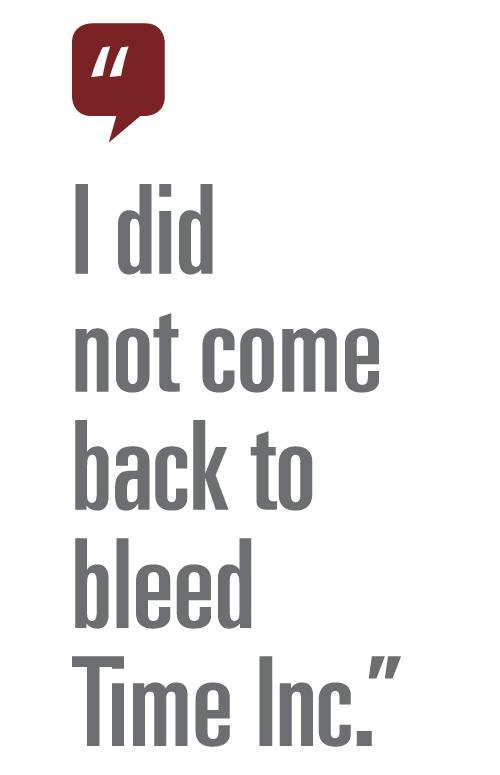
When Joe Ripp joined Time Inc. he had what some considered an impossible task. The publishing giant was about to spin off from Time Warner, ad revenues were on a steady decline and rumors surfaced that the company would either be sold or would begin to divest its holdings. But when he joined the company he told Re/Code, “I did not come back to bleed Time Inc.”
In fairness, he hasn’t bled the company, although its 2014 revenues were down $73 million (-2 percent) compared to 2013. Its bread and butter— print advertising—continued to decline (down 3 percent YoY) and digital revenue didn’t come close to offsetting the losses in print. In fact, digital revenue shrank by 1 percent YoY.
But in hindsight, Ripp’s comment becomes especially awkward when looking at the number of jobs Time Inc. has cut since his return—like in January when Sports Illustrated, All You and InStyle all fell victim to layoffs.
Not Quite the Future You Expected
Last year, Source Interlink Distribution rocked the industry with news that its financial woes were insurmountable and it would shut down. Not only did SID owe tens-of-millions to major publishers like Time Inc., but it was also the distribution lifeblood for many small, niche publishers.
In 2010, however, the now-former CEO Michael Sullivan had much grander visions for the future of the company. In an interview with Newsstand Forum, Sullivan said:
“As [Source chairman] Greg Mays has stated, the board’s most important factor in choosing me as CEO was my record as a strategic thinker and planner, based on my roles in the CMG launch and subsequent management and initiatives, such as the IMPACT program with wholesaler partners. The make-or-break, in Greg’s words, was ‘ability to lead Source into the future.’”
As it turns out, Mays and Sullivan were wrong. Sullivan might have been doomed from the start though. After all, he did join a company rebounding from a bankruptcy and still holding staggering debts. But he also had four years to turn it around, which he didn’t. In fact, there was little noticeable change in how he reorganized the distribution arm to make it more efficient and viable.
Pointing out these instances isn’t an attempt to create a “gotcha moment,” but instead to show how sound bites—no matter how well crafted—can come back to haunt you. And they serve as reminders that sometimes truth goes further than spin when times are tough. 