Thinking Differently and Thinking Big
At Farm Journal Media, Andy weber challenges his team to “Think a decimal bigger.”
Thinking Differently and Thinking Big
At Farm Journal Media, Andy weber challenges his team to “Think a decimal bigger.”
Thinking Differently and Thinking Big
At Farm Journal Media, Andy weber challenges his team to “Think a decimal bigger.”

The change happening in the magazine media market is happening across all the verticals—B2B, consumer, city and regional—but perhaps no other vertical has been blindsided quite as dramatically as B2B. The decline in print has been more acute, leaving business publishers in a confounding position of wholly redefining their corporate strategies. Some began to identify as technology companies, others hung their hats on their ability to provide information and data. And “media” was usually relegated to the end of the tagline. These identity changes are often followed by significant structural shifts to align with the new strategy.
The reasons for these changes vary, but can be motivated by the type of ownership—private equity or banks, for example. But even independently owned publishers have had to evolve their corporate and product strategies.
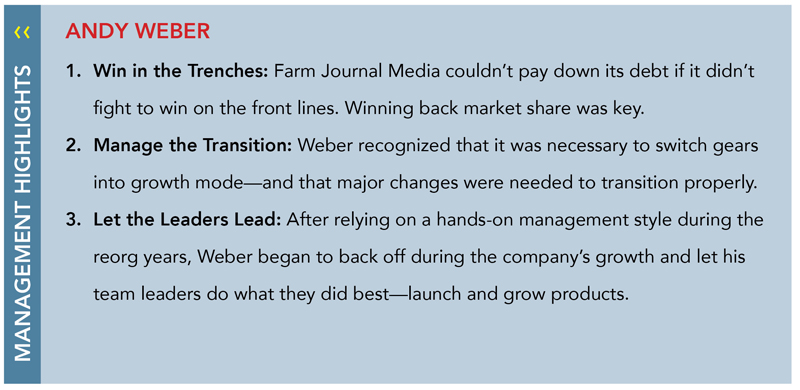
At Farm Journal Media, that meant some radical changes to company structure, sales approach and leadership style, especially at the top.
Pay Off Debt
In 2003, Farm Journal Media struggled its way through that period’s downturn, coming very close to throwing in the towel with a divestment of assets. “There was a lot of failure—not so much failure as much as getting through a mind-set shift,” says president and CEO Andy Weber. “We’re not a family-owned company, we’re not a publicly traded company, or owned by private equity. What we have in the bank is what we have in the bank. At one time we had a ton of debt and nothing in the bank. You better get a pretty strong and close team to get through those times, but that’s not a revelation.”
That may not be a revelation, but common sense is all too frequently delayed, to a company’s peril. Nevertheless, Weber, who became CEO in 2000, instituted a debt pay-down program before the company began to ramp up new product development. That was achieved in about four years, but not without the help of a directive to dramatically boost competitiveness on the front lines. “What did it for us to get through an extraordinary period of time—2003 being the worst, we almost split up our assets—was creating a business that worked. We focused on winning in the trenches, winning day-to-day and winning competitively,” says Weber.
Reorganize for Growth
By 2007, the company’s debt was paid off and Weber instituted a plan to double the company’s revenue in five years. But as it turns out, that was only the first wave and the plan was immediately challenged by external market forces. What followed was yet another financial downturn paired with an acceleration of digital media while marketers began to shift spending away from print.
“The five-year plan sounded good on paper—to double the size of the company—and then a few things happened: the years 2008 and 2009 were not good and we didn’t have the creativity to deal with it and we had a low tolerance for risk.”
The expertise that Weber had developed during the debt pay-down days came up short during the most recent recession because what was also needed was the muscle to push major cultural change through the ranks. That change meant convincing the company’s leadership to light a fire under product development and dramatically change the way they sold their advertising.
Add a Zero
The germ of Weber’s second act emerged from a simple statement: “Think a decimal bigger.”
In other words, a $10,000 ad sale becomes $100,000. “We realized we had to raise expectations,” Weber says. “I told my division presidents that they needed to work on $300,000 or bigger projects. I wanted sales people to be working on six-figure multimedia projects instead of a banner or ad page. And that was a commitment by senior management first and then pushed down the ranks.”
But that kind of mandate doesn’t just fall into place. “The cultural thing was huge,” Weber says.
Making the transition from cost control and debt reduction to turbo-charged business development was difficult.
In 2009, Weber initiated a major consolidation of Farm Journal Media’s sales teams, and the move couldn’t be done quickly enough.
The company was already gaining traction with new product launches, going to market with a growing array of integrated media products across print, digital, data and FJM’s broadcast content, but the sales teams weren’t offering comparable solutions across those platforms. In fact, the various ad services were competing with each other. “Our go-to-market strategy was working beautifully, and that was to integrate our media, [but] we were sending conflicting messages to the market,” says Weber.
The bigger, six-figure deals that became part of the rallying cry were initially handled by senior executives. “It was mostly management doing it and dragging the reps along,” he says. “I took a scorched earth policy, broke down the silos and made everyone learn how to package. We’ve got business people treating the sales process now as a solutions process, a portfolio process. We do business at a much higher level.”
Four separate sales groups were merged into one. That, combined with the growing complexity of the company’s market strategy, sparked a 150-percent churn rate among sales employees.
But that churn helped the organization bring in new talent that offered new perspectives on product and business development—particularly on the digital side. “Fresh thinking helped open the flood gates and we became very prolific in organic development,” says Weber.
“To this day, seven years later, ‘think a decimal bigger’ is still frequently repeated around this organization,” he adds.
Re-Think Management Style
As the company grew—topline jumped 20 percent in 2013—Weber realized his own management style needed to change. The debt reduction and reorganization years required hands-on, day-to-day attention. But as new employees began to join the company, new products rolled out and groups began to stabilize, Weber knew he had to back off. He realized his leadership style worked for a corporate culture that had since changed.
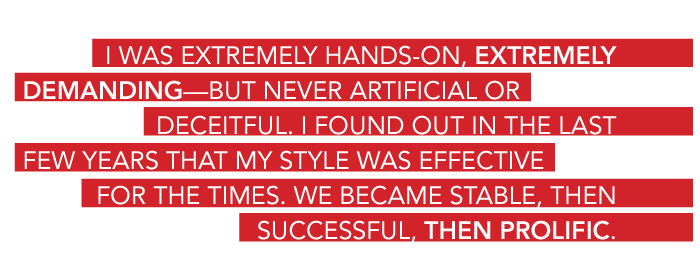
“Through the tough times here ten years ago, I had a fairly new management team, inexperienced in B2B. I was extremely hands-on, extremely demanding—but never artificial or deceitful. I found out in the last few years that my style was effective for the times. We became stable, then successful, then prolific.”
But to manage through the rapid growth took a different skillset, and Weber sought the council of an executive coach. “What I found out was [the management teams] knew more about what they were doing than I did. The last three years I’ve been trying to change and get out of their way and not stifle growth. We were in a go-go mode and I had to learn how to manage that. It’s less about mandates now and more about repositioning and restructuring the company to handle growth.”
Going forward, Weber is encouraging even more speed from his team while looking at new areas for growth. Data and information are ripe for development, he says, but they need to move fast. “We’re doing some training on agile development and the scrum theory. We want to develop bigger things in half the time.”
Meanwhile, after years of focusing on organic growth, Weber says it’s time to start acquiring more. “We’re going to have to acquire to get better, too,” he says.
But any deals will likely stay within the agriculture market, and get done with minimal leverage. “We’re going to stick with our knitting. I’ve been with the Thomsons and the Reed Elseviers, public companies and private equity. [Companies] have been recapitalized every three or four years because they’ve been too far over their own skis and it’s happening all over again. I don’t want to do that.” 