
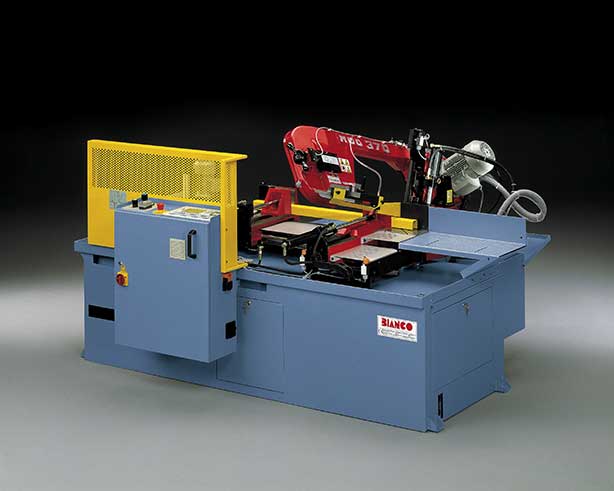
The BTM 370 A DS is fully programmable and allows materials to be advanced two to four times faster than on a vertical bandsaw.
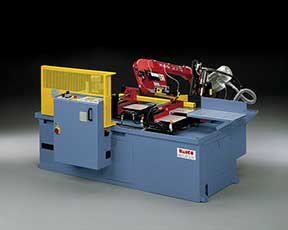
The BTM 370 A DS is fully programmable and allows materials to be advanced two to four times faster than on a vertical bandsaw.

Watch this video on Cosen’s CNC-800DM bandsaw.
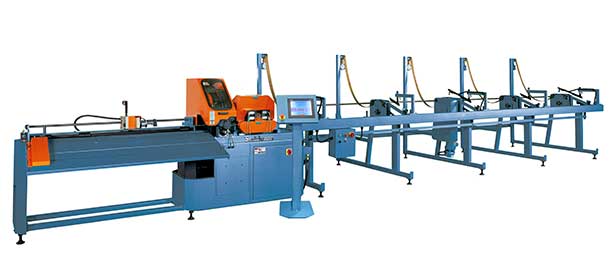
Scotchman’s CPO 315 RFA saw is ideal for high volume and long length applications that require very accurate and clean cuts.
Scotchman’s CPO 315 RFA saw is ideal for high volume and long length applications that require very accurate and clean cuts.
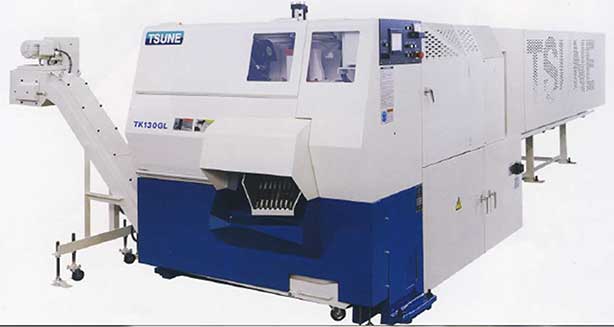
Tsune intends for its TK130GL to replace about three other saws for a fabricator.
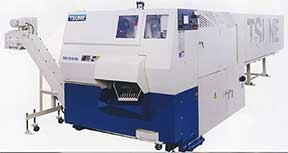
Tsune intends for its TK130GL to replace about three other saws for a fabricator.
No one can deny that FABTECH is a huge show. Not only that, but it makes for an extremely busy week, both for exhibitors and attendees, and few people can say that they legitimately saw everything.
With that in mind, it's possible that you might have missed a few equipment introductions. We're here to help. FSMD has scoured the show for new sawing equipment, and we're presenting it to you here. The new saws described below were all introduced at or around FABTECH over the past two years.
Cosen
Cosen has introduced the CNC-800DM, a fully programmable, horizontal double-miter bandsaw. One of its most important features is its ability to accomplish variable geometry cuts.
"Let's say that you need to cut a 4-in. by 4-in. tube and put a 45 degree angle on the front and then a 45 degree angle on the end, so you're making a trapezoid," says Michael Finklea, Cosen's director of sales for North America. "We can do that. Or if you need to make a parallelogram for some reason, we can do that, too. The saw will miter cut 45 degrees to the front and 60 degrees to the rear."
The CNC-800DM is a large machine with a large capacity that changes depending on the angle. According to Cosen's website, at 0 degrees, it can handle 20 in. round and 16 in. by 31 in. rectangular. At ±45 degrees, it can handle 17.7 in. round and 16 in. by 21 in. rectangular, and at 60 degrees, 16 in. round and 16. in. by 16 in. rectangular.
"The big thing about this saw is that it enables a customer to a do a job with just this one machine," comments Finklea. "It's a cost savings, because you need fewer people and it reduces a two-step process to only one. Before they might have had to cut everything off to length with a square cut and then go over to a smaller saw to do miter cuts manually, which would slow down the manufacturing process."
Other features of Cosen's CNC-800DM include a 10-hp motor, a 2-in. bi-metal sawblade and a planetary gearbox with the direct-drive motor.
"The planetary gearbox is essentially 97 percent efficient, so all of that horsepower in the motor is going to the blade, and that allows you to cut your material more efficiently," explains Finklea. "And today, as you know, it's all about efficiency and getting the most out of your equipment and the most out of your people."
DoALL Sawing
From DoALL Sawing, FABTECH saw the addition of the TF-1418 Tilt-Frame Vertical Precision Saw System.
"It's designed to be an affordable option for small to mid-sized fabrication operations with the versatility and flexibility to perform 60/45-degree tilt cutting, and material feed from the front, left or right," says Michael Frommelt, DoALL's national sales and marketing manager. "This makes it the perfect saw for a variety of cutting applications."
This was the result of market demand. DoALL listened to its customers and then gave them exactly what they wanted.
"This comes as kind of a shock to a lot of people – we're really listening to our customers," comments Frommelt. "But we have to listen to our customers so that we can provide what they need, rather than try to present something that we think they need and hope that it catches on in the industry."
By following this approach, DoALL was able to ensure that the TF-1418 would really boost customers' productivity by offering them what they really wanted: the versatility and flexibility mentioned earlier. The saw has the capability to be adjusted for a number of different material sizes and shapes, allowing it to cover a variety of different cutting scenarios.
"Traditionally, in the old fabrication facilities, they would need to have two different saws – one that would do standard straight cuts and another that would do miter cuts and specialty cuts," explains Frommelt. "The TF-1418 will do both, which means that it eliminates the need to have multiple saws for different cutting scenarios."
Maintenance needs on DoALL's TF-1418 system are minimal. Only the blade guides, band brushes and coolant control would need to be replaced over time. The saw also includes a mist lubricator that further contributes to lower maintenance requirements by eliminating the need for a large coolant vat that has to be monitored for contamination.
"The mist lubricator lightly mists the saw blade continuously, so it doesn't require a pump system," points out Frommelt.
The TF-1418 also features a competitive price point that comes with DoALL's service and support.
Frommelt also points out that they're able to support their saws with first-party saw blades and coolants, thanks to their divisions devoted to manufacturing those items.
"The DoALL quality, service, and support is second to none in the industry," says Frommelt.
HYDMECH
HYDMECH's introduced the Futuro-420CNC Bandsaw at last year's FABTECH, and, in so doing, gave the market a saw of mostly cast-iron construction that can run carbide tipped blades without damaging them. The Futuro-420CNC is a guillotine-style saw with 90 degrees of cutting capability and 16.5-in. cutting capacity square and 0.5-in. round. The blade is 1.5 in. and 22-in. long with an 8.8-hp motor.
"The reason it can run carbide tipped blades without damaging them is that its cast-iron construction allows it to absorb vibration, making it a much more rigid machine," says Jim Little, regional sales manager for HYDMECH.
Little says that the target market for this saw is shops that are doing a high volume of alloy materials, as well as stainless steel – things, he says, that are tough to cut and can't easily be cut very well using a typical bi-metal blade.
"The Futuro-420 was built with the idea to run carbide blades all the time, though it does have the ability to run a bi-metal blade," comments Little. "But the advantage is that you can run carbide blades on it and increase the life of the blade."
Other advantages of the machine include its advanced CNC control.
"It's a true CNC bandsaw, of which there are very few," says Little. "Its computer control has a complete library in which all the groups of metal – all the different types of metal you would ever want to cut on it – are stored. So when an operator goes up to this machine, he can plug in the size of the material, the type and the hardness, and the machine will automatically set all the cutting parameters.
"It takes the guesswork out of it for the operator. He doesn't have to guess if he's cutting too fast or too slow, because the control will automatically set up the machine."
As a result, Little points out that the machine can remain unmanned for hours at a time, freeing the operator up for other tasks.
"Ninety percent of your cost with a machine, especially a sawing machine, is the operator," he says. "So if you can eliminate the operator for most of the operation, you're saving a tremendous amount of money."
The advanced control also means that it's easy to train new operators, as well. Little says that he can train one in about an hour, but he usually trains the supervisor instead, so that they can set-up the machine in whatever manner they desire.
"Another advantage of the CNC control is that, because we have a ballscrew that feeds the head through the cut, we can program the cutting rate down to thousandths of an inch," he continues. "If you use a hydraulic machine, pneumatic machine or any of the old machines, you have to adjust the cut throughout the day as the machine warms up and cools off. But with our CNC control and ballscrew feed system, it stays consistent."
New programming can be loaded into the control with an SD memory card. The control also stores information on any errors that have occurred, making maintenance easier when it's necessary.
While the Futuro-420CNC does require minimal routine maintenance, it also includes a washdown system that will wash chips from the cutting area and into the chip conveyor, removing about 95 percent of the chips automatically, says Little.
Scotchman
Scotchman's FABTECH addition was its CPO 315 Roller Feed Automatic Cold Saw, which has a supply table that can accept raw stock loading of tubing lengths from 30 in. up to 24 ft. The saw can also be equipped with a full bundle loading attachment in place of the supply table, but either option allows the CPO 315 to automatically load, trim, cut and sort tubing lengths up to 10 ft. and hold ±0.006 in. lengths up to 3 in. in diameter.
This allows the CPO 315 RFA to provide uninterrupted cutting on tubes, solids, and extrusions and also supply the highest quality cuts" says Mike Albrecht, Scotchman's national sales manager.
Scotchman's saw also features new touchscreen controls that simplify operation, decrease cycle times and have the ability to store profile settings such as speeds and feeds, making changing material sizes faster. Optional equipment includes adding the ability to allow material to be fed directly into a deburring machine after processing and acquiring form jaws to handle thin-wall applications without distortion.
The CPO 315 RFA saw is also available in ferrous and non-ferrous models, both with a three-year warranty.
BTM Bandsaws
BTM Bandsaws introduced two saws, the 125 SA floor grating saw and the 370 A DS-1000 double-miter saw. Both of these two new saws include the benefits of BTM's special manufacturing processes.
One of these processes yields hardened welds that result in the components of the machine acting like cast components in that they absorb the cutting vibrations from the saw, rather than allowing them to vibrate out.
"This results in 30 to 35 percent extra cutting time with around 30 percent better blade life," explains Ian Tatham, BTM's president.
Another thing that sets BTM apart is the fact that their saws include an independent shaft that isolates the gearbox from blade tension stress. This design allows them to use a high quality gearbox without fear of it breaking down and needing to be replaced.
"A lot of manufacturers use a lower quality gearbox because the component is expensive, and they tend to replace quite a few of them under warranty," explains Tatham. "Our use of an independent shaft means we can use an extremely high quality gearbox which also gives the customer better cutting action through hardened and ground gears."
BTM's 125 SA floor grating saw was built from the ground up for the purpose of cutting floor grating.
"It's the only true heavy production grating saw that's being made basically anywhere," comments Tatham. "Apart from this saw, typically what manufacturers would do is take a standard bandsaw and use that to cut floor grating, but the problem with those machines is that they weren't designed for that task, so they end up getting very poor blade life.
"But the 125 SA is specifically designed for cutting floor grating, and when you design a machine from the very beginning to cut a specific product, you're obviously going to end up with a better machine than something that was designed for another purpose but modified to make it work.
"When one of our customers installed the 125 SA, it basically paid for itself in 13 months and increased their throughput by 30 percent. And it replaced a machine that was twice as expensive."
The 125 SA offers a 49-in. capacity with 10 in. of height. The sawing head is a 10-degree head cant.
"That blade is coming straight in like a guillotine," says Tatham. "What this does is spread the whole cut over the cross section of the workpiece, meaning it's coming in and starting cutting on the one edge, working its way across as the head comes down."
Two guide arms are also included on the machine that, in conjunction with the head cam, allow for a 1.25-in. blade to be used. Tatham remarks that this blade is 30 percent of the cost of a 2-in. blade and actually cuts faster with less vibration.
Another advantage of the 125 SA is its use of a spray-mist lubricator over a flood coolant.
"Flood coolant just goes all over the place, so by using a spray mist, it's a very clean operation," comments Tatham. "You get the same blade life as a flood coolant, but it just makes it a lot cleaner."
BTM's other new machine, the 370 A DS-1000, is a double-miter saw and also the smallest machine in their product line. It provides 60 degrees of movement in one direction and 45 degrees in the other with a standard 40-in barfeed and an optional 10-ft., single-stroke barfeed. The 370 A DS-1000 is also fully programmable.
"The neat thing with this machine is that nobody else really makes a machine this small that does everything ours does," says Tatham. "It will out-produce a vertical bandsaw with the same capacity 2:1. That's significant."
Material being processed on the 370 A DS-1000 is able to be advanced two to four times faster than on most vertical bandsaws, thanks to its rack-and-gear system, allowing for faster cut times.
A certain versatility is also afforded by the saw's control.
"You can download into our controller from just a PC, whether it's in the shop or the office," says Tatham. "The controller is straightforward and extremely simple to operate, and not only does it allow you to download from your computer, you can also watch what the operator is doing on the machine from the office."
Tsune America
Tsune has introduced the Model TK-130GL, an automated CNC circular carbide saw with Mitsubishi controls and a 5.1-in. OD capacity and 4.3-in. square capacity. The saw is manufactured in Japan by Tsune Seiki and features ballscrew drives for the saw head feed and material index, as well as a chip conveyor to keep the work surface clean.
With its automated CNC control, the Model TK-130GL is designed to run unattended.
"Our CNC control really takes the operator out of the machine," says Tom Billington, Tsune America's sales manager. "All they have to do is enter blade speed and downfeed force and then pick the material shape, size, cut-off length, parts quantity and material and grade from the library, and then the control takes care of the rest. After that, he basically just walks away.
"This way, you don't need two or three guys in a sawing department. Your personnel are freed up to do other things."
Billington also notes that the TK-130GL runs four to five times faster than a typical bandsaw. Thus, with its speed increase and automated nature, it can easily replace several saws for a fabricator, he says.
"It doesn't take breaks, doesn't call in sick and it works straight through lunch," he says. "As long as there's material there for it bring in off the magazine, it's going to keep running. And it doesn't require a watchful eye, because it has the ability to watch itself – it has monitors that will safely shut it down if there's a problem. In other words, it's not going to let anything happen that will hurt it."
Billington specifies that the machine has a material range extending from 0.625 in. up to 5.1 in., which means that it can cut about 85 percent of all the materials that their customers handle. The saw can handle almost all stainless steels and provides a good finish on the first run.
"That's where people are most surprised by us," he says. "They just can't believe the finish they see, especially when it's steel we're cutting."
Other features of the TK-130GL include its ability to allow an operator to make adjustments while it's running.
"If you want to add one or two thousandths to something while it's running, you can do that without stopping the machine," comments Billington.
The TK-130GL also includes an enclosed sawing cabinet with electromechanically interlocked doors, as well as a spray-mist lubricator that provides relatively dry parts with a small environmental foot print.