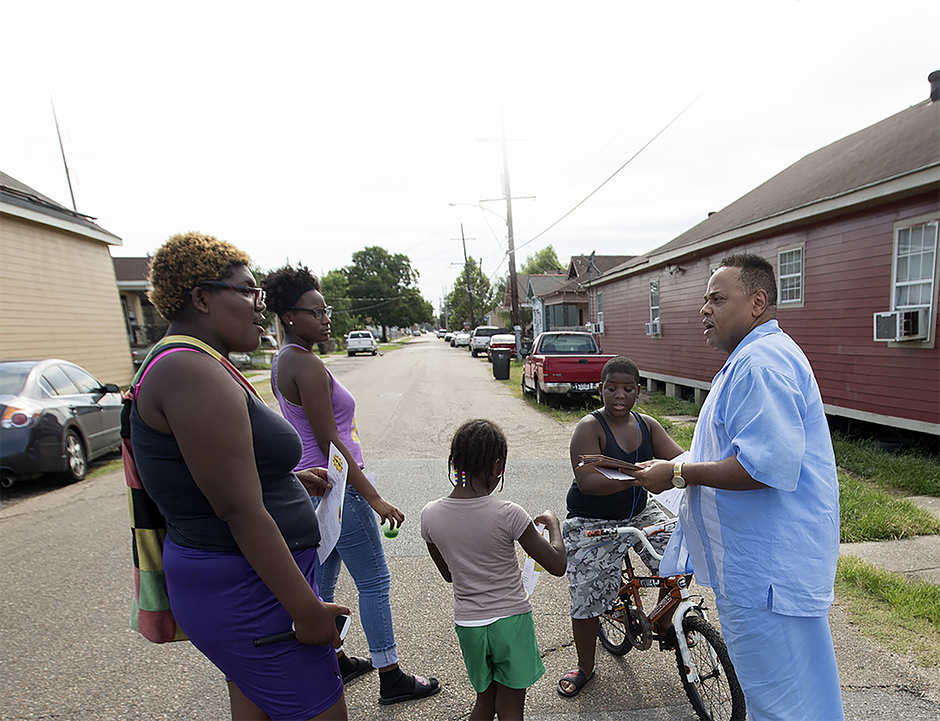
The Rev. Hadley Edwards (right) hands out fliers in New Orleans’ 7th Ward to tell people about “The Spirit Church,” a new United Methodist ministry he is starting there.
Mike DuBose/UMNS
The Rev. Hadley Edwards (right) hands out fliers in New Orleans’ 7th Ward to tell people about “The Spirit Church,” a new United Methodist ministry he is starting there.
Mike DuBose/UMNS
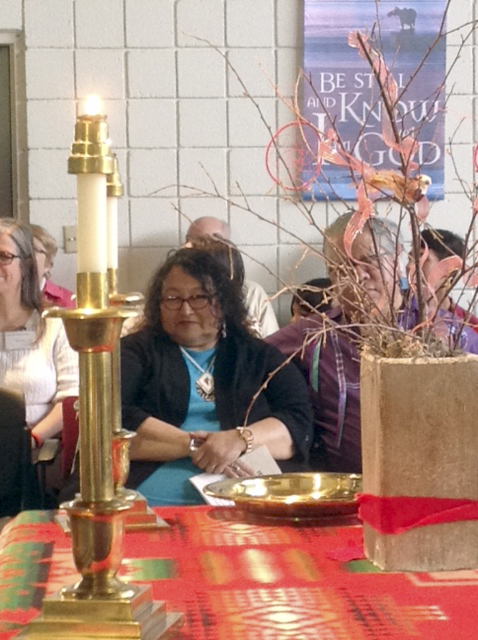
Members of several tribes are worshipping together at a new Native American United Methodist Fellowship in Oklahoma City.
COURTESY DAVID WILSON
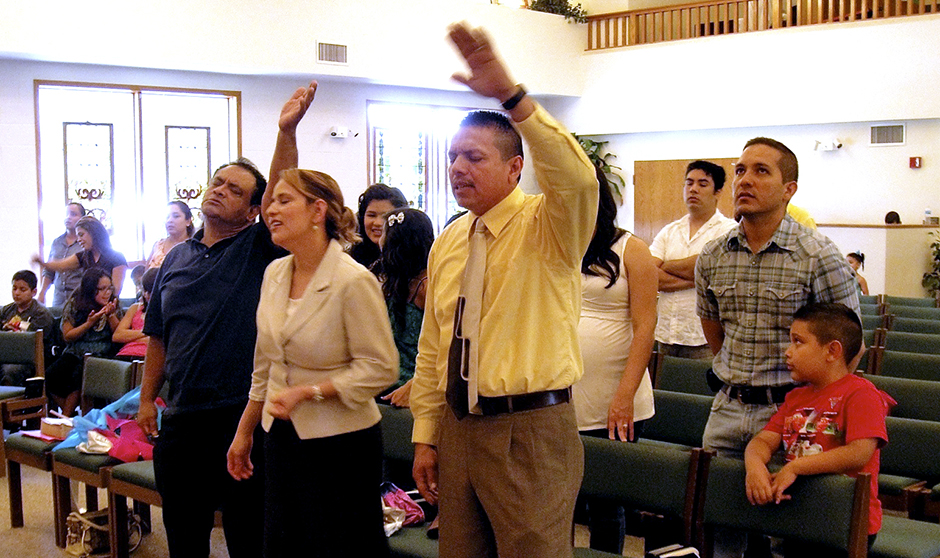
Lay missioner Ruben Rivera (hand raised in worship) prays with his wife, Julissa, at the La Luz de Cristo at a 2012 service at Epworth United Methodist Church in Elgin, Illinois.
J. Martin Lee/UMNS
Lay missioner Ruben Rivera (hand raised in worship) prays with his wife, Julissa, at the La Luz de Cristo at a 2012 service at Epworth United Methodist Church in Elgin, Illinois.
J. Martin Lee/UMNS
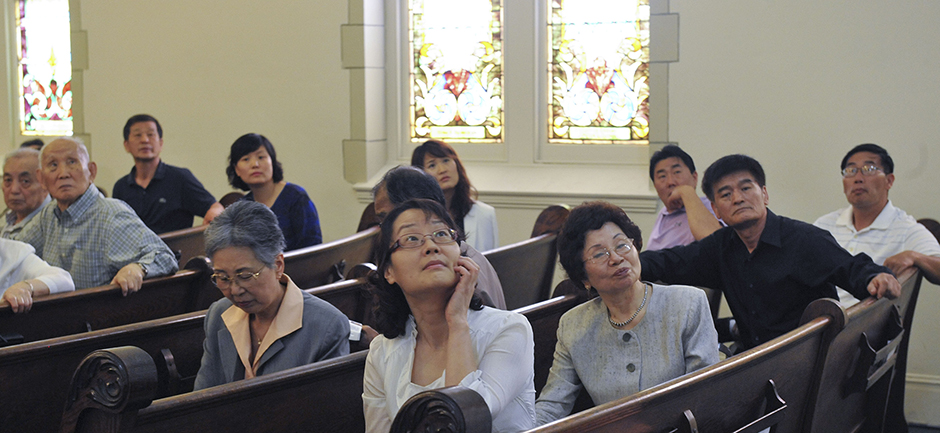
Worshippers watch a brief Korean-language video on Nepal at Eden Korean Memorial United Methodist Church in Baltimore. The congregation collected more than $2,000 last spring for people affected by rioting in Baltimore and earthquakes in Nepal.
Jay Mallin/UMNS
Worshippers watch a brief Korean-language video on Nepal at Eden Korean Memorial United Methodist Church in Baltimore. The congregation collected more than $2,000 last spring for people affected by rioting in Baltimore and earthquakes in Nepal.
Jay Mallin/UMNS
Evangelism.
The word often brings to mind a fiery preacher, shouting from the pulpit, inciting a large crowd of people to “turn or burn.”
But that’s mostly Hollywood.
For real people, evangelism is more about doing the work of Jesus and finding a way to bring unbelievers alongside believers to discover and embrace the faith that gives their lives meaning and purpose.
How this is done can vary from culture to culture. What seems to be true cross-culturally, however, is it all begins with relationships.
The adage, “People don’t care how much you know until they know how much you care,” holds true. Once someone loves and trusts you, they are more likely to love and trust your Jesus.
The Rev. Heather Heinzman Lear, director of evangelism ministries for United Methodist Discipleship Ministries, said, “Evangelism is the good news of God’s saving love, not membership recruitment.”
The churches that do evangelism most effectively have people who enter into dialogue with their neighbors. Needs determine the best evangelistic work for any culture.
At one church where Lear served, members saw the need for English-as-a-Second-Language classes for new immigrants in a nearby apartment complex.
As the church talked with the immigrants and learned more about them, however, members realized the people had come from an agrarian society and greatly missed growing their own food.
“They wanted to get their hands dirty,” she said. “We gave them a plot of land on the church property and let them plant a garden and grow their own produce.”
From that, church families adopted immigrant families and discovered even more needs. Families formed relationships. People were brought to Christ.
One-on-one relationship building
“Evangelism is how we bring Jesus Christ to the people,” said the Rev. David Kim, director of Korean, Asian and Pacific Islander ministries for Discipleship Ministries. “It’s a way to connect people and bring hope and salvation.”
Kim said the majority of Asian people feel most comfortable with those who share a cultural history and common language, but added, “That is probably true of everyone.”
Kim said the most effective evangelism in the Korean, Hmong, Taiwanese and other Asian churches he sees is one-on-one relationship building.
“Often, Asians are involved in the same businesses,” he said. “This is a good way to form relationships with people, help them out [and] get to know each other. We do good evangelism through a marketplace ministry.”
Asian churches are likely to offer language classes, open to anyone who wants to come.
“These language classes may be English classes, or they might be the mother tongue,” he said. “We do much bilingual teaching. This is a good way to connect with people.”
Asian churches are often small congregations, he said, that gather jointly for special events like vacation Bible school or a community project. Celebrating the different cultures together is important.
Many cultural heritages
Ministry in the Native American community has unique challenges because each tribe has its own cultural heritage. Even so, church starts are primarily intertribal, according to the Rev. David Wilson, conference superintendent and director of connectional ministries for the Oklahoma Indian Missionary Conference.
“Even now, one of our biggest challenges is correcting what missionaries taught many years ago: you have to do away with your tribal culture to become Christian,” he said. “That isn’t true.”
Wilson said community, relationships and hospitality are the three critical elements in any type of evangelism with Native Americans. All ministry is based around those three elements.
“Most evangelism happens as people go along,” he said. “It happens individual to individual. One reason that is the case is because our communities are small.”
Revivals, especially during Easter week, are important outreach and evangelism strategy for Native Americans. Members enjoy meeting together and singing intertribally.
“When the various tribes host their powwows, a local church is invited to have a Sunday morning service at the event,” Wilson said. “This is good visibility for the church because the powwows are big and important events. The Choctaw powwow alone will have about 100,000 people attending.”
Wilson said many people are trained for ministry in the Native American sphere, but they can get discouraged because they never see the large numbers of new churches or new members other groups post.
“We can’t grow big,” Wilson said. “We just don’t have the large population that other ethnic groups and majority groups have. But our task is to reach the Indian people for Christ, so that is what we do.”
Follow Jesus’ example
The Rev. Samuel Rodriguez, director of Hispanic/Latino and Multiethnic New Church Starts for Discipleship Ministries, suggested anyone wanting to do evangelism in the Hispanic culture would do well to follow Jesus’ example when he talked to the woman at the well.
“He started by asking for a cup of water; then he listened to her for the first half of the passage,” Rodriguez said. “That’s the beginning – being willing to listen. As you hear people’s stories, you can make your own story relevant to them. From there, you earn the opportunity to tell how your life has been made different because of Christ.”
Many Hispanics who immigrate to the United States come from at least a nominally Catholic background. Rodriguez cited a Pew Foundation study that said many first-generation Hispanics in the U.S. find the freedom to discover their own faith and an intimate relationship with Christ.
“For many, being in a relationship with a friend in Christ is so different from anything they have known before,” he said. “Friendships and relationships are important. Hispanics are much more relationship oriented than task oriented. Think about Mary and Martha. There is a time to live and a time to work. Just have fellowship with them!”
Many African-American United Methodist churches still have large revivals once or twice a year, according to the Rev. Cheryl Walker, director of African-American ministries for Discipleship Ministries.
“Oh, yes; we still have revivals,” she said. “That’s a big part of our worship culture and always has been. These large-scale events are important.”
‘Stories connect us’
The personal touch and the relationship building are still crucial, however.
“If you are a visitor to one of our churches, you will hear a great sermon, but if no one speaks to you, you aren’t going to feel welcome,” she said. “There has to be a one-on-one connection, even in a large event.”
Storytelling, an important part of the African-American culture, is still widely used in churches, Walker said. Connecting the past to the present is meaningful.
The Wesleyan tradition of sharing and inviting people to experience the good news of Jesus Christ meshes well with the storytelling tradition. “Telling our stories is a gateway to evangelism,” she said. “Stories connect us.”
“All evangelism is about relationship in ministry,” she added. “As we look at the decline of denominations, we see the loss of the notion of relationships. You can never substitute a personal relationship.”
Another door to evangelism in African-American churches is the focus on holidays and back-to-school time.
“These are ways we reach out into the community,” she said. “Backpacks and shots! Getting kids ready to go to school is very important in our communities.”
Door-to-door evangelism, inviting people to church, is still an important activity.
“Going door-to-door gives you a great picture of your community,” she said. “You see who lives around you. You listen to their stories. You find out their needs. You let them know you are there for them.
“You have to come outside your walls,” she said. “You can no longer assume the people in your area are just like you. You have to change with the community and accept it. Churches who refuse to change are the ones in decline.”
Every community has specific needs. Many of United Methodism’s ethnic churches are at the forefront of meeting them. The bottom line for ministry is knowing those needs.
“Don’t make assumptions about what people need,” Lear said. “Ask people what the things are that keep them up at night. Then, as you learn the stories, develop a plan to meet these needs. What you have can make a difference.”
Polly House is a freelance writer and editor based in Nashville, Tennessee.