

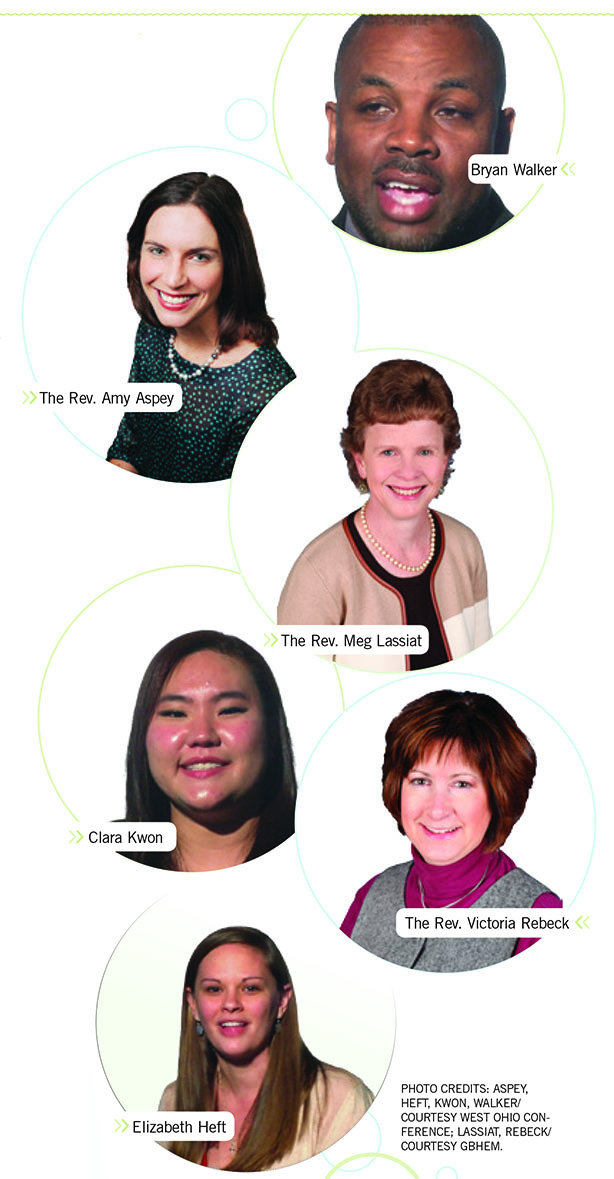
“The thing I liked about discerning in a small-group community,” says Elizabeth Heft, “is that each of us had different angles that we thought about things from. To be able to hear everyone else’s story and to hear how God had been working in their lives was really neat.” A certified candidate for ordained ministry, today she is a missions specialist at Ginghamsburg United Methodist Church, Tipp City, Ohio.
Group mentoring for candidates exploring United Methodist ordained and licensed ministry is increasing in annual conferences in the United States. Most participants give the opportunity an A-plus.
Residency in ministry and similar programs also use group mentoring to assist provisional deacons and elders to continue to discern their call and learn from each other. In addition, provisional clergy members also have to present a project that demonstrates their effectiveness in carrying out the church’s mission “to make disciples of Jesus Christ for the transformation of the world.”
Peers in the candidacy and provisional membership stages of the process toward ordination and licensing reflect together, experience discernment in community and the United Methodist connection, network and begin building what can be lifetime relationships with people with whom they may share ministry.
Experiencing community
“We live out our call in community,” explains the Rev. Amy Aspey, director of clergy professional development for the West Ohio Conference.
“Mentoring groups provide an intentional, formational community that reinforces the expectation that we are together on the journey. We also experience diversity — of ages, ideas, perspectives and experiences — which enriches the journey. We have prayerful companions to pray with us and for us. This is invaluable.”
The Rev. Meg Lassiat is director of candidacy, mentoring and conference relations for the General Board of Higher Education and Ministry. She says candidacy mentoring first helps those responding to discern whether God is calling them to licensed or ordained ministry. They also get help applying for certified candidacy and annual conferences gain a structure to guide candidates beginning the process.
Heft recently participated in mentoring for prospective ministerial candidates in West Ohio. Eighty-nine candidates and 36 mentors were part of summits filled with worship and learning. During the two large events and at least three times in between, small groups of four to six candidates and two clergy met to reflect and explore the question: Is God calling me to licensed or ordained ministry?
Group mentoring, Aspey says, “provides the framework for exploring a ‘God-call’ to credentialed ministry.” At the end, “our hope is that candidates have increased clarity about their God-call, a life-giving experience in community and a greater appreciation for the gift of the United Methodist connection.”
Clara Kwon learned “that God has been calling me to something bigger than I ever expected. When I first received the calling, I never knew that (it) could be so wide and that there would be so many possibilities.” The certified candidate attends Methodist Theological School in Ohio and directs youth and English-speaking ministries at Korean United Methodist Church, Dayton, Ohio.
Bryan Walker wound up in a candidacy group with someone who seemed his polar opposite.
Now, he says, “we’re the best of friends. We made a brotherhood covenant that we’re going to get through this thing together.” He serves Calvary United Methodist Church, Milford, Ohio.
“It was really the first time,” says the Rev. Christina Miller, “that I’ve been in a roomful of people that I feel have the same heart and passion and desire that I do for serving God.” A local pastor, she works in children, youth and family ministry at Hoffman United Methodist Church, West Milton, Ohio.
Learning best practices
The Louisiana Annual Conference expected 11 candidates as it launched its first mentoring groups in August.
During the candidacy summit, participants completed an orientation to ministry and took psychological assessments, says the Rev. John Edd Harper, coordinator of the conference board of ordained ministry. Small groups in each of the conference’s six districts will meet five times before the second summit in December. The curriculum will take participants through the candidacy guidebook created by the General Board of Higher Education and Ministry, he says.
Harper expects the mentoring to prove positive.
With one-on-one candidacy mentoring, some people took two years to complete the process to prepare for certification, Harper says. “This new model will have it completed in five months.”
For those prospective candidates who are not ready in five months, the group mentors have “agreed to serve one-on-one for five more months to nurture them in their discernment process,” he adds. “I believe we are creating the best of both worlds in our process: group work but (also) one-on-one, if needed.”
He lists some advantages of group mentoring.
“Accountability, sharing of ideas, creating a bond with potential colleagues in ministry that may last a lifetime and networking ... the sharing of best practices with each other and our connectional system.”
Benefiting candidates, conferences
When candidates explore similar discernment issues together, Lassiat says, “They can share stories, joys and concerns with each other; support each other, and learn from other candidates as well as their mentor.”
With fewer mentors required, Lassiat adds, annual conferences can recruit, train and guide “those who truly are gifted and skilled at mentoring.”
Candidacy mentoring and the district committee on ordained ministry interview process are more consistent throughout an annual conference, resulting in “a more effective and consistent system to train and communicate with candidates and establish critical application and interview deadlines.”
Residency extends learning
“Education does not end with seminary,” says the Rev. Victoria Rebeck, director of support for deacon ministry, provisional membership and specialized ministry certification for the Board of Higher Education and Ministry.
The Book of Discipline requires each annual conference to lead a “residency curriculum” for its provisional clergy members. “It can be called residency in ministry, provisional program, new clergy leadership academy, whatever the conference chooses,” adds Rebeck. The board provides resources and guidelines.
“A good provisional/residency in ministry process,” she says, provides “a safe place for new clergy to wrestle with ministry-related questions and experiences. They can discuss the challenges and joys, celebrate successes and learn from experiences that did not go so well.
“The relationship building among clergy that should happen in this process helps protect against loneliness and lone ranger practices of ministry.”
Carrying out the mission
The 2012 General Conference adopted what some refer to as “the fruitfulness project.” It requires provisional elders and deacons to present a project that demonstrates fruitfulness in carrying out the church’s mission of “making disciples of Jesus Christ for the transformation of the world.”
Conferences are still polishing their guidelines. “The first thing conferences’ boards of ordained ministry have to clarify for themselves and their provisional members,” Rebeck says, “is what can qualify as ‘making disciples’ and what is ‘transformation of the world?’”
Some boards, during the ordination interview, simply ask the provisional member to describe the project and ask follow-up questions. The Dakotas Conference requires a written report and evaluations of the project by three people.
“Peninsula-Delaware Conference, on the other hand, developed a project-management manual to help provisional members choose, plan and execute a project and a manual to help (the board) evaluate the provisional clergy member’s written report of the project,” Rebeck says.
The Discipline directive is brief, she adds, allowing conference boards to develop their own guidelines. The Board of Higher Education and Ministry’s Division of Ordained Ministry has also posted guidelines on the board’s website.
Barbara Dunlap-Berg is associate editor of Interpreter and general church content editor at United Methodist Communications, Nashville, Tenn