
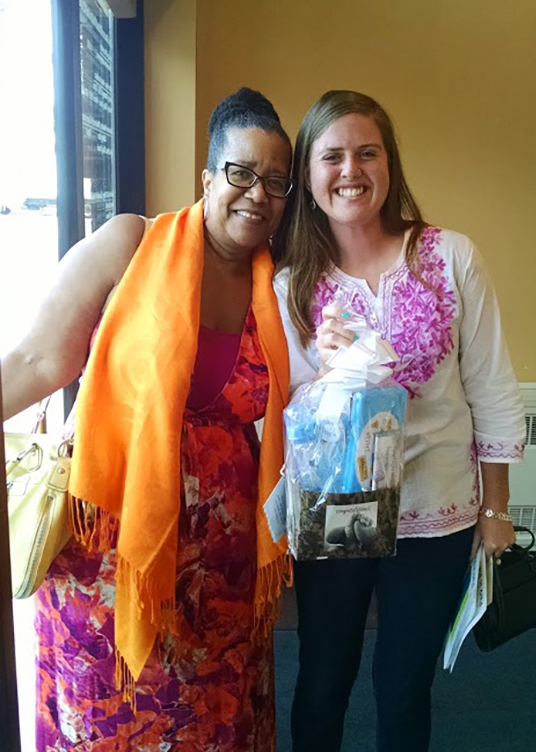
Kari Louwagie (right) experienced providing pastoral care during her ELI project internship.
COURTESY KATIE MATSON DALEY
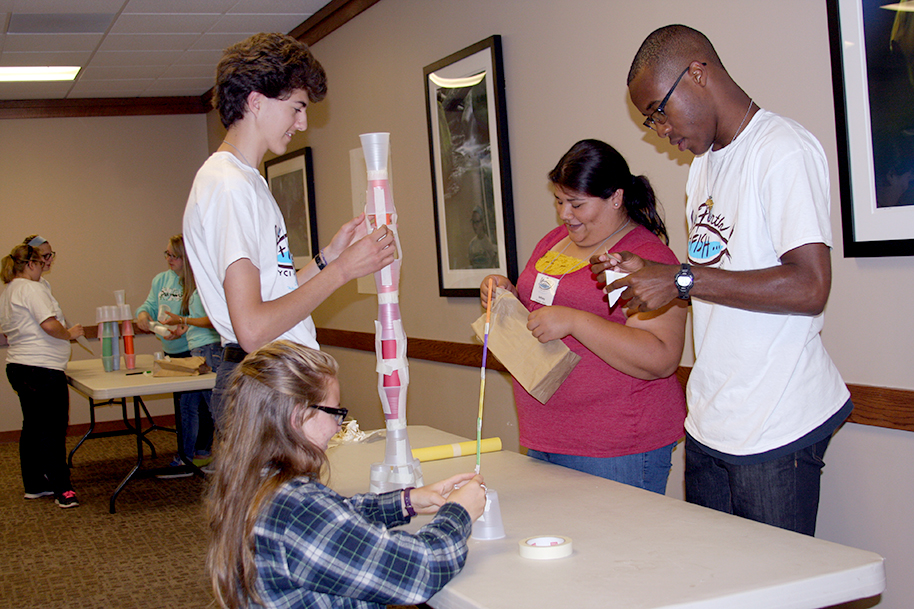
(From left) Allison Walkley, Andrew Post, Bethany Printup-Davis and Weagba Nelson do a team-building activity during a session for participants in the Upper New York Young Clergy Initiative project.
UPPER NEW YORK/KEVIN DUNN
(From left) Allison Walkley, Andrew Post, Bethany Printup-Davis and Weagba Nelson do a team-building activity during a session for participants in the Upper New York Young Clergy Initiative project.
UPPER NEW YORK/KEVIN DUNN
“As a 20-something and a millennial, I think one of the best things the church can do is create chances for young potential clergy to see what ministry looks like up close, to ask questions and to experience it firsthand.”
These are the words of Lorin Leake, who wants to be a college chaplain. Maybe. She has questions and doubts, but, most importantly, she wants to know if vocational ministry is right for her. With trends indicating a potential shortage of clergy to serve local United Methodist congregations by 2032, Leake is who the church is looking for.
General Conference 2012 created the $7 million Young Clergy Initiative (YCI) Fund to “increase the number of young clergy among the jurisdictional conferences” in the United States.
Tasked with administering the fund, the General Board of Higher Education and Ministry assembled an advisory team to determine how best to use the money. The board unanimously approved a plan to disburse the funds to projects of all sizes that could attract young people to ordained ministry in The United Methodist Church.
The fund was to provide seed money that recipients would match in order to develop and implement creative projects.
More than 160 grant requests have come from local churches, districts, campus ministries, annual conferences, nonprofits, seminaries, United Methodist-related colleges, foundations and camps, said selection committee member Kim Ingram. To date, 78 grants totaling $5.5 million have been awarded to projects across the United States.
Minnesota’s ELI Project
Grant recipients include the Minnesota Conference’s Exploring Leadership Internship (ELI) Project for college students interested in vocational ministry. Participants spent the first week in June learning about The United Methodist Church and visiting seminaries. Each then spent the next eight weeks at a host church gaining experience in preaching, leading worship, working with children and youth and providing pastoral care. Each intern also had a clergy mentor.
Leake entered the program with an interest in chaplaincy and social work. “There are countless opportunities to serve The United Methodist Church professionally,” she said. “It can be a daunting task to sift through them all and discover if one fits.”
She values the candid conversations with her mentor. “I could speak very frankly and very directly about my concerns and have my questions answered,” Leake said. “My church site and mentor worked with me to ensure my summer experience was relevant to my call. ... They did a fantastic job.”
One challenge in evaluating the success of YCI is difficulty seeing immediate movement toward increasing the number of young clergy – due to the time it takes to be ordained. The Rev. Trip Lowery, director of Young Adult Ministry Discernment and Enlistment for the board, said measuring attitudes, behaviors and intentions could indicate early success.
After her ELI experience, Leake said, “My call to serve as a chaplain and in social work has been affirmed.” She is now applying to seminaries.
David Hodd entered his internship after a five-year career in fast-food restaurant management. “The wisdom I have been gaining from the people I have met ... has strengthened my call to ministry in ways I would have never imagined,” he said.
Then the newly hired director of youth ministry at Spirit of Hope United Methodist Church, Hodd said in an August Facebook post, “Looking forward to serving the students and their families in this leadership role.”
Lee Miller’s experience at Uptown United Methodist Church in Minneapolis “solidified my desire to be a pastor. I want to be able to share God’s love that I feel so strongly and help others see that God is still relevant. I can’t imagine doing anything else.”
Kari Louwagie was an ELI intern at Park Avenue United Methodist Church in Minneapolis. Her experiences included helping with vacation Bible school.
In a story on the ELI website (www.eliprojectmn.com), she reflected on “discovering that it’s amazing what you can learn from the faith of a child simply by asking a question and listening.”
Her mentor, Katie Matson Daley, minister of children and middle school youth, told her that most young adults who grow up and continue in church had five or more adults within the church that invested in them when they were young. “I would not be where I am today if it weren’t for the people in my home congregation who loved, supported and cared for me when I was young,” Louwagie said.
Upper New York uses group approach
The Upper New York Camp and Retreat Ministries Young Clergy Initiative project included 12 participants ages 17 to 26. The 16-month program included team-building activities and seminary visits and paired participants with mentors and prayer partners. It used social media, conference calls and newsletters to keep participants accountable and connected.
“I’ve met and made connections with young adults with similar passions,” said Weagba Nelson. “Getting to hear their stories and dreams has made me more determined not only to reach my goals but [also] to help them reach theirs. I am now fairly confident that I want to pursue pastoral ministry. Since participating in YCI, I feel God pulling me in that direction.”
Allison Walkley acknowledges the “incredible support network. I think that the people you surround yourself with and the people who support you become a reflection of who you are.” She calls her peers “a wonderful resource in the discernment process because they have been able to see things in me that I couldn’t see in myself.”
For Bethany Printup-Davis, connecting with others was the most important reason for participating. “Our lives’ seasons become interconnected as we grow closer to God and build relationships with one another,” she said.
SPARK focuses on the nontraditional
Higher Education and Ministry also created SPARK to support faith-based projects. “Churches as we understand them are changing, so it’s really exciting to see these kids exploring that call,” said Lowery.
SPARK gives small grants to realistic initiatives that serve God in communities. It connects project leaders with people and organizations that help them develop skills in business modeling, social media and marketing and outreach strategies.
Among them is the Nigeria Peace Initiative, created by the Rev. Ande Emmanuel to foster peace and unity among different religions, denominations and tribes in the northeastern part of Nigeria.
Returning home after graduation from Wesley Theological Seminary, Emmanuel discovered most communities in northern Nigeria broken by either religious or tribal (ethnic) war. He created the peace initiative “to reach out to these warring communities with the message of peace, unity and development and to transform the existing conflict to an enterprise that will benefit the conflicting communities.”
SPARK brought Emmanuel and his group to a five-day training on peace with justice at Wesley. With his team better prepared to strategize, Emmanuel said, “We received new perspectives in conflict resolution and developed an action plan for our work here in Nigeria.”
Meeting people ‘where they are’
Young people today may find their call looks different from that of their predecessors. They may hear God calling them to serve their community, counsel or do other ministry outside the typical pastoral vocation. The goal of the Young Clergy Initiative and SPARK is to nurture that discovery process.
“We are getting back some fantastic stories and feedback,” Lowery reported. In some places, he sees changed attitudes and approaches to a lack of youth presence. “We see that the church is changing because the world is changing, and the church needs to change to meet people where they are.”
Tyrus B. Sturgis is senior communications specialist at the General Board of Higher Education and Ministry. Hayley Graham is a freelance writer from Hixson, Tennessee.