

Marcie Bigord (right), scholarship program manager at the General Board of Higher Education and Ministry, visits with a participant at Youth 2015 in Orlando, Florida, in June.
GBHEM PHOTO
Marcie Bigord (right), scholarship program manager at the General Board of Higher Education and Ministry, visits with a participant at Youth 2015 in Orlando, Florida, in June.
GBHEM PHOTO
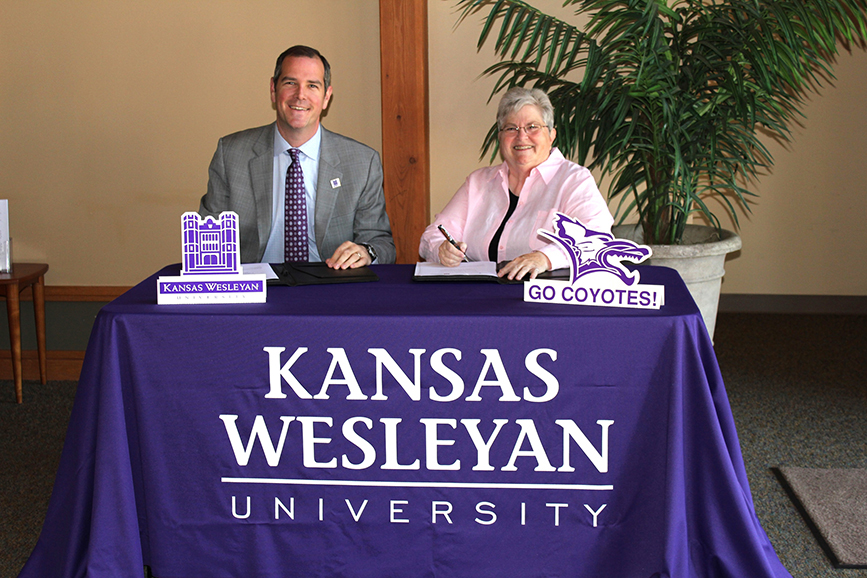
Kansas Wesleyan University President Matt Thompson and the Rev. H. Sharon Howell, president of Saint Paul School of Theology, Kansas City, Kansas, recently signed a Memorandum of Understanding for a 3+3 theological studies program. It allows students to save both money and time as they prepare for ordination and entry into the ministry in six years instead of seven. Under the arrangement, students at the university in Salina, Kansas, will condense the four-year course of study for the Christian ministry major into three years, followed by completion of the three-year Master of Divinity degree at the seminary. They earn both bachelor’s and Master of Divinity degrees. United Methodist-related Morningside College in Iowa and Garrett-Evangelical Theological Seminary in Chicago have a similar agreement.
KANSAS WESLEYAN UNIVERSITY
Kansas Wesleyan University President Matt Thompson and the Rev. H. Sharon Howell, president of Saint Paul School of Theology, Kansas City, Kansas, recently signed a Memorandum of Understanding for a 3+3 theological studies program. It allows students to save both money and time as they prepare for ordination and entry into the ministry in six years instead of seven. Under the arrangement, students at the university in Salina, Kansas, will condense the four-year course of study for the Christian ministry major into three years, followed by completion of the three-year Master of Divinity degree at the seminary. They earn both bachelor’s and Master of Divinity degrees. United Methodist-related Morningside College in Iowa and Garrett-Evangelical Theological Seminary in Chicago have a similar agreement.
KANSAS WESLEYAN UNIVERSITY
Receiving a college acceptance letter is wonderful. Earning a degree from that college or university is even better. Paying for higher education is something entirely different.
According to CNN, more than 40 million people in the United States have some college debt. Research shows that clergy and candidates for ordination younger than age 35 commonly identify finances and debt as barriers to ordination and other professional goals in ministry.
The General Board of Higher Education and Ministry is working to address student debt concerns. A 2012 General Conference mandate created a Seminary Indebtedness Task Force to reduce and eliminate United Methodist clergy debt.
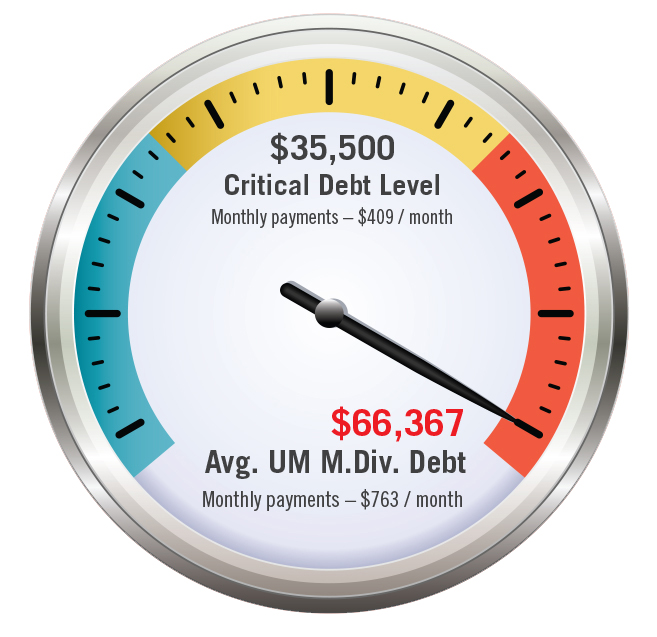
Initial findings from task force research revealed that nearly three out of four United Methodist Master of Divinity graduates in the 2013-14 academic year borrowed money to finance their education. The total average debt for these students was around $66,000; yet, based on the median clergy salary of $49,742, their total school debt should not exceed $35,500.
While the critical issues that students and graduates face are clear, the resources and knowledge available to help consolidate and even prevent debt is not always as obvious. Higher Education and Ministry is working to share the research and facts behind the rising debt issues, while bringing resources and solutions to light.
Critical conversations
Higher Education and Ministry staff are facilitating conversations with denominational constituents who can assist those God calls into ordained and licensed ministry. Because of these ongoing talks with institutions and foundations, grants are now available to support United Methodist-related schools and students.
In 2013 and 2014, Lilly Endowment Inc. awarded seven United Methodist theological schools grants of up to $250,000 each as part of the “Theological School Initiative to Address Economic Issues Facing Future Ministers.” Recipients included Boston University School of Theology, Candler School of Theology (Emory University), Duke Divinity School, Iliff School of Theology, Perkins School of Theology (Southern Methodist University), United Theological Seminary and Wesley Theological Seminary.
Allyson Collinsworth, executive director of loans and scholarships at Higher Education and Ministry, recognizes that support needs to be set in place, so new students may benefit from grants and scholarship programs before their financial debt becomes a serious burden.
“In August 2015,” she said, “the General Board of Pension and Health Benefits, in partnership with Higher Education and Ministry and the Texas Methodist Foundation, submitted a collaborative implementation grant to the Lilly Endowment Inc. If approved, this grant, totaling $1 million, will help the church improve financial literacy of pastoral leaders and their overall financial well-being.”
Making a difference
Every grant and scholarship offered ultimately makes a personal impact on a student’s life.
Younghwan Won, a student at Garrett-Evangelical Theological Seminary, struggled with the financial burden that accompanied her education. She prayed for answers to the practical matters of life and education, and found support through the Higher Education and Ministry student loan program. She received assistance with her tuition, making it more affordable for her to continue her journey at the seminary.
“God gave me practical help,” reflected Won. “Through this help, I am still learning and growing my spirituality, academic ability and the practice. I would like to be a tunnel through which others can experience the help of God.”
Ashley Will, a student at Candler School of Theology, is a recipient of the Gift of Hope Scholarship. Asked about the benefit she has received from this scholarship, Will said, “Without this scholarship and the chance to receive a master’s in divinity, I do not know how I would be able to fully live into God’s call on my life for ministry. I am so grateful for the support, not only financially, but also the gift of affirmation from Higher Education and Ministry.”
Tips for students
Educational assistance is available at all levels of The United Methodist Church for candidates in ministry. In fact, assistance is available to all members of The United Methodist Church who are pursuing vocations outside of seminary or ordination, and attending any accredited institution of higher education. Students should inquire about opportunities from their local church, theological school, annual conference and the general agencies and foundations of the church.
Higher Education and Ministry provides $5 million each year in loans and scholarships to undergraduate, graduate and some doctoral United Methodist students seeking to fulfill their academic and vocational calling. The Borrow Smart repayment option has a low interest rate of 3.75 percent, well below the federal loan interest rate. The earlier a candidate becomes certified, the more funding options he or she will have available.
Heather Jarvis, a student loan expert, leads efforts to establish and expand student debt-relief programs and to inform borrowers, schools and employers about how to benefit from available debt-relief programs. Jarvis offers these tips to students and graduates:
- Begin by getting a clear inventory of your federal loans using the National Student Loan Data System at nslds.ed.gov.
- Review your free credit report for private student loans at annualcreditreport.com.
- Understand that clergy may qualify for Public Service Loan Forgiveness as long as they spend at least 30 hours a week engaged in activities “unrelated to religious instruction, worship services or any form of proselytizing.”
- Check out AskHeatherJarvis.com for more resources.
Raising awareness of available resources like low interest rate loans, scholarships and grants is the first step in helping students ease the burden of debt. With clear goals, along with help and guidance from Higher Education and Ministry, the seemingly insurmountable challenges surrounding student debt can start to be alleviated, lighting the path for tomorrow’s leaders in the church.
Betty Elrod is digital communications specialist at the General Board of Higher Education and Ministry, Nashville, Tennessee.
Who we are
The United Methodist Student Loan Fund, administered by General Board of Higher Education and Ministry, www.gbhem.org, is the oldest student loan fund in the United States. U.S. Methodists created the fund in 1866 from the Children’s Education Fund. The purpose has always been to assist students in paying for their education with affordable loans.
Church’s investment in scholarships
The General Board of Higher Education and Ministry offers nearly 70 scholarship programs. From 2012 to 2015, 7,622 students received $11.5 million in scholarships:
- 40 percent of scholarships benefit racial/ethnic students
- 25 percent benefit seminarians awarded a total of $4.1 million in scholarships
- 60 percent benefit women
- 3.7 percent benefit international students enrolled in United Methodist-related schools in the United States
- 63 percent benefit students enrolled in United Methodist institutions
Learn more at www.gbhem.org/loans-and-scholarships
Financial management conference for students and clergy
In August 2015, The Academy of Faith and Money, hosted by the General Board of Higher Education and Ministry, organized a four-day money and ministry training event led by Horizons. Tailored for provisional members and young clergy, the event focused on personal and church financial management. This event gave United Methodist clergy the tools to cut through the haze of managing church finances by providing resources to develop a practical, theologically-based plan for the future.