RxLegal
Regulation of Internet Pharmacies: A Continuing Challenge
Michael Gabay, PharmD, JD, BCPS*
RxLegal
Regulation of Internet Pharmacies: A Continuing Challenge
Michael Gabay, PharmD, JD, BCPS*
RxLegal
Regulation of Internet Pharmacies: A Continuing Challenge
Michael Gabay, PharmD, JD, BCPS*
Hosp Pharm 2015;50(8):681–682
2015 © Thomas Land Publishers, Inc.
doi: 10.1310/hpj5008-681
The ability of consumers to obtain prescription medications via the Internet has grown exponentially over the past decade, with the Federal Bureau of Investigation (FBI) estimating that there are more than 80,000 “portal” Web sites that allow individuals to place medication orders through illegal pharmacies.1 Consumers choose to utilize online pharmacies over traditional “brick-and-mortar” pharmacies for a variety of reasons, including accessibility, time constraints, and potential cost savings.2 Indeed, there are reputable online pharmacies (eg, walgreens.com, cvs.com, healthwarehouse.com) that are widely available, provide access to a pharmacy professional if needed, and adhere to both the laws and regulations of the country in which the Web site operates and the destination country.2,3 However, the number of reputable online pharmacies is dwarfed by those that operate illegally.
In June 2013, the US Food and Drug Administration (FDA) shut down 1,677 Web sites for selling counterfeit or substandard medications or for selling medications to consumers without appropriate safeguards.4 In addition to dispensing counterfeit, unapproved, misbranded, or adulterated medications, many illegal online pharmacies dispense prescription-only medications without a valid prescription or fill prescriptions generated by “cyberdoctors” who obtain patient information solely from a questionnaire.2 Obviously, these practices can have a potentially negative impact on the health of the consumer.
Although national and international regulations and laws exist regarding online pharmacies, effective regulatory oversight and enforcement is often difficult, if not impossible, to achieve.3 Until an international legal framework is constructed and agreed upon, illegal pharmacies will continue to expand and inappropriately dispense medications to consumers. Therefore, pharmacists need to be aware of indicators that an online pharmacy Web site is unsafe in order to counsel patients. Unsafe sites5:
- Do not provide contact information including a phone number.
- Offer prices for medications that are dramatically lower than competitors.
- Offer to dispense prescription-only medications without a valid order from a licensed prescriber.
- Deliver medications that are of unknown quality or origin or dispense an incorrect medication for the patient’s illness.
- Do not protect the personal health information of the patient.
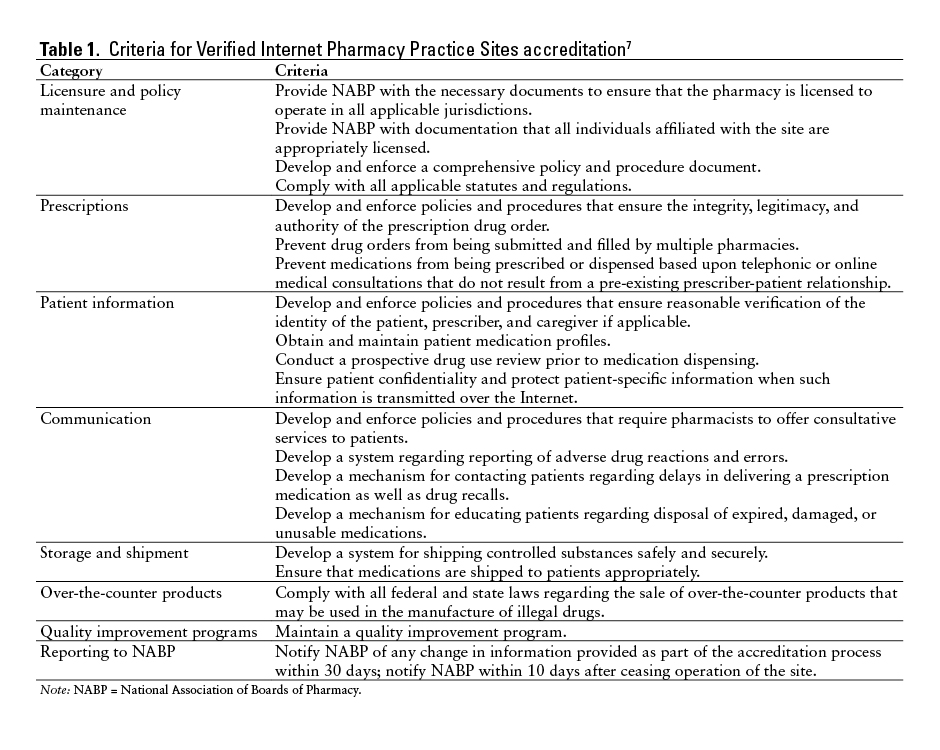
Conversely, a trustworthy online pharmacy site requires a valid prescription from a licensed health care professional prior to dispensing, contains appropriate contact information for the site, provides access to a licensed pharmacist, and is licensed by the state board of pharmacy where the Web site is located.5 In addition, a trustworthy site can be identified by the appearance of the National Association of Boards of Pharmacy’s (NABP) Verified Internet Pharmacy Practice Sites or VIPPS seal. To receive the VIPPS seal, a pharmacy must satisfy the requirements of the VIPPS program standards and criteria, which are available through the NABP site. The criteria may be broken up into various categories and are summarized in Table 1. A list of current online pharmacies that have received the VIPPS seal of approval is available at: http://www.nabp.net/programs/accreditation/vipps/find-a-vipps-online-pharmacy.6
Online pharmacies continue to grow in number, and many sites operate illegally or inappropriately through distributing counterfeit or substandard medications, dispensing medications without a valid prescription, or filling prescriptions from “cyberdoctors” who do not have a legitimate relationship with the patient. Although several laws exist to regulate online pharmacies, oversight and enforcement are poor. Pharmacists should be aware of the far-reaching nature of this problem and direct patients to legitimate online pharmacies that have the NABP VIPPS seal of approval in order to promote ordering of safe medications through the Internet.
REFERENCES
- The Federal Bureau of Investigation. Don’t put your health in the hands of crooks. March 2009. https://www.fbi.gov/news/stories/2009/march/pharmacy_030309. Accessed June 11, 2015.
- Fung CH, Woo HE, Asch SM. Controversies and legal issues of prescribing and dispensing medications using the Internet. Mayo Clin Proc. 2009;79(2):188-194.
- Fittler A, Bosze G, Botz L. Evaluating aspects of online medication safety in long-term follow-up of 136 Internet pharmacies: Illegal rogue online pharmacies flourish and are long-lived. J Med Internet Res. 2013;15(9):e199.
- Hellerman C. FDA shuts down 1677 online pharmacies. http://www.cnn.com/2013/06/27/health/online-pharmacies-closed/. Accessed June 11, 2015.
- FDA Consumer Health Information. The possible dangers of buying medicines over the Internet. http://www.fda.gov/downloads/ForConsumers/ConsumerUpdates/UCM204943.pdf. Accessed June 11, 2015.
- National Association of Boards of Pharmacy. Find a VIPPS online pharmacy. http://www.nabp.net/programs/accreditation/vipps/find-a-vipps-online-pharmacy. Accessed June 11, 2015.
- National Association of Boards of Pharmacy. VIPPS criteria. http://www.nabp.net/programs/accreditation/vipps/vipps-criteria. Accessed June 11, 2015.

*Director, Drug Information Group and Prior Authorization Services, Clinical Associate Professor, Department of Pharmacy Practice, University of Illinois at Chicago College of Pharmacy, Chicago, Illinois