Director's Forum
Social Media As a Leadership Tool for Pharmacists
Blake Toney, PharmD*; Debra A. Goff, PharmD, FCCP*,†; and Robert J. Weber, PharmD, MS, BCPS, FASHP*,†
Director's Forum
Social Media As a Leadership Tool for Pharmacists
Blake Toney, PharmD*; Debra A. Goff, PharmD, FCCP*,†; and Robert J. Weber, PharmD, MS, BCPS, FASHP*,†
Director's Forum
Social Media As a Leadership Tool for Pharmacists
Blake Toney, PharmD*; Debra A. Goff, PharmD, FCCP*,†; and Robert J. Weber, PharmD, MS, BCPS, FASHP*,†
The profession of pharmacy is currently experiencing transformational change in health system practice models with pharmacists’ provider status. Gaining buy-in and support of stakeholders in medicine, nursing, and other advocates for patient care is critical. To this end, building momentum to advance the profession will require experimentation with and utilization of more efficient ways to disseminate relevant information. Traditional methods to communicate can be inefficient and painstakingly slow. Health care providers are turning to social media to network, connect, engage, educate, and learn. Pharmacy leaders can use social media as an additional tool in the leadership toolkit. This article of the Director’s Forum shows how social media can assist pharmacy leaders in further developing patient-centered pharmacy services.
The profession of pharmacy is currently experiencing transformational change in health system practice models with pharmacists’ provider status. Gaining buy-in and support of stakeholders in medicine, nursing, and other advocates for patient care is critical. To this end, building momentum to advance the profession will require experimentation with and utilization of more efficient ways to disseminate relevant information. Traditional methods to communicate can be inefficient and painstakingly slow. Health care providers are turning to social media to network, connect, engage, educate, and learn. Pharmacy leaders can use social media as an additional tool in the leadership toolkit. This article of the Director’s Forum shows how social media can assist pharmacy leaders in further developing patient-centered pharmacy services.
The profession of pharmacy is currently experiencing transformational change in health system practice models with pharmacists’ provider status. Gaining buy-in and support of stakeholders in medicine, nursing, and other advocates for patient care is critical. To this end, building momentum to advance the profession will require experimentation with and utilization of more efficient ways to disseminate relevant information. Traditional methods to communicate can be inefficient and painstakingly slow. Health care providers are turning to social media to network, connect, engage, educate, and learn. Pharmacy leaders can use social media as an additional tool in the leadership toolkit. This article of the Director’s Forum shows how social media can assist pharmacy leaders in further developing patient-centered pharmacy services.
Hosp Pharm 2015;50(7):644–648
2015 © Thomas Land Publishers, Inc.
doi: 10.1310/hpj5007-644
Health care providers (HCPs), hospital health systems, professional organizations, and patients are using social media to connect, educate, and engage. In his article, “Leading Change: Why Transformation Efforts Fail,” John Kotter, of the Harvard Business School, describes the importance of “communicating the vision” in leading an organization.1 Due to social media’s ability to reach a wide audience, pharmacy leaders can use it to effectively communicate their leadership vision. Gaining buy-in and support for the vision of pharmacy practice from stakeholders in medicine, nursing, and others is critical. Traditional methods to communicate this vision can be painstakingly slow, but social media increases the speed in which HCPs communicate with each other. Understandably, HCPs are often hesitant to engage in social media due to a lack of understanding or fear it could be detrimental to themselves, their institution, or the profession. A recent study that surveyed physicians found that 66% were hesitant to immerse themselves in social media due to worries about public access and legal concerns.2
The goal of this article is to show how pharmacy leaders can use social media to connect and communicate in a professional context. In particular, we discuss Twitter, LinkedIn, blogs, and Facebook, which we believe are the most useful of the social media tools in advancing the pharmacy profession.
SOCIAL MEDIA OVERVIEW
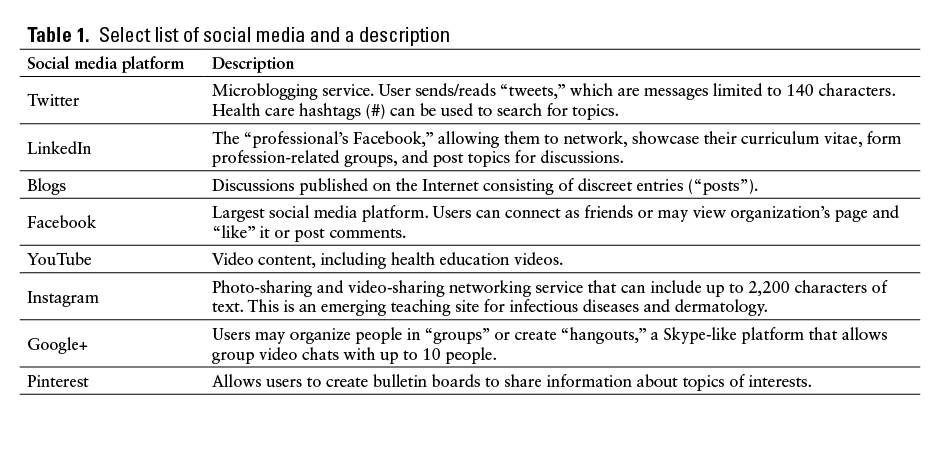
Select examples of social networking tools include Facebook, Twitter, blogs, LinkedIn, Pinterest, Instagram, YouTube, and Google+. Each tool offers a different way to communicate and network. Social networking sites are growing at a rapid pace. Facebook, founded in 2004, has more than 1.28 billion active monthly users.3 Twitter, a form of mini- blogging launched in 2006, has more than 302 million active monthly users sending over 500 million tweets each day. Each form of social networking offers a unique service. Table 1 lists select social networking sites and describes their features.
This relatively young market of social media tools means that older pharmacists, many of whom hold leadership positions, may not have experience or expertise using them. In order to bring transformational change to the pharmacy profession, pharmacy thought leaders need to familiarize themselves with these tools.
SOCIAL MEDIA AS A LEADERSHIP TOOL
Twitter is a micro-blogging social networking service that enables users to send and read short 140-character messages called “tweets.” It is estimated that over 75,000 doctors, nurses, pharmacists, and health care consultants use Twitter around the world, 31% of whom are American. This activity accounts for roughly 152,000 tweets per day and a cumulative 208 million tweets from Twitter’s launch in 2006.4
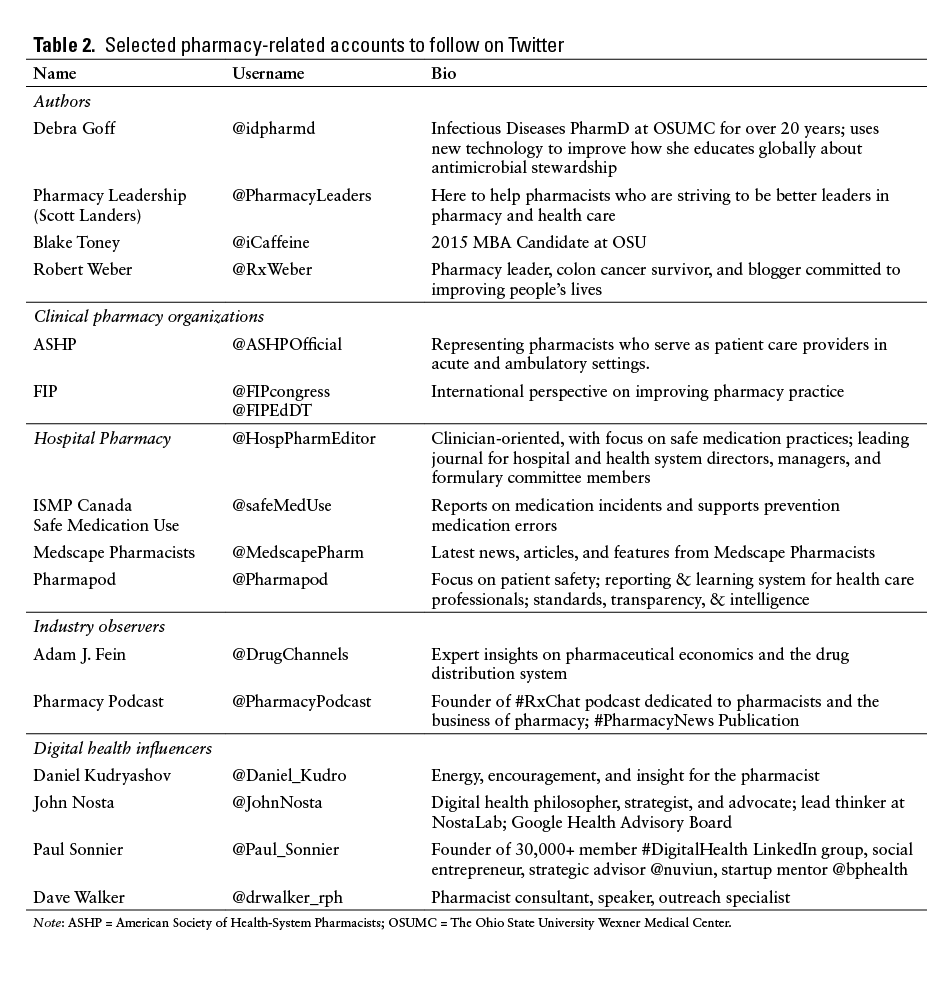
Pharmacists can utilize Twitter to educate, engage, advocate, collaborate, and network. Twitter is, in a word, flexible. The value of Twitter lies in its ability to disseminate information quickly and globally to a large number of people. This was demonstrated during the 2014 Ebola epidemic, which sparked over 10 million tweets from 170 countries in 3 weeks.5 Twitter users can be “active,” meaning they tweet and engage with others on Twitter, or “passive,” meaning they observe and read tweets but they do not post their own tweets. Topics of interest on Twitter can be identified by typing in a hashtag (#) followed by a key word (#pharmacist). A list of some reputable people and organizations in the pharmacy profession or health field to follow on Twitter are listed in Table 2.
A recent article entitled “Review of Twitter for Infectious Diseases: Useful of a Waste of Time?” describes how to get started on Twitter and lists potential pitfalls.6 These authors describe 4 ways in which HCPs can use Twitter. Networking with other HCPs and connecting to journals and organizations through Twitter widens your contacts to include worldwide experts and allows sharing of links to articles, photos, and videos. Pharmacy directors and other department leaders can use Twitter to provide links to their department of pharmacy Web site, blogs, or newsletters. One of the authors (D.G.) of this article uses Twitter to network with HCPs on the topic of antimicrobial stewardship. She has followers in over 31 countries.
Tweets from medical conferences disseminate information in real-time and increase the “reach” of the information. Tweets from conferences will reach members who are not able to attend. Re-tweeting messages multiplies the impact of scholarship. The American Society of Health-System Pharmacists (ASHP) studied Twitter use by attendees of the 2013 ASHP Midyear meeting.7 More than 400 Twitter accounts from 7 different countries using #ashpmidyear tweeted 1,539 tweets creating 33,116 impressions. Symplur (www.symplur.com), a Web site that provides archiving and analysis of tweets with a hashtag, can generate a transcript of every tweet from a conference to generate future discussions. Pharmacy thought leaders should encourage national pharmacy conference organizers to engage in social media.
Twitter journal clubs led by key opinion leaders or the authors of the articles provide a unique platform for engagement and learning among HCPs worldwide. Surgeons have collaborated with the JAMA Surgery journal to implement an international general surgery Twitter journal club (#IGSC). A free pdf of the selected article is released to Twitter
followers 1 month prior to the Twitter journal club. The lead author is invited to participate with the journal Twitter organizers. All tweets from the live Twitter journal club are indexed using the journal club hashtag (#IGSC), and they are saved and archived to their blog and PubMed. Rather than the usual
20 to 30 attendees at a hospital pharmacy journal club, a Twitter journal club may have hundreds of global participants. This concept could be implemented with any medical journal to increase the reach of its articles and to engage the author “live” with interested readers.
Hospital Pharmacy started its journal club in December 2014. Its goal is to “promote meaningful
literature evaluation experiences, to increase critical appraisal skills, and to encourage professional discussion” regarding recent Hospital Pharmacy articles “among pharmacy clinicians, academicians, managers, preceptors, residents, fellows, and students.” 8(p179) Twitter is used to promote and communicate with its followers about the next journal club selection. Pharmacy leaders, many who are editors or on the editorial boards of pharmacy journals, could explore starting Twitter journal clubs.
Live twitter chats conducted by experts or medical organizations provide the opportunity for HCPs to post questions and share ideas on a particular topic. A predetermined hashtag is used in each tweet to follow the conversation. Twitter chats allow experts to field questions from HCPs, consumers, patients, and policy makers. During the 2014 Ebola outbreak, the Centers for Disease Control and Prevention (CDC) conducted live Twitter chats to provide HCPs and the public with news updates, recommendations, and an opportunity to ask experts questions in real-time. Pharmacy leaders could conduct a Twitter chat on important topics such as credentialing pharmacists as a way to engage colleagues, political advocates, and public opinion on this topic.
Once Twitter is integrated into the users’ daily routine, many find it an indispensable medium of news and networking, customizable to their interests. All major news agencies have a Twitter presence, and there has been recent proliferation of niche news organizations with targeted content. If Twitter is the microphone, then Digital Health is the unifying message lending cohesion and common ground to all HCPs. Nuviun Digital Health is “an umbrella term for all healthcare-related applications, technologies and delivery systems that result from the confluence of medicine, genomics and the technologies that comprise the digital space.”9 One can create a user profile and select from a menu of topics to customize the newsfeed.
It is likely that many more pharmacists in leadership positions are familiar with LinkedIn than Twitter. Until Twitter gains widespread adoption, LinkedIn will be more useful as a networking tool. In the business world, this is referred to as the network effect, wherein a product or service becomes exponentially more valuable as a function of the number of users.
One could readily argue that LinkedIn creates more value for more people simply because more people use it.10,11 LinkedIn has been called the “professional’s Facebook.” Unlike Twitter that restricts tweets to 140 characters, LinkedIn allows users to publish articles of unlimited length. For example, one of the authors (B.T.) published 2 articles on LinkedIn about the marketing strategies surrounding the new hepatitis C drugs. As in Facebook, readers demonstrated their interest by liking or commenting.
Pharmacy leaders can also join LinkedIn groups and actively participate in discussions. They can potentially find a new employee using LinkedIn.
Blogs
A blog is a discussion published on the Internet. More than 12 million people blog via social networks. The most recognized physician blogger, KevinMD (@KevinMD), has 120.3K followers on Twitter. He has multiauthor blogs with guest author contributors that include doctors, pharmacists, nurses, policy experts, and patients. Dave Walker (@drwalker_rph), with 13.5K followers on Twitter, was recognized in 2013 and 2014 in the Top Healthcare Influencer list. As a past pharmacy director, he writes and tweets on various pharmacy-related topics.
A retired surgeon (@skepticscalpel) blogs regularly and uses Twitter to announce a new posting. He compares the value of blogging versus publishing in peer-reviewed medical journals. His blog “Appendicitis: Diagnosis, CT Scans and Reality” has been viewed over 22,000 times and accounts for far more viewers than the total for all his medical publications combined.12 A blog has a very wide audience reach. Pharmacy leaders can use this as an effective communication tool. One of the author’s (R.J.W.) writes a monthly blog for the department of pharmacy at The Ohio State University Wexner Medical Center (OSUWMC). The blog is viewed by employees on the department’s Web page. Recently the blog was made available externally. Twitter is used to announce a new posting and provide a link to the blog. This global reach will allow others to learn about OSUWMC’s department of pharmacy and the vision of the director. Guest authors are invited to write a post. A blog is an effective way for a director of pharmacy to communicate ideas to a large department of diverse employees and for pharmacy leaders to extend their reach outside of their current organization. The blog also provides an avenue for staff to write about topics of interest. The process of writing a blog is not as overwhelming as writing a manuscript for a peer-reviewed journal. It is a good way to enhance the writing skills of new pharmacists.
With over 1.28 billion monthly active users, Facebook is the most popular social networking service. Although only 26% of hospitals actively participate in social media, 84% of those hospitals use Facebook.13
The Mayo Clinic embraces social media, including Facebook; it has over 586,597 “likes” on its Facebook page. Facebook can create a great online presence to consumers, and it can also be a great tool for employees. A pharmacy department can create a public page without having to become “friends” with other Facebook users. Department outreach, open positions and recruitment efforts, faculty in the news, employee accomplishments, patient education, and other important news can be shared with a large global audience.
CONCLUSION
Research suggests that consumers and patients are turning to social media to find health care information. HCPs are turning to social media to network, connect, engage, educate, and learn. Pharmacy leaders can use Twitter, blogs, LinkedIn, and Facebook applications to promote the department, recruit qualified staff, and expand patient-centered pharmacy services.
REFERENCES
- Kotter JP. Leading change: Why transformation efforts fail. Harvard Bus Rev. January 2007:2-9.
- Brown J, Ryan C, Harris A. How doctors view and use social media: A national survey. J Med Internet Res. 2014;16(12):e267.
- Ajmera H. Social media 2014 stats. http://blog.digitalinsights.in/social-media-users-2014-stats-numbers/05205287.html. Accessed April 25, 2015.
- MacDonald I. Healthcare professionals flock to Twitter. Fierce Healthcare. April 22, 2014. http://www.fiercehealthcare.com/story/healthcare-professionals-flock-twitter/2014-04-22. Accessed March 7, 2015.
- Luckerson V. Watch how word of Ebola exploded in America. Time. October 7, 2014. http://time.com/3478452/ebola-twitter/. Accessed October 24, 2014.
- Goff DA, Kullar R, Newland JG. Review of Twitter for infectious diseases clinicians: Useful or a waste of time? [published online ahead of print February 4, 2015]. Clin Infect Dis.
- Awad NI, Cocchio C. Use of Twitter at a major national pharmacy conference. Am J Health Syst Pharm. 2015;72(1): 65-69.
- Generali JA. Hospital Pharmacy journal club. Hosp Pharm. 2015;50(3):179.
- Nuviun. http://nuviun.com/digital-health. Accessed March 18, 2015.
- Twitter. https://about.twitter.com/company. Accessed March 20, 2015.
- LinkedIn. https://press.linkedin.com/about-linkedin. Accessed March 20, 2015.
- Scalpel S. Why I blog and tweet [published online ahead of print March 6, 2015]. Can J Anesth.
- Ottenhoff M. Infographic: Rising use of social and mobile in healthcare. The Spark Report. December 17, 2012. http://thesparkreport.com/infographic-social-mobile-healthcare/. Accessed April 17, 2015.

*College of Pharmacy, The Ohio State University, Columbus, Ohio; †Department of Pharmacy, The Ohio State University Wexner Medical Center, Columbus, Ohio