Director's Forum
Applying Leadership Qualities of Great People to Your Department: Sir Winston Churchill
Matthew Gibson, PharmD, BCPS,* and Robert J. Weber, PharmD, MS, BCPS, FASHP†
Director's Forum
Applying Leadership Qualities of Great People to Your Department: Sir Winston Churchill
Matthew Gibson, PharmD, BCPS,* and Robert J. Weber, PharmD, MS, BCPS, FASHP†
Director's Forum
Applying Leadership Qualities of Great People to Your Department: Sir Winston Churchill
Matthew Gibson, PharmD, BCPS,* and Robert J. Weber, PharmD, MS, BCPS, FASHP†
As pharmacy leaders develop health-system pharmacy services, it is important for them to understand successful leadership behaviors and apply them effectively to be successful in managing the challenges of health care. Directors can learn various skills from leaders both in and outside of pharmacy. Learning from these great leaders can provide pharmacy directors with guidance on how to shape various aspects of their leadership style. Winston Churchill is considered to be one of history’s greatest leaders; without his leadership, the outcome of World War II may have been completely different. Leadership qualities that made him successful include the use of clear and simple communication, decisiveness, willingness to take risks and learn from failure, commitment to self-improvement, and the ability to inspire and lead others. This article describes these leadership characteristics displayed by Winston Churchill and discusses ways these qualities can be used effectively by today’s pharmacy leaders in building patient-centered services.
As pharmacy leaders develop health-system pharmacy services, it is important for them to understand successful leadership behaviors and apply them effectively to be successful in managing the challenges of health care. Directors can learn various skills from leaders both in and outside of pharmacy. Learning from these great leaders can provide pharmacy directors with guidance on how to shape various aspects of their leadership style. Winston Churchill is considered to be one of history’s greatest leaders; without his leadership, the outcome of World War II may have been completely different. Leadership qualities that made him successful include the use of clear and simple communication, decisiveness, willingness to take risks and learn from failure, commitment to self-improvement, and the ability to inspire and lead others. This article describes these leadership characteristics displayed by Winston Churchill and discusses ways these qualities can be used effectively by today’s pharmacy leaders in building patient-centered services.
As pharmacy leaders develop health-system pharmacy services, it is important for them to understand successful leadership behaviors and apply them effectively to be successful in managing the challenges of health care. Directors can learn various skills from leaders both in and outside of pharmacy. Learning from these great leaders can provide pharmacy directors with guidance on how to shape various aspects of their leadership style. Winston Churchill is considered to be one of history’s greatest leaders; without his leadership, the outcome of World War II may have been completely different. Leadership qualities that made him successful include the use of clear and simple communication, decisiveness, willingness to take risks and learn from failure, commitment to self-improvement, and the ability to inspire and lead others. This article describes these leadership characteristics displayed by Winston Churchill and discusses ways these qualities can be used effectively by today’s pharmacy leaders in building patient-centered services.
Hosp Pharm 2015;50(1):78–83
2015 © Thomas Land Publishers, Inc.
doi: 10.1310/hpj5001-78
The term leadership has many definitions. Leadership is defined by one set of authors as the art of mobilizing other people to want to struggle for shared aspirations,1 whereas others define leadership as the ability to influence a group toward the achievement of a vision or set of goals.2 Regardless of the definition, several key behaviors are present in all great leaders: effective communication, decisiveness, willingness to take risks, commitment to self-improvement, and the ability to inspire and lead others.
As pharmacy leaders develop patient-centered services, it is important for them to understand leadership behaviors and apply them effectively to manage the future of health care. Learning through the examples of great leaders can provide the pharmacy director with guidance on how to shape their leadership style. Few leaders are more iconic or celebrated than Sir Winston Churchill. Winston Spencer Churchill was born into a privileged English family in 1874. His father, Lord Randolph Churchill, was an English politician and his mother, Jennie Jerome, was an American successor of a rich businessman. Through his mother he gained a love for America and from his father he received the desire for politics and power. Winston Churchill held many positions throughout his career, including war correspondent, politician, soldier, writer, historian, painter, and even bricklayer.3 Winston Churchill is best known for his leadership as the British Prime Minister during World War II and for receiving the 1953 Nobel prize in literature. Pharmacy leaders can learn from Churchill’s leadership style and apply these leadership lessons in advancing their department and enhancing the pharmacy profession.
CHURCHILL’S LEADERSHIP CHARACTERISTICS
Taking Risks and Learning from Failure
Among Sir Winston Churchill’s leadership attributes, perhaps the greatest was his willingness to take risks. This made him unpopular with other politicians of his time who were typically risk-averse because of the fear of taking a career-ending stance on an issue. Churchill had a core belief that taking risks was necessary to achieve greatness. Churchill understood that not all ventures would be successful and that learning from mistakes defines success. He once was quoted as saying, “Success is going from failure to failure without loss of enthusiasm.”4 Churchill had failures throughout his career. During World War I, Churchill was appointed the First Lord of the Admiralty. In 1915 he requested that Britain send naval and ground forces to take control of a strategic strait near the Gallipoli peninsula known as the Dardanelles. British control of the Dardanelles would have given them access to the only waterway between the Mediterranean Sea in the west and the Black Sea in the east. If the British had control over the strait, it would have opened a direct channel to Russia to facilitate moving Russian armies. Churchill was responsible for the operation but did not have the authority to make the decisions that he thought were necessary for a successful mission. Forces attacked the Dardanelles, leading to thousands of Allied casualties and the destruction of valued ships. After the disaster, Churchill recognized his failure; he “was trying to achieve a great enterprise without have the plenary authority which could so easily have carried it to success.”4 Churchill learned from the Dardanelles catastrophe and used that experience when making key decisions during World War II. During World War II, Churchill did not appoint a defense minister so he could have the appropriate authority over strategic maneuvers during the war. Ultimately this unilateral decision making won the war.
Pharmacy leaders can learn 2 lessons from Churchill’s experience with the Dardanelles catastrophe. First, in order to achieve greatness, one must be willing to take risks. Churchill realized the importance of obtaining control of Dardanelles and therefore was willing to risk the potential for failure. Pharmacy leaders should recognize when there are opportunities for improvement within their departments and be willing to take risks if a successful outcome will enhance pharmacy practice and patient care. Projects involving some risks include implementing complicated technology or a drastically different pharmacy practice model, where the staff may not be comfortable with the degree of change necessary to move forward.
The University of Minnesota Medical Center exhibited their willingness to take risks in implementing a change in their pharmacy practice model.5 The leaders realized that there were significant opportunities for increased efficiencies and expansion of clinical services beyond daytime hours. Potential risks of such a large-scale change included resistance from stakeholders within and outside of the department and employee dissatisfaction and lack of engagement. The pharmacy leadership team took the risks to implement the change, and they also reflected on what they learned throughout the process. The leadership team published the lessons they learned in a journal article.5 They highlighted the need to anticipate the politics that can be involved with such a change and the importance of communication with key stakeholders. The authors of the article realized that having a good understanding of the lessons learned during their experience could help them succeed in other changes in the future.
Pharmacy leaders should consistently reflect on the outcomes of their decisions and continue to learn from these decisions. Being prepared with lessons learned from previous decisions will increase their chances of success in the future.
Decisiveness
Churchill was never afraid to make a decision, and he always accepted the consequences of those decisions. He measured success in people by how they managed failure and whether they had the energy to move forward after failure. With this attitude, it is less intimidating to make risky decisions; one can always learn from an experience, regardless of the outcome.
Unlike most politicians of today, Churchill enjoyed making decisions. Churchill understood that most individuals and organizations were resistant to change and that for most it is easier to remain stagnant than it is to make and act on decisions. During World War I, he stated that “there are plenty of good ideas if only they can be backed with power and brought to reality.”4 During World War II, he said, “I never worry about action, but only about inaction.”4 These quotes stress Churchill’s belief about the importance of making decisions and the pitfalls of indecisiveness. According to Steven Hayward, author of Churchill on Leadership,4 Churchill utilized 3 hallmarks for decision making; first, always keep the central aspect of the problem in sight; second, understand how to balance both sides of a decision; third, have the ability to change course if new facts present themselves.
The following case scenario will demonstrate the application of Churchill’s 3 decision-making tenets. Administration at your hospital has just approved a new full-time equivalent (FTE) for next year’s budget. As the Director of Pharmacy, you have the ability to utilize this new position at your discretion. How do you make the best use of this position – one that benefits the department and patients? Following Churchill’s thought process, you keep the central aspect (ie, needs of the department) of the situation in mind. You may determine multiple areas of needs (ie, pharmacist/technician in the emergency department [ED], technician for medication reconciliation, etc) within your department and how the addition of each role would align with the strategic plan of the department and the organization. Next, you analyze the chances of success and failure with each possible position. After this analysis, you decide to hire a new technician in the ED to help with medication reconciliation, because this position will help reduce medication errors. This is 1 of the 5 priorities of the department’s strategic plan. Once the decision is made, you move forward without hesitation. Churchill stressed that decisions, once made, should be left alone, as “you cannot be content to sit as a judge pronouncing on events after they have taken place.”4 Finally, you make yourself aware of any changes within or outside the department that may influence the decision. Only after new information arises is it appropriate to reconsider the decision that was made.
Pharmacy leaders are constantly making decisions on a daily basis. These decisions, no matter how large or small, can affect members within and outside of the pharmacy department and can affect patient care. If pharmacy leaders use Churchill’s strategy for making decisions, they will make sound decisions that keep the problem in sight, have an understanding of the consequences of those decisions, and will not waiver once a decision has been made. These principles will decrease the chances of inertia in decision making.
Clear and Simple Communication
Churchill had the confidence and ability to make educated decisions quickly. Once the decisions were made, he would effectively communicate the result of the decision. Churchill’s speeches are regarded as some of the greatest speeches in history. In spite of this, his ability to speak publicly did not come easily. Churchill had a stutter and a lisp. He was known to put an incredible amount of energy, preparation, and reflection into the language and the delivery of his speeches. Whether communicating to his staff or giving a speech that was broadcast across the world, Churchill utilized 4 communication principles.5
The first principle of effective communication is the correctness of diction or the specific choice and use of words. Churchill believed that the most effective communicators reflect on the use of the best possible word. He preferred using short and simple words and refrained from jargon or polysyllabic words, as he believed these words reduced clarity. The second principle in communication is rhythm. Churchill believed that speaking had a certain cadence. The use of short and simple words allowed for appropriate cadence throughout Churchill’s speeches. Accumulation of argument is Churchill’s third principle of communication and is represented in the majority of his speeches. He used facts to build focus on a single point. Churchill explained that “the end appears in view before it is reached,”4 referring to the foreshadowing that is necessary when accumulating an argument. The last principle for effective communication is analogy. The use of analogies during communication connects the unknown to the known. Churchill realized the difficulty in explaining complex topics, such as war strategies, to the common person. The use of analogies clearly and effectively communicated his points and allowed for those not familiar with the topic to gain an understanding. These principles defined Churchill’s communication style. He was a simple and clear communicator and he was able relate to a broad range of people with various educations and intelligence levels.
Most pharmacy leaders do not have to give speeches on a daily basis, but there are core communication principles demonstrated by Churchill that can be utilized to help lead pharmacy practice within and outside the department. The overall theme of Churchill’s communication style is clarity and
simplicity. Regardless of the forum, whether communicating directly to a pharmacist or technician or to the entire department, it is vital to speak simply and clearly.
Consider how Churchill would have approached a conversation regarding a practice model change with pharmacists and technicians as your audience. Prior to initiating the conversation, Churchill would spend a considerable amount of time and reflection on his dialogue. He would approach the conversation with a series of facts regarding why the department should move in the new direction (eg, accumulate the argument). These facts would lay the groundwork and foreshadow the announcement of the change rather than stating the change in the beginning. During this conversation, he would avoid terminology or jargon that could confuse audience members. It is important to recognize that members within the pharmacy department have contrasting backgrounds and education levels. He would try to use an analogy that would fill any gaps of understanding for those who may not be familiar with the new practice model. His analogy would focus on a current practice that everyone in the audience could relate to.
Pharmacy leaders interact with a diverse group of individuals every day outside the department of pharmacy, and it is crucial that these interactions involve clear and effective communication. Consider interactions with different disciplines such as physicians, nurses, and social workers. The selection of correct terminology and the analogies used to communicate are going to differ with this audience compared to pharmacy personnel. For example, when explaining the benefits of a new medication for the treatment of pulmonary hypertension to a cardiologist, a pharmacist could compare the new medication with a medication that the physician has prescribed before. Using this analogy with specific details would help the cardiologist understand the new medication (the unknown) in relation to familiar medications (the known). This conversation would be different if the audience was a nurse or a social worker, because their knowledge level (the known) varies. Regardless of the audience, the common theme of clear and simple communication will guide the pharmacy leader’s efforts in promoting pharmacy practice.
Commitment to Self-Improvement
An exceptional attribute of Churchill was his desire and commitment for self-improvement. He once stated that “every night, I try myself by Court Martial to see if I have done anything effective during the day. I don’t mean just pawing the ground, anyone can go through the motions, but something really effective.”4 In addition to self-reflection, Churchill constantly requested criticism and feedback from his subordinates. He understood the value of these opinions and encouraged those around him to speak their minds. During meetings, he expected his colleagues to express their opinions on the issues at hand, and he did not penalize those with opposing views. This type of environment allowed for the flow of open ideas and deep discussion.
All pharmacy leaders can learn from Churchill’s ability to self-reflect and welcome criticism from others. Receiving feedback from superiors, although at times being difficult to accept, is easier for most people compared to subordinates. Receiving feedback from a superior is typically not voluntary. On the contrary, for most individuals it takes an effort to request feedback from subordinates. The majority of pharmacy leaders have regular meetings with their boss and receive feedback on their progress. If they were to behave like Churchill, pharmacy leaders would provide regular opportunities for colleagues and subordinates to provide feedback as well.
The key to obtaining valuable feedback from others is to create a culture similar to one that Churchill created, which allows for the opinions of others to be expressed without negative consequences for opposing views. The next time you provide direction in a meeting, ask yourself how you would respond if one of your subordinates offered an opposing view. If you would welcome the opposing opinion and accompanying discussion, then you are leading like Churchill. If not, take the opportunity to encourage your subordinates and colleagues to express their views.
Management of People
Winston Churchill was well aware of the importance of relationships in leading others. Over Churchill’s career, he developed a pattern for selecting individuals with strong personalities who were not afraid to speak up. In fact, many times he was criticized for exercising poor judgment in placing controversial individuals in key roles. He shied away from individuals who were not willing to voice their opinion. Harold Alexander, a formal field marshal, said, He “hated yes-men – he had no use for them.”6(p229) He wanted people who would challenge him, and he chose these strong-willed individuals for key positions as he believed that these people had what it would take to be successful during wartime.
When selecting people to work for him, he adhered to 3 basic principles. The first principle is to choose the leaders at the top. Churchill wrote that a leader “has to organize a good group of men at the top and let them work out the details in accordance with principles which have been clearly prescribed.”4 Churchill had a good understanding of the importance of organizational structure and the impact that an effective organizational structure can have on the attainment of goals within an organization. Second, Churchill had an understanding of what needed to be accomplished before choosing personnel. Last, Churchill always chose the person who was best suited for the position at hand.
Most large hospitals and medical centers have layers of pharmacy leaders within their department. Utilizing Churchill’s principle, the Director of Pharmacy or Chief Pharmacy Officer (CPO) should evaluate the leadership team and verify that these leadership roles are filled with the appropriate people. This structure allows for the Director of Pharmacy or CPO to have a vision of the direction of the department and have the appropriate leadership team in place to make sure the details are carried out that will satisfy the goals of the department. The leader of the department should hold the other members of the leadership team accountable to achieving these objectives. Large hospitals, like Churchill’s staff, typically have large leadership teams. How might smaller hospitals utilize this principal? It is important for pharmacy leaders to recognize the “little L” leaders within the department. Sara White defined “little L” leaders as those leaders within the department who do not have a formal leadership role.7 Directors of Pharmacy in smaller hospitals should utilize “little L” leaders to build the structure within their department.
Churchill believed not only in having the correct structure in place, but also in having the correct people for the job. When leaders of the pharmacy department have a hiring opportunity, they should consider what results they want from that position. To illustrate this, imagine that a critical care clinical pharmacy specialist position needs to be filled. As the leader of the department, you know that the critical care physician group is not considered to be
“pharmacy friendly.” You have already assessed the needs of the department and the organization, and you understand it is vital to have a pharmacist in this role that can positively interact with the physician group. Utilizing Churchill’s principle of hiring the best person for the position, you focus on a person who has the technical skills (ie, trained in critical care) and will not back down from critical care physicians if challenged. In this situation, Churchill would consider hiring a less technically trained pharmacist (ie, generalist) who has the ability to stand up to the physician group over a pharmacist trained in critical care. Churchill believed in the importance of matching the characteristics of job and the candidate in order to have a successful outcome regardless of other factors. Using these principles, pharmacy leaders can manage members of the pharmacy department effectively.
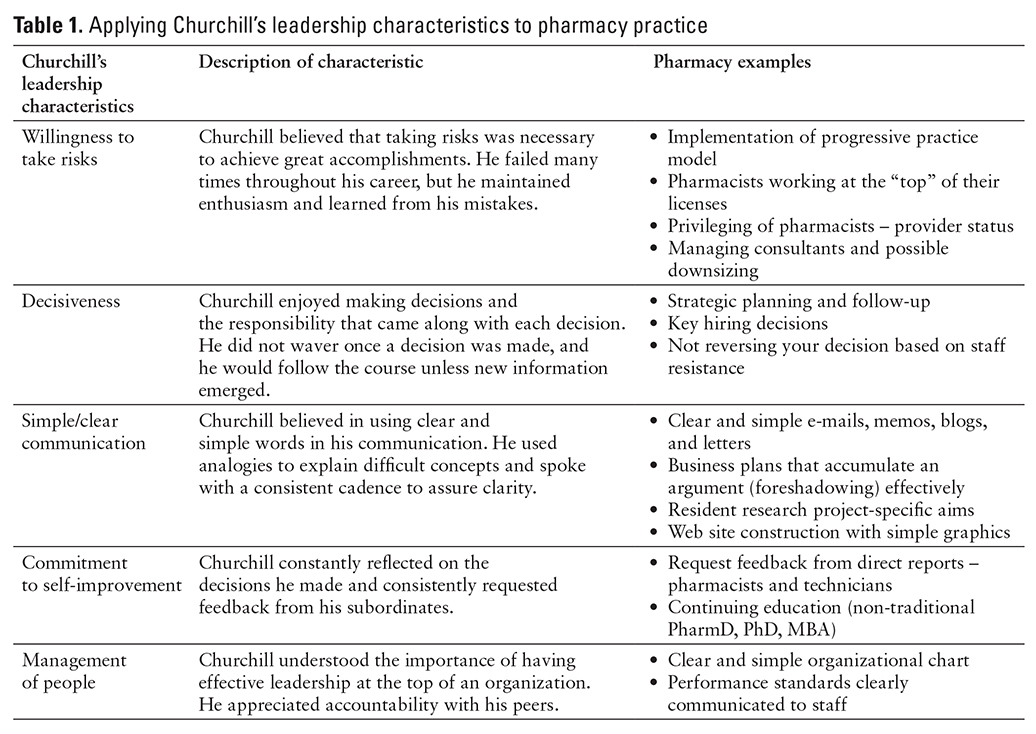
We have described a few situations in which the 5 key leadership characteristics of Churchill can be applied to pharmacy leadership. Table 1 provides additional examples of the application of Churchill’s leadership characteristics to pharmacy practice model and professional development.
CONCLUSION
Winston Churchill is considered by many to be one of the greatest leaders of all time. Pharmacy leaders can learn from Churchill’s leadership style and apply his approaches to leading within their departments. Directors of Pharmacy should consider application of these leadership qualities to their daily practice to enhance their patient-centered services.
REFERENCES
- Kouzes JM, Posner BZ. The Leadership Challenge. San Francisco, CA: Jossey-Bass; 2007.
- Robbins SP, Judge T. Essentials of Organizational Behavior. Boston: Pearson; 2014.
- Neillands R. Winston Churchill: Statesman of the Century. Cold Spring Harbor, NY: Cold Spring Press; 2003
- Hayward, Steven F. Churchill on Leadership: Executive Success in the Face of Adversity. Rocklin, CA: Forum, 1997.
- Knoer SJ, Pastor JD, Phelps PK. Lessons learned from a pharmacy practice model change at an academic medical center. Am J Health Syst Pharm. 2010;67(21):1862-1869.
- Churchill W. The scaffolding of rhetoric. November 1897. https://www.winstonchurchill.org/images/pdfs/for_educators/THE_SCAFFOLDING_OF_RHETORIC.pdf
- Duncan SM. Only the Most Able: Moving Beyond Politics in the Selection of National Security Leaders. Lanham, MD: Rowman & Littlefield Publishers; 2013.
- White, SJ. Leadership: Successful alchemy. Am J Health Syst Pharm. 2006;63(16):1497-1503.

*Health-System Pharmacy Administration Specialty Resident, The Ohio State University Wexner Medical Center, Columbus, Ohio; †Administrator, Pharmacy Services, The Ohio State University Wexner Medical Center, The Arthur G. James Cancer Hospital and Richard J. Solove Research Institute, Columbus, Ohio