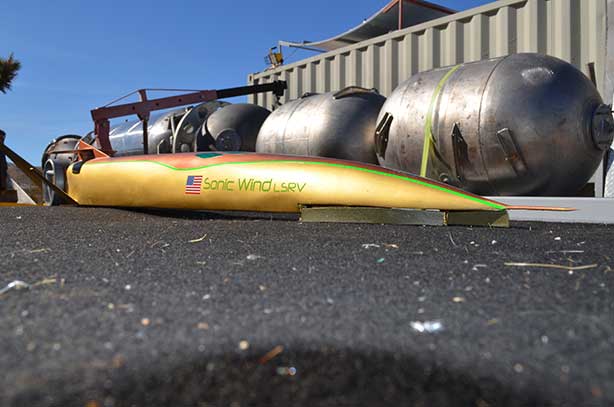
In the foreground is a model of the car with the real car in the background.
In the foreground is a model of the car with the real car in the background.
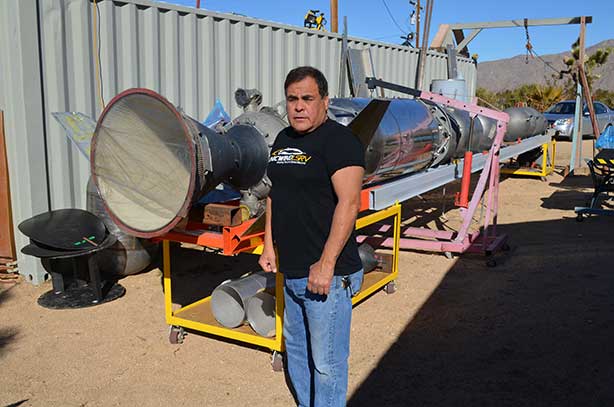
Waldo Stakes with the rocket car.
Waldo Stakes with the rocket car.
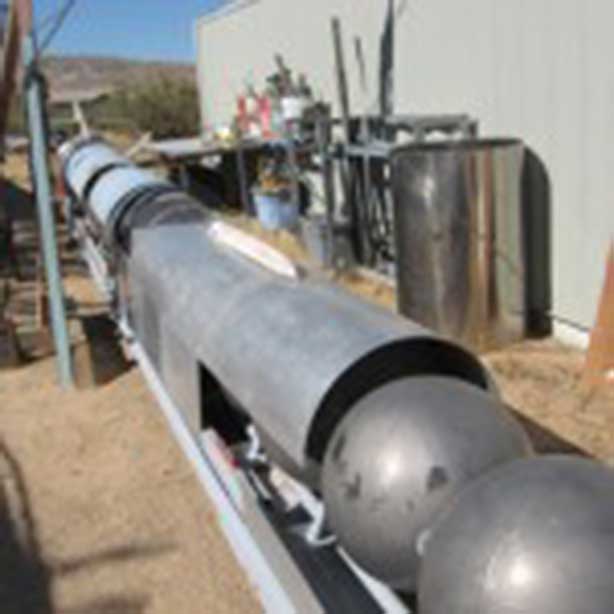
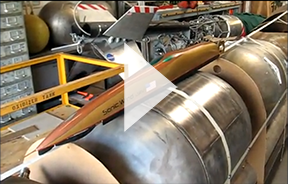
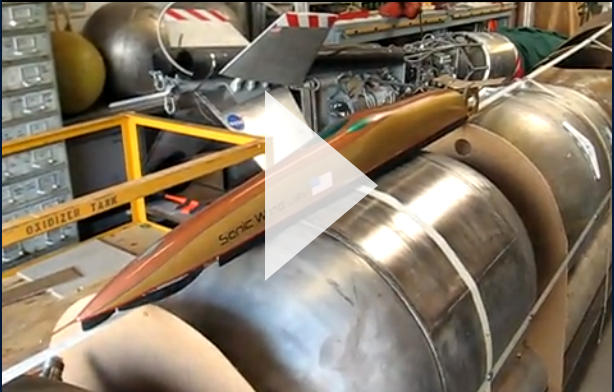
You can see the various tanks for fuel in this photo.
You can see the various tanks for fuel in this photo.
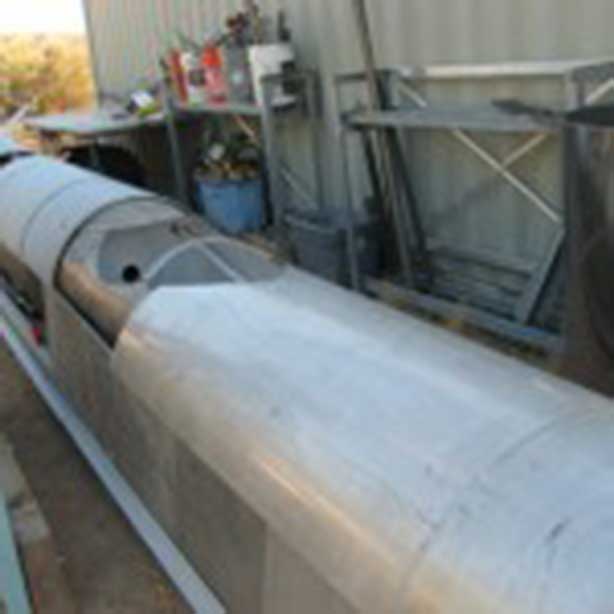
Stakes is using sheet aluminum and stainless steel where needed as a covering for the car.
Stakes is using sheet aluminum and stainless steel where needed as a covering for the car.
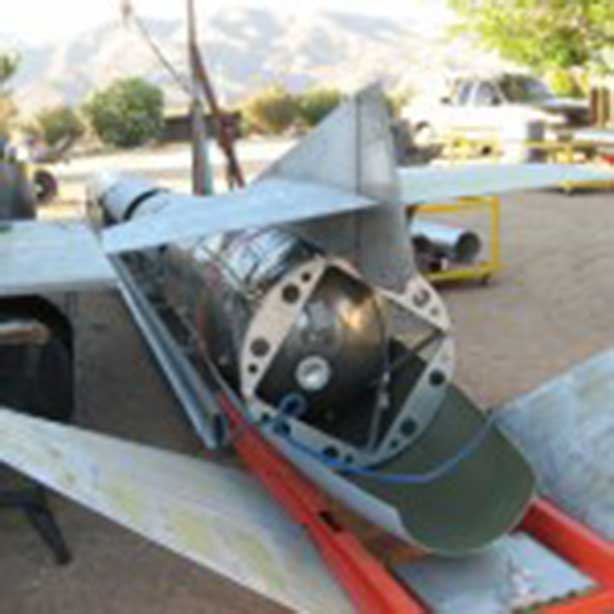
At the rear of the car is a rocket engine from the X-15.
At the rear of the car is a rocket engine from the X-15.
Waldo Stakes is building a car to break the world land-speed record. But not just break it, rather shatter it with a vehicle that he believes will go 2,000 mph.
Probably 99.9 percent of the people who know about this venture would tell him he’s crazy. But Stakes, who has a self-taught education in engineering and aircraft technology, has the experience, background, street-smarts and drive to do it. Occasionally, he even lectures at the University of Southern California to senior and post graduate students in auto engineering. Now it’s just a matter of finding the money to finish building and campaign the car that is currently 60 percent complete.
Stakes’ construction area, called the Little Rocket Ranch, is in Northern California's Mojave Desert where the hills and mountains are made from rock, sand and dirt and hem in the Los Angeles' basin.
Parts and pieces of Stakes’ car are a glimpse into cold-war rockets and their associated technologies. Many of the parts he’s picked up at rock bottom prices. Where today, if they had to be built from scratch or purchased, would cost 20 to 50 times what he paid for them. They include high-pressure vessels made from titanium, Inconel X or stainless steel and a couple of rocket engines scavenged from the famous X-15 rocket plane.
These are just some of the parts he’s using to construct his car: a pencil-thin, dragster-rail design that comes from 30 years of developing vehicles to break various land-speed records.
Stakes’ experience includes designing and racing the Outer Limits-Instant Insanity rocket dragster in the early 1980s. It ran a best elapsed time of 5.20 sec at 280 miles per hour and was powered by a 2,500-lb.-thrust, hydrogen-peroxide fueled rocket engine.
Between 1985 and 1997, Stakes built the Sonic Wind that evolved into a ice racer that can attain a top speed of 1,000 mph and uses a Reaction Motors LR-11 rocket engine that was also used for Chuck Yeager's X-1 rocket plane. However, he found no sponsors to continue with the project.
He was voted into the Southern California Timing Association (SCTA) club of the “land speed racers” and worked with Kenny Lyons on his Becker Lyon motorcycle streamliner. Together they set 17 land-speed records in various classes at Bonneville Speedway in Utah. Stakes handled the aerodynamics and was team's crew chief. The bike set records from 217 to 221 mph and made one pass at 271 mph.
From 1994 to 1996, Stakes worked with Ron Pruett on his Pretty Woman land-speed record car, a C-gas stock-car racer. Together they modified a 1988 Ford Thunderbird to achieve over 300 mph. Stakes drove the car to over 200 mph at Bonneville. It set 15 records while Stakes was with the program.
Stakes’ latest creation is the Thiokol XLR-99 rocket-engine powered automobile, the Sonic Wind LSRV (land speed research vehicle). The XLR-99 is the rocket engine used for the X-15 rocket aircraft that set a never exceeded aircraft speed record in 1967 of 4,520 miles per hour. Stakes has created the company Land Speed Research Vehicles LLC and is putting together a team while raising capitol to complete the project. The car has a projected top speed greater than 2,000 mph.
FSMD: Why are you building a 2,000-mph car?
Stakes: I worked with land speed machines all my life. I started studying them when I was about 10-years old. By the time I was 19, I was designing bodies for rocket dragsters.
By 1978, the rocket dragsters were running the quarter-mile at just under 400 mph in about three seconds, and the nitrogen fueled dragster owners tried to get them banned. Of the 15 or so rocket cars that were built, and run all over the country for a decade, three drivers were killed in accidents. But these had nothing to do with the rocket engines, but rather design flaws or the handling of the vehicle. This, and the lack of fuel from suppliers, helped eliminate them from exhibition drag racing.
I grew up in Chicago and then came out to California after reading an article about Robert Truax. He was the person who built the Evil Knievel Sky Cycle. I wanted to work with him. Truax also built a steam powered rocket dragster that was running the quarter-mile at 250 mph in the mid-60s. But the car was so overpowered that they ran it twice and it crashed both times.
FSMD: Tell me about the challenges behind this vehicle's construction.
Stakes: One of the challenges was that it took me 20 years to find the right parts. Then it took me about 15 years to figure out how to make it work. For a car like this you have to be both creative and knowledgeable. I studied physics, aerodynamics, tribology and land-speed design. Most of the car is made up of welds, sheet metal, tubes, nuts and bolts just like any other car.
However, the titanium spheres I use for the propellant system are about $60,000 each. One of the ones I was gong to use to pressurize the liquid oxygen tank cost $341,000 and came from the Apollo Service Module. I changed that, and instead I'm using seven of the $60,000 ones. They are various sizes from 18 in. to 28 in. in diameter. I have about $8 million in parts sitting in this car right now.
FSMD: Explain the vehicle's construction.
Stakes: The chassis is made of rectangular, mild-steel tube that is 2-in. wide by 5-in. deep with a 0.1875-in. wall thickness. I've developed a ladder within a ladder-style frame. I'll use the pressure vessels as part of the frame for stiffness.
There is a center steel-ladder frame that supports the fuel tanks that will be structurally anchored to the outside ladder frame. This is a very strong type of construction.
The car has seven wheels. Five of them are up front and stacked side by side and three in the back spread wide apart. The front wheel will actually be made up of five 3-in. wide, 30-in.-diameter titanium rings spinning around a 30-in. diameter by 14 in. wide hardened steel drum. The drum will contain water under pressure that will be sprayed under the inside of the rings keeping them lubricated and cooled as they spin, essentially allowing them to float.
The rear wheels are similar in design, the same diameter, but much wider at 8 in. They revolve around a hardened steel ring and use water to cool and lubricate them. I use rings to keep the wheels light and minimize spinning mass. At 15,000 rpm, a solid-metal wheel of just about any material would rip itself apart from the centrifugal forces. The concept of my ring wheel is basically expanding the diameter of the axle all the way out to the diameter of the metal tire or ring as I mentioned.
The chassis is made of a 30-ft.-long center section with two swing arms mounted at the front and end as suspension components. The front wheels spinning on the drum are mounted to trail, like a fighter jet nose wheel. This keeps the wheel wanting to realign itself, and it will always want to properly track. The driver will not try to steer the car to keep it going straight. It will automatically want to track straight. There is a steering fin under the car's nose to steer it dynamically and aerodynamically.
All the pressure vessels and fuel and oxidizer tanks are mounted to the chassis with chrome-moly tube struts and aluminum-sheet structures. This design uses the tanks as structural components. When the tanks are pressured to 500 psi, and the seven titanium spheres are pressurized between 2,200 psi to 2,400 psi, the chassis will be very rigid.
The spheres can handle pressures of up to 6,000 psi, but I will run them at relatively low pressures, so that I can cascade fill them with standard pressure bottles and filling them won't become a logistics nightmare.
I will use helium gas as a pressurant to push the oxidizer, liquid oxygen (LOX), into the rocket engine, and pressurized nitrogen gas to push the methanol-alcohol fuel into the engine. This is known as a blow-down system. The LOX is a cryogenic, and as a liquid is -246 degrees F. When the stainless steel, 8-ft. long, 30-in. diameter tank is full, it will shrink about an inch from the cold.
The skin is built from hand-formed aluminum 0.125-in. thick and sheet-stainless steel is used where the car will get hot from air friction. All the body panels will be anchored to the side of the car with rivets and screws making it monocoque.
This is the last configuration of the Sonic Wind, and it won't change anymore. This is the 2,000 mph design. The car is 55 ft. long, the body is 32-in. wide and it's 7-ft. wide from tail tip to tail tip.
FSMD: Why are you using mild steel for the chassis?
Stakes: Racecar guys like to use chrome-moly steel, and it's really strong for its weight, but if it gets any kind of spring into it, it feeds this vibration back into its welds. That's why you have to heat treat the welds when you build anything out of chrome-moly steel.
Mild steel will bend to absorb shock and stay bent. You always have to build with a crash in mind. There will be a pressure switch sensor on the chassis and if it should crack, the sensor will shut the engine down and deploy the parachute.
FSMD: Explain the vehicle's design.
Stakes: Aerodynamically the car's design is very complex. The general design is like a missile sliced lengthwise and cut in half with the flat side on the ground. There are a series of tails at the rear to make it go straight. All the air that strikes the car is used to either stabilize it and/or anchor it to the running surface. The body is shaped like a bell, looking at it from the front. This allows 70 percent of the air striking the car on the top to generate negative lift.
On top I use a cruciform tail that creates four boxes or sheets of air that resist movement. There are also two canted out bi-wedge tails mounted low and at the rear that create focused shockwaves that rebound against the ground and stabilize the car in a roll. A convex fin can't do this job, as its shocks are unstable and unfocused. There's also a ground effects tunnel under the car that takes the turbulent air from under it directing it into the high velocity rocket-engine plume. This essentially vacuums out the underside.
The car will weigh about 3,600 lbs. empty and about 6,900 lbs. loaded. Initially it would have 26,400 lbs. of thrust.
Even the parachutes I'm using to slow the car down are designed for military use for special weapons. They can withstand the high air pressures from the car when they open.
FSMD: How is it designed to keep the driver safe?
Stakes: The driver sits in a safety capsule that is a cylinder made of maragin steel, Nitronic-40 stainless steel and wrapped with carbon fiber. The driver is suspended in a Kevlar strapped hammock stretched between two chrome-moly tubes.
FSMD: How will the driver get the car up to speed?
Stakes: A pickup truck will push the car to about 60 mph then moves away. When the driver straightens up the car on the course she hits a switch to pressurize the rocket and turns on a green-laser pointer on the nose of the car to help steer it.
Then she'll squeeze a trigger on the steering handle igniting the engine. The car will have up to 26,400 lbs. of thrust in less than one second. In five seconds the car will be high in the transonic range and the next stage will push the engine to 34,600 lbs of thrust. At this point the car will be accelerating at 100 mph per second.
FSMD: You mentioned "she" as a driver. Who will drive this rocket car?
Stakes: I will shake the car down until I think it's as safe as possible. But I'm talking to a couple of female Navy aviators. These are the only type of people I would consider to drive this machine as no racecar driver could give me the performance I want.
FSMD: And the main reason you're doing this?
Stakes: Not for the money, that's for sure. Sonic Wind LSRV was built form rocket engines and hardware developed in the cold war for machines that will never be built again. I'd like to think that I'm building an American icon, a living legacy. I'll donate it to the Smithsonian after it goes 1,000 mph. It's irreplaceable, and I hope unbeatable, a tribute to the American can-do spirit.