Clean and classic, the baguette finds itself back in fashion
By Sarah Hucal
Clean and classic, the baguette finds itself back in fashion
By Sarah Hucal
Clean and classic, the baguette finds itself back in fashion
By Sarah Hucal
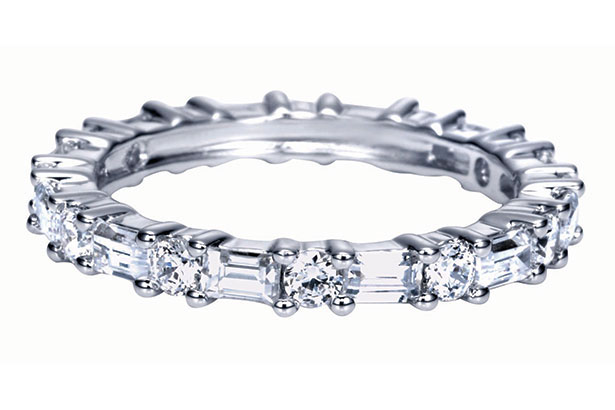
This 14-karat white gold eternity band from Gabriel & Co. alternates between baguettes and round diamonds ($3,380).
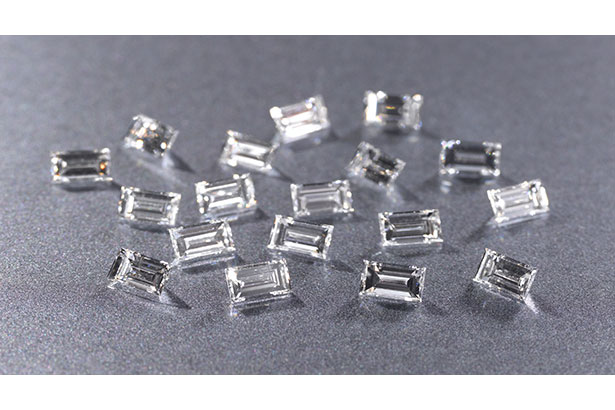
A parcel of baguettes from Rubel & Ménasché. Because of the mirror effect of this particular step cut, “Only the most beautiful stones can be used for baguettes,” Rubel & Ménasché CEO Stephan Wolzok says.
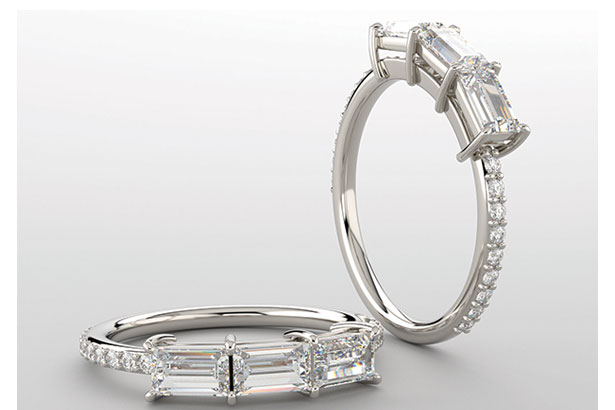
Stuller’s three-stone, 14-karat white gold straight baguette engagement ring mounting (semi-mount starting price is $426).
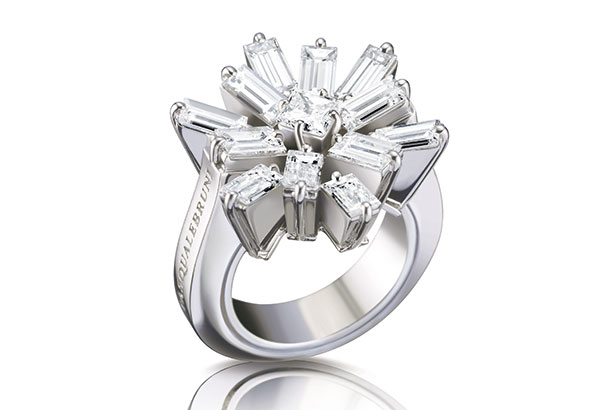
This ring from Pasquale Bruni is 18-karat white gold with baguettes, 5.65 carats total. It retails for $60,550.

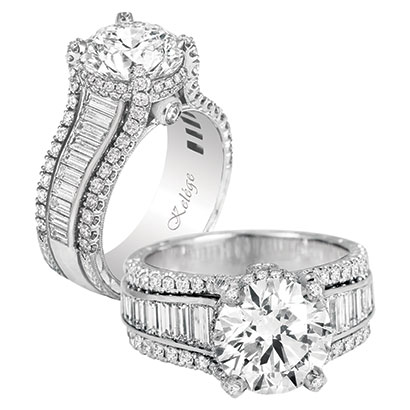
Jack Kelége’s platinum engagement ring set with 1.30 carats of baguette diamonds and 0.78 carats of round diamonds ($18,500).
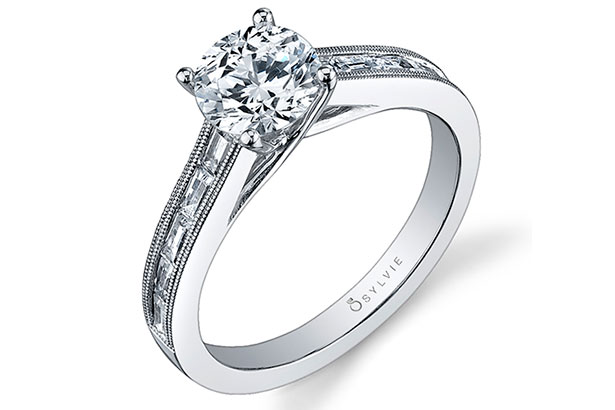
From the Sylvie Collection, a 14-karat white gold engagement ring with 0.45 carats of baguette diamonds set east-west ($2,190).
Brides-to-be are saying “I do” to baguette-cut diamonds, as the geometric shape closely associated with the Art Deco period is en vogue once again. And with plenty of baguettes on the market, designers increasingly are incorporating the classic cut into contemporary baubles perfect for today’s modern bride.
Sharing its name with the famous French bread, baguette translates to “long rod,” a fitting description for the lengthy rectangular cut with octagonal corners. While lacking the sparkle of quintessential round brilliants, baguettes are unbeatable in luster and clarity.
“Baguettes bring a different dimension to a ring that no other diamond shape can achieve,” says designer Jack Kelége whose use of the cut gives many of his engagement rings their present flair.
“The baguette remains a symbol of high jewelry,” says Stephan Wolzok, CEO of Rubel & Ménasché, a Paris-based company that cuts and sources diamonds for high jewelry houses. The complexity of the cut has rendered it almost exclusively bespoke, requiring a high level of craftsmanship. “Because the step cut has a mirror effect, no flaws can be permitted,” he says. “Only the most beautiful stones can be used.”
The baguette cut rose to prominence during the Art Deco period of the 1920s and 30s, when its streamlined, geometric shape harkened to the architectural aesthetic of the day. According to Wolzok, it also sparked an interest in other geometric shapes cut from baguettes, such as trapezoids and tapers, which became popular side stones in rings by Harry Winston and Cartier.
Baguettes remained à la mode as cutting techniques evolved in the 1950s and 60s, and fashion houses turned to the shape for its ability to be set without visible metal casings. “This gave the appearance of the stone sitting on the hand, and not on the metal setting itself,” Wolzok says.
Yet, in the 1980s the angular cut fell out of fashion as industry leaders such as Bulgari, Chopard and Cartier took to the feminine, curved shapes of brilliant heart, pear and marquise-cut diamonds.
In the past several years, however, the price of brilliant cuts has skyrocketed, bringing baguettes back into prominence. Their resurgence in popularity also can be attributed to the expansion of the Israeli diamond market, where many manufacturers specialize in fancy cuts, according to Wolzok.
Other industry insiders agree that the baguette is most definitely making a comeback. “We are seeing a resurgence of demand for baguettes of all sizes,” said Bernard Livi of M. Livi & Sons, who expects demand for both straight and tapered baguettes to increase throughout 2015.
Livi also highlighted the return of the classic tapered baguette--a slender cut that is broader at one end --that designers traditionally have used to flank center stones. “Even though the price of tapered baguettes has more than doubled in recent years, it is still one of the most sought-after side stones for engagement rings,” he tells National Jeweler.
Tapered or straight, many designers indeed are placing baguettes in the classic side stone position, albeit in updated settings. This trend also is gaining momentum from celebrities who are choosing the geometric shapes as accent stones in engagement rings, says Taylor Burgess, director of bridal design at Stuller Inc.
Actresses Angelina Jolie, Jennifer Garner and Kate Hudson are among those who have donned baguettes in recent years, allowing consumers to see these lustrous gems in a new light. In response, Stuller has introduced a host of developments featuring baguettes as side stones. “Whether it’s a tapered baguette or a small round diamond next to a straight baguette, we are finding new ways to offer this classic stone,” says Burgess, who feels the cut’s linear form appeals to brides seeking a modern look.
Designer Sylvie Levine also is finding ways to update the baguette for her namesake line, the Sylvie Collection, calling the cut “very clean and precise.”
Her latest line of engagement rings features the addition of baguettes accenting halo designs and signature pieces.
Like many of her peers, Levine’s collection includes baguettes in Art Deco and vintage-inspired designs. However, instead of echoing the bulky pieces popular during The Great Gatsby’s heyday, her updates are streamlined and contemporary, ideal for the fashion-forward woman of today. “Vintage is back, but clearly with a modern twist,” she says.
For an updated vintage look, the designer enjoys setting baguettes down the ring’s shank in both east-west and north-south patterns. “Either setting style can provide a completely different aesthetic,” Levine says. She also has been cutting straight baguettes into tapered trapezoidal shapes for an effect she says blends well with three-stone engagement rings.
While its getting plenty of replay on the side, perhaps the future of the baguette cut lies in its use in center stone settings, an atypical look that speaks to the modern bride’s desire for a piece that reflects her individual style. One of Stuller’s newest engagement rings includes a baguette option for the three-stone center. According to Burgess, the look is “very on trend with today’s market.” 