Frank Talk
with Association Luminaries

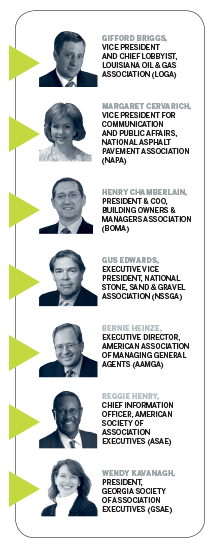
Association Adviser: Tell us a little about your background and how you came to your current role.
Edwards: I started as a newspaper reporter covering government and politics for a city daily. I was lured to work on Capitol Hill, and my plan was to use that experience as a springboard back into journalism. But, I ended up staying on the Hill for 12 years, serving as a chief of staff in both the House of Representatives and the Senate. From there I worked in two presidential administrations before a stint at a major Washington, D.C., consulting firm. In 1997, I had the opportunity to join the staff of the National Stone Association as head of communications. In 2000, the National Stone Association and the National Aggregates Association merged to become NSSGA, and I continued in the communications slot until 2008, when I became executive vice president.
Cervarich: I’ve always had a background in communications, marketing and public affairs. Before coming to NAPA in 1996, I held several communications and public affairs positions, including running my own firm, which had a number of clients in the transportation industry.
Henry: I graduated from Georgetown University with degrees in economics and computer science, but was really hell-bent on becoming a lawyer. However, after graduation I landed a job in the consulting division of (accounting firm) Coopers & Lybrand and got to see firsthand the power of information. That experience led me to a position at a strategic planning firm before starting my own technology consulting firm with a partner (Henry, Kinnelly & Associates). It was there that we developed an association management software (AMS) product. From there, I held senior technology roles at several other associations before becoming CIO as ASAE. I guess you could say I’ve been working with (or for) non-profit organizations since 1985.
Chamberlain: I’m your classic PR and marketing guy. I was director of communications for the Gannett Company during the launch phase of the Nation’s Newspaper—USA TODAY—and began my career in Washington working in the press office of the Carter/Mondale presidential campaign. I’ve also managed accounts for two public relations firms. I’ve been with BOMA since 1985 and held a variety of roles until being promoted to president in 2001.
Kavanagh: I have both an entrepreneurial and not-for-profit background, and this job lets me take advantage of that mix. I’ve been the president here since 2005, but was a GSAE board member first. It gave me the opportunity to really know the organization and what it stands for—helping members connect, advance and achieve—before I took the job. Earlier, I founded and ran an association management company called Tessera Association Management.
How would you describe your leadership style?
Edwards: It’s more or less laissez-faire. The people we have on staff are seasoned professionals and experts in their fields. I respect them because they know their jobs and do them well, so there’s not much need for me to interfere. I do like to challenge them from time to time—and they like to be tested—so when a sticky or seemingly insoluble issue arises, I encourage them to astonish me with their ingenuity. And they do.
Chamberlain: People watch you by the example you set and how you build and nurture your team. I’m a big believer in continuous learning and the continuous training of our staff. You can’t do it all alone. You have to have a staff who’s going to help you figure out what’s coming next and how your organization is going to be the one that gets there first.
Aside from the economy, what other key challenges ARE your organization facing?
Heinze: We’re information organizations at our core. The Internet has commoditized the two things that we used to have all to ourselves—professional networking and reliable industry information. We had those markets cornered for so long. Now we all have to evolve.
Chamberlain: I agree. Like many associations, what used to be part of our unique value proposition is now offered free on the Web. For example, anyone can find lots of free information about things like payback periods, property life cycles, tax credits and the like. They don’t necessarily need us for that. The information isn’t all reliable and carefully vetted, but it’s out there free to the public. Associations really have had to shift to a new business model.
Kavanagh: It would have to be information overload. We’re very sensitive about over-communicating with our members. We want to be very strategic about how often and when we touch them. Our philosophy is basically: We respect how busy you [members] are. So when we send you something, please pay attention to what we say—we’re not going to keep re-sending it to you.
Edwards: Regulation. We’re constantly challenged by federal, state and local regulators. Ours may be the most heavily regulated industry in the nation. We’re subject to stringent safety and health rules and constant inspections; we are required to meet strict environmental requirements set by virtually all levels of government, and we fall under the jurisdiction of some major federal laws, such as the Clean Air Act, the Clean Water Act and others.
How do your advocacy efforts fit into this picture?
Cervarich: Many people aren’t aware that asphalt is America’s most recycled material. The asphalt cement in the reclaimed pavement is reactivated to become an integral part of the new pavement. The recycled asphalt cement replaces part of the new asphalt cement that’s required for the pavement, thus reducing costs for road agencies and conserving precious natural resources.
Briggs: One of the biggest misconceptions we fight is that people think LOGA members are similar to ExxonMobil, Shell and BP—massive global organizations that are doing only a small amount of domestic exploration and drilling. Our members are primarily small independents doing the majority of domestic exploration. Everyone’s anger toward the big oil companies shouldn’t be directed at us. We’ve helped keep oil prices down so that in the U.S, we’re only the 100th least expensive gas in the world.
Edwards: Nearly 60 percent of NSSGA’s budget is allocated to advocacy. Our Government Affairs Division staff and our Environment, Safety and Health Division staff are constantly present on Capitol Hill, in the halls of the regulatory agencies and the White House to advocate on behalf of the aggregates industry. Also, we don’t hesitate to use the courts if necessary to defend the industry against unreasonable or burdensome regulations.
What programs and strategies do you have for recruiting and retaining younger industry up-and-comers?
Henry: No one’s joining associations anymore because it’s the “right thing to do.” That’s especially true for younger people. Now everyone’s so bottom-line oriented, so value oriented. They keep asking themselves, “Why should I join?” Associations have to drop the one-size-fits-all mentality and become more specialized to appeal to specific sub-groups of their member base. We started the Young Association Professionals Group and that’s getting great traction. Young people are acknowledging that they’re association professionals, not just younger members of a particular industry or profession. They’re very active. They have their own social functions at our meetings. They actively submit suggested topics for the program content. It’s pretty cool.
Heinze: With the recent contraction in the industry—MGAs buying one another —AAMGA has been aggressive about reaching out to younger members of the profession. As an incentive to join, any under-40 employee of an AAMGA member company can join the association for free. AAMGA also helps younger members to go abroad for a year so they can learn about the global side of the insurance business. Our Under Forty Organization (UFO) elects its own president and vice presidents for the board of directors, holds an annual meeting in September of each year, sponsors a reception open to all attendees at the AAMGA annual meeting in May, and conducts special education and leadership training sessions.
Edwards: We have a very highly regarded Young Leader’s program that invites participation from under-40 up-and-coming managers and executives from companies of all sizes and makeups. We’ve also waded in slowly to the social media environment, recognizing that younger workers are more likely to be engaged on the Internet.
Cervarich: As my fellow panelists have shared, we also have a Young Leaders Conference every fall and the Young Leaders Committee develops workshops, tours and other programs in conjunction with NAPA’s Annual Meeting. The Committee also works with the National Asphalt Pavement Association Research and Education Foundation at Auburn University to administer the Young Leaders Scholarship and to sponsor the Professor Training Program. Our foundation grants 150 scholarships a year to college kids focusing on asphalt technology and we have a professor training program for 40 professors.
How have members reacted to your social and mobile media efforts?
Edwards: We’d like to be more aggressive with our social media efforts, but we are heavily regulated and our primary focus is on advocacy. That makes it hard for us to launch social media programs like you might see in less regulated industries. That said, we have established a presence on Twitter, Facebook and various blogs. We hired a young person to oversee our social media efforts and monitor the Internet for relevant information. We’ve also launched a members-only social network that we hope will re-energize the collaborative networking that used to take place at the many events we held prior to the economic collapse.
Chamberlain: BOMA members are not sitting in their offices a lot. They’re on the go, working at multiple locations. Mobile has been a particularly effective way for us to get information out to them, and we have apps to facilitate that. We also have a Facebook page. Our LinkedIn platform has about 10,000 members using it for networking and problem solving. We post videos on YouTube. Our PR and marketing efforts go through Twitter to reporters as well as to younger people who are searching for expertise on particular topics.
Henry: We all have to start acknowledging the mobile member. Why are we always pushing our members to websites when they’re not always at their desks with a computer on? We’ve also been using mobile apps to help our conference attendees navigate the show floor and creating apps that compile all the education sessions and integrating all the show-related blogs and Twitter feeds into one place. Like many organizations, we need to look at where the most up-to-date, juicy and relevant content is bubbling up. Know where that is? It’s in discussion groups. How do you get information out to members that will help them solve a problem? That’s what we’re all wrestling with and that’s part of why we started our Acronym blog.
Heinze: Many organizations don’t realize how helpful social media can be in terms of reaching many sub-communities of its membership. In AAMGA’s case, that means catering to individual lines of business: trucking, restaurants, construction, cargo, oil and gas, marine, pharmaceutical, satellite and medical malpractice. They each have unique issues, challenges and opportunities.
Can you describe your overall communications strategy in a nutshell?
Briggs: Customization. We try to blend the best of old school communication (speaking tours and lobbying) with new school (technology and social media) communication tactics. In total, we send out an insane amount of communication, but everything is highly customized—we have 20 different templates, for example—which is one of the best things we’ve ever done.
Edwards: Relevance. We try to provide members with the information and services they need to be successful in their businesses without overwhelming them with too much communication. We send them a weekly electronic newsletter, the NSSGA e-Digest & Washington Watch, and a bi-monthly magazine, Stone, Sand & Gravel Review, which also is available online. In between, we provide them “as-it’s-happening” legislative and regulatory updates via email.
Cervarich: Integrated communication. Let’s say breaking news or an important piece of legislation hits. We’ll send out an Electronic Legislative Report right away—in fact, I’m finishing one right now on the Highway Bill that was introduced yesterday. We’ll also reference the bill on our website and it will be included with some analysis in the next issue of Action News, our members’ only bi-weekly e-newsletter.
Any predictions for the future?
Heinze: Our parents always warned us to have something to fall back on in case our dreams didn’t come true. Now we’ve got to teach the younger folks how to fall forward, how take a chance. Like a lot of people in leadership positions, I’ve learned more from my failures than I have from my successes.
Edwards: We expect memberships will be more frictionless, so it will be easier to join and leave than it was in the past. It will be critical to have a robust, innovative value offering. Sometimes it feels like we have to drag members along technologically, but they are very smart and focus internally where they’ll see their greatest return. That’s tough for an association that is in place to make an impact externally.
Sounds like it’s tougher being an association head than it used to be
Edwards: Principally because of the economy, it’s become tougher to attract and maintain dues-paying members over the last five years. We’ve had to work extra hard to make sure our members are getting an outstanding return on their investment in us. Like many national associations, we’re finding member companies less willing to send their employees to national meetings. Travel and the new, leaner work environment mean it’s just not as easy an investment for a member company.
Chamberlain: Let’s just say association CEOs didn’t have to work as hard 10 to 20 years ago as they do now. You really have to be more creative and learn to do more with less. It’s not just the economy; it’s the profound impact of technology. It’s a 24/7, real-time, instant access environment for association leaders, as well as their staffs and their members. You’re on call all the time—just like our members. Believe me, when a building owner gets an emergency call at 2 a.m., they have to deal with it ASAP. They can’t say they’ll get to it when they arrive at the office in the morning.
So, what’s keeping you up at night?
Kavanagh: Are we spreading resources in the right ways with our social media “light” initiative? Also, I’m still very concerned about the economy. As associations, we’re slower to feel the pain of a downturn, but also slower to come out of the downturn mindset when things start to improve. Are we doing enough for our members? Are we giving them enough guidance about negotiating contracts and employee compensation?
Cervarich: Always too much to do and not enough time to do it.
Heinze: I’m always asking myself: “Are we staying ahead of the curve? Can we be proactive rather than reactive when anticipating members’ needs? Can they use what we produce to differentiate themselves from their competitors?”
Chamberlain: I agree. Are we staying ahead of the curve? Are we seeing around the corners? Are we swimming in a nice blue ocean or heading into the red?
Henry: I worry about maintaining our fast organizational pace. We’re up to 130 staff members. How do you stay nimble and keep the pace moving without people falling off the bus?
Any final takeaways for our readers?
Kavanagh: Ask yourself every day if you’re having fun. We work so hard at our careers. If you’re not having fun, then it’s just not worth it.