Did You Know
Our research shows associations are making strides in innovation, member retention and mobile adoption. But, there’s still much work to do on the overall communications front.
As ASAE’s Reggie Henry quipped during a recent conversation with Association Adviser, “associations have historically evolved to meet the demands of their members and a changing society.” Association Adviser’s proprietary research and online reader polls seem to support that view. Sure, mistakes are being made, but associations seem to be working their magic despite a host of economic, political, technological and demographic challenges on the horizon.
Naylor president and CEO Alex DeBarr said that now is an unusually ripe time for associations to experiment with new tools to get a leg up on their for-profit competitors. “Many trade publishers,” he said, “are in the grasp of painful reorganizations without an association’s cushion of dues revenue and professional education income.”
Association leaders pleasantly surprised by membership retention, less enthused with their communication efforts
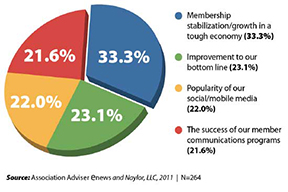
Are associations staying relevant in these challenging times? A recent Association Adviser reader poll indicated “yes,” as one third (33.3 percent) of respondents told us that they’ve been surprised by their ability to grow, or at least maintain, their membership bases through the economic downturn. However, on the financial side, less than one in four (23.1 percent) respondents said they had better than expected bottom line results over the past year. More disturbing, just 22 percent said they were pleasantly surprised by their social and mobile media initiatives, and only 21 percent said they were surprised by the success of their member communications programs overall (see chart above).
Here’s how some Naylor clients are adapting to the changing times. Association members, especially the younger ones, are very socially active online and very tech savvy, according to Chris Monek, head of business development and partnerships for the Associated General Contractors (AGC). “That’s how they communicate and network with each other, and they expect you to have core capabilities in the mobile and social arena,” he said.
Kim Howard, editor-in-chief of ACC Docket, the flagship publication of the 26,000-member Association of Corporate Counsel (ACC), agreed, saying, “You can’t wait for members to tell you what they want. You have to be proactive.” For instance, Howard said you have to be ready for “all the digital natives coming up in their careers.” They’re used to getting information “wherever they are, whenever they want and in the format they want since they always have their mobile devices with them.” When ACC interviews a subject for its magazine, it also records an audio file of the interview. Outtakes from the interview that don’t make it to the print magazine can be furnished as additional premium content for the e-zine, website, RSS feeds and mobile channels, she said.
Mike Hyland of the American Public Power Association (APPA) said his organization is developing mobile apps so utility workers in the field can get instant access to safety manuals and procedures on the job. Like APPA, members of the American Society of Interior Designers (ASID) are frequently in the field and not at their desks. “They live on their smartphones and iPads,” said ASID’s Director of Research & Knowledge Michael Berens. The next iteration of ASID’s website is more mobile friendly, like the organization’s new portal ASID Icon, which, according to Berens, integrates “everything that’s happening at ASID,” from its magazine and newsletters to its Web-only content. This content includes interviews, articles, photos, case studies, blog posts and more.
Association innovation starts at the top, but more input IS accepted from all parts of the organization
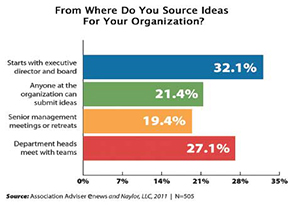
According to one of our most popular Association Adviser reader polls of the past year, nearly one-third (32.1 percent) of associations get their inspiration for new ideas from their executive director or board (see top left chart). No surprise there, but more than 21 percent of the 505 respondents to our online survey told us that anyone at the organization can now submit ideas. That’s a trend that’s really picking up steam according to many of the association leaders we’ve profiled over the past year.
Less than one in five (19.4 percent) associations told us they still rely on tried and true senior management meetings or retreats and more than 27 percent still start with department heads meeting with teams. But, the move toward an all-inclusive ideation culture should help associations gain relevance with their members, particularly younger members and staff.
Associations plan to increase communications staffs in 2012
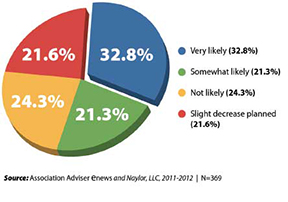
Speaking of staffing, many association leaders acknowledge that their communications teams are feeling overworked. More than half (54.1 percent) of the 369 respondents to a recent reader poll about this subject said they planned to increase their member communications staffs in the next year, including almost one-third (32.8 percent) who said they were VERY likely to do so. Less than 22 percent of respondents plan to cut communications staffs (see top right chart).
Member magazines increasingly moving to digital, hybrid or web-based offerings
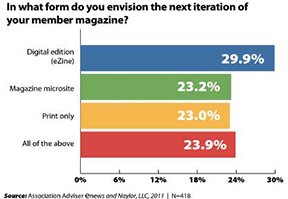
In terms of improving association member magazines, it seems the tide is shifting toward the digital shores. Nearly 30 percent of the 418 respondents to another recent reader poll said the next version of their member magazine will likely be digital-only (see top left chart). Nearly one in four (23.2 percent) believe it will resemble a microsite rather than a magazine per se, and about the same percentage (23 percent) believe it will remain print only.
So, does this spell the end of print? Hardly. Nearly one in four associations (23.9 percent) plan to use an integrated approach that offers members their magazine in a variety of convenient platforms including digital, Web and print.
Upgrading member databases and websites tops on associations’ wish lists
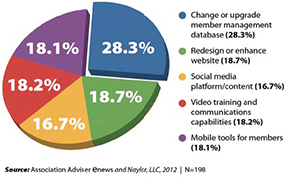
If you think your member database is falling behind the times, you’re not alone. More than 28 percent of the 198 association leaders who responded to a recent reader poll said “changing or upgrading their member database” would have the “single greatest impact” on their organizations (see left middle chart).
It might be time for a website makeover as well. About one in five respondents (18.7 percent) told us that “redesigning or enhancing their website” would have the single greatest impact on their organizations. Almost the same ratio (18.2 percent) told us that offering “more mobile tools for members” would be most impactful for their organizations. Finally, one in three respondents (34.9 percent) said that either creating video or improving their social media platforms would have the single greatest impact on their organization.
When it comes to member databases, Renato Sogueco (CIO, Society of American Florists) said he’s not surprised by the results because associations are increasingly learning to look at their members’ psychographics and online behavior patterns, and not just their demographics and company contact information. You need your member database to provide that kind of information for you if you want to stay relevant, Sogueco said.
Association members using smartphones for a lot more than JUST talking
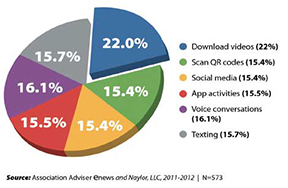
Do members still use their smartphones for voice conversations? Yes, but not as often as they do for downloading videos and texting.
According to another of the year’s most popular reader polls, 22 percent of the 573 respondents believed their members were using smartphones to download videos, compared to 16.1 percent who believed smartphones were being used for talking, 15.7 percent for texting, 15.5 percent for app activities and 15.4 percent each for social media or scanning QR codes (see chart at the bottom of page 20).
Fortunately, associations are making a lot more video content available than they used to. As we discovered in January’s reader poll, nearly two-thirds (64.9 percent) of respondents said they are using online video or planning to do so this year—a substantial jump from 40 percent who were using video at this time a year ago.
Majority of associations now making at least portions of live events available to virtual attendees
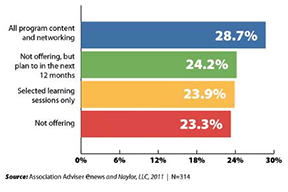
In perhaps the latest example of innovation in a tight economy, nearly 30 percent of the 314 respondents said they now offer all of their program content, networking and keynote presentations to members who cannot attend their live events in person.
An additional 24 percent of respondents told us they’re offering selected learning sessions of their live events to virtual attendees. What’s more, one in four respondents (24.2 percent) told us they plan to offer a virtual attendance option within 12 months (see top left chart).
The latest reader survey results are very consistent with our 2011 Association Communication Benchmarking Report in which 57 percent of the 700 responding associations told us they’re either offering virtual attendance to their live events now, or plan to do so within 12 months.
Associations rapidly adopting QR codes
Still wondering what those quirky black boxes at the bottom of magazine ads and conference brochures are used for? It might be time to get up to speed.
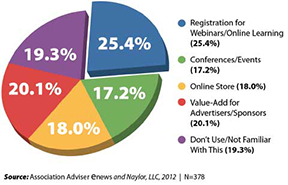
More than 80 percent of association leaders who responded to the Association Adviser reader poll said they were using quick response (QR) codes for at least one purpose, with more than one in four (25.4 percent) using them to help members register for webinars and other online learning opportunities.
Twenty percent of the 378 respondents to date said they are using QR codes to add value to their advertising and sponsorship programs; 18 percent are using them to bolster purchases at their online stores; and more than 17 percent are using them for their conferences and events (see top right chart).
Conclusion
From 360-degree innovation programs to social media, mobile apps and QR codes, research shows associations are trying mightily to stay on the cutting edge and remain relevant to a new group of industry up-and-comers who don’t belong to organizations just because it’s the “right thing to do.”
While most associations won’t be able to deliver an Apple- or Amazon-like customer experience, members of all ages are noticing the effort and will reward the associations who continue to break new ground and remain the No. 1 voice of their respective industries.