
What can companies learn from organizations that sell experiences rather than services or products? |
BY OREN SMILANSKY
What can companies learn from organizations that sell experiences rather than services or products? | BY OREN SMILANSKY
What can companies learn from organizations that sell experiences rather than services or products? | BY OREN SMILANSKY

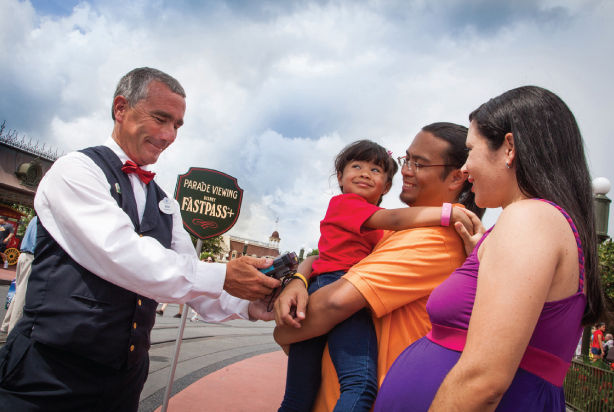
Disney World’s MyMagic+ Bands let guests access rides and food—and the company chart touch-point activity.
Disney World’s MyMagic+ Bands let guests access rides and food—and the company chart touch-point activity.


Imagine planning an out-of-state business trip and facing these two travel options: Hotel A, which has a reputation for bad service, is offering a room for $180 per night. Hotel B, which is known for great experiences, is offering a comparable room at the same price. It’s likely, assuming everything else is equal, that you’d select Hotel B. So wouldn’t it make sense to learn from organizations that make positive experiences the central asset of their business?
It certainly does—which is why customer experience (CX) is becoming a top priority for progressive companies.
The concept of creating positive customer experiences is nothing new. In fact, amusement parks and museums have been successfully doing it for decades. Though amusement parks do sell products, they live and die not by the goods they offer but from the experiences they provide. For nearly a century, Disney World has marketed and sold its magical experience. Similarly, museums have historically depended on the appeal of the environments they create. And some museums continue to thrive in the age of the Internet because they offer a one-of-a-kind experience that extends beyond the physical location.
If these organizations are still nailing the experience, why not apply this approach to businesses whose goal is to sell goods and services? And why not take it a step further and collect data from those experiences that can later be used to reconnect with customers when they’re out of physical reach?
What Experience-Centric Businesses Have Yet to Perfect
Experience-centric organizations are becoming more reliant on linking offline experiences with those they provide online. But they haven’t quite figured everything out. These companies are beginning to realize the difficulty of getting visitors to return if you lack sufficient information regarding their interests or preferences.
Since the earnings of such companies depend largely on the success of physical locations, it is vital they keep customers engaged while they visit. And there’s another motive in play: The on-site experience presents an opportunity to learn about customer preferences, so getting customers to interact with the environment in ways that produce more data will only help future engagement efforts.
Increasingly, the standards for a good experience are going up, and it’s becoming more important for organizations to provide a seamless one. For Disney World, reducing the friction within its parks has been a growing concern in recent years. Visitors now have the option of investing in MyMagic+ Bands, wearable devices that track their progress at various touch points throughout the park grounds. The band is designed to make the customers’ experiences easier by offering an all-in-one device that serves a number of functions, including access to rides and food. But the added benefit to Disney is that it allows the company to gather more substantial data on those customers.
A number of museums are also making efforts to better engage patrons, says Allegra Burnette, former creative director of digital media at MoMa and now a principal analyst at Forrester Research. “The notion of marrying the physical and digital, and thinking about them through different channels, makes a lot of sense,” she says.
Cooper-Hewitt, Smithsonian Design Museum allows its patrons to engage with exhibits in ways that connect the physical space to the digital world. Visitors are given a digital pen when they enter with which they can draw on rubber screens throughout the museum, bookmarking certain objects that they’d like to see later online. Once they’ve left the museum, they can go online to revisit exhibits digitally. There are also design-related exercises they can do along the way.
The hospitality industry is also beginning to react. “Like all hotel companies, IHG is unique in that the experience is a product,” says Billy Turchin, head of CRM and customer experience at InterContinental Hotels Group. “In the old days, it used to just be a bed and shelter. Now, when I step into a city, I can find six hotels that are roughly comparable. What drives me to choose one hotel over the other? More and more, it’s the experience.”
To keep an edge, IHG is determining how to use apps to stay connected with customers before, during, and after their stays by offering easier ways to make requests while they are at the hotel.
Personalization is crucial to the effort. People expect companies to know more about their preferences now, and what might delight one customer may not be appreciated by another. A particular offer might seem considerate to one customer, but insulting to another. This is particularly true of the hotel industry, Turchin notes.
IHG is now making an effort to better understand the various types of people staying in its hotels. For instance, one traveler might be the type who spends little time at the hotel, returning only to sleep; another might like to take advantage of the hotel bar and restaurant. If hotels can better understand the needs of each type, it can create more personal experiences.
Connecting Offline and Online Worlds
Businesses in which the experience determines whether a sales is made can learn a lot from businesses that peddle an experience itself.
A lasting appeal of brick-and-mortar stores is that they let customers interact with the products they’re interested in. For some time, retailers feared that this would lead to “showrooming”—evaluating a product in-store, then purchasing it cheaper online.
But that fear is dying out.
Contrary to common expectations, the great digital revolution has created a greater need for physical stores and locations—spaces that are appealing and enjoyable to be in. Even companies that were formed to function solely online, such as Amazon.com, Birchbox, and Warby Parker, are beginning to understand the benefit of having physical locations a customer can walk into.
Robert Spector, author of The Nordstrom Way, highlights a number of reasons people are still so attracted to physical stores, among them the ability to interact and form relationships in person. The stores’ sales staff can connect to a customer and understand her personal needs. “It’s all about the person you want to sell to,” Spector says. “You want to learn about the customers and listen to them.”
But just because people by and large want to visit stores doesn’t mean that companies are absolved from engaging them in sophisticated ways once they are there. Simply having merchandise and warm bodies isn’t enough to get them to come back, Spector says. The culture has to be up to par, which is not as easy as it might sound.
Having observed the company for 30 years, Spector deems Nordstrom an innovator in uniting the digital and physical worlds. The company’s TextStyle app puts customers in contact with a person they’ve met and trusted and knows their tastes based on previous interactions. It’s “one…reason why Nordstrom does it better than any other retailer,” Spector says.
Spector points out that Recreational Equipment Inc. (better known as REI), a retailer specializing in outdoor sports equipment, hosts lectures by authors who are well versed on a variety of topics. “If you’re interested in hiking, or skiing, or bicycling—whatever—you can find a meeting or a speaker or somebody [who] has written a book, and there will be an event at an REI store,” Spector says. With these kinds of events, customers can feel like they’re part of a community. It goes without saying that recommendations should be pointed enough to align with the customer’s interests.
Combining Offline and Online Experiences
A benefit to having a physical location, Burnette suggests, is that it gives companies a laboratory with which to test out ideas. “Ministry of Supply’s retail environments are places where they experiment and see what kind of content, designs, and layouts work,” Burnette states.
A retailer can make improvements to its dressing room environments, for instance, to offer experiences that simply would not be possible elsewhere—like smart mirrors, which combine technology with a traditional in-store experience to give customers the chance to compare how they look in various outfits. It’s also a way for companies to link items to other information they have about the customer.
Story, a Manhattan retailer that changes its design and merchandise every four to eight weeks, has made it its mission to serve as a sort of testing ground for companies and their products. The store takes inspiration from a magazine: Once every few weeks, the store will select a theme and organize the products on display to align with that theme. The company then opens an exhibit-like space to brands that pay to have their products in the store, providing a gallery setting for companies to showcase their goods in appealing ways. Shoppers are welcome to interact with the in-store stations and take part in various activities, such as contests. They can also buy the products. Story keeps track of how customers interact with the store’s exhibits to see what is working and what isn’t. The store tests how popular certain items are with heat-mapping cameras.
Stores can also use technology to enrich an experience after a person has left the physical location. Joe Gagnon, senior vice president and general manager of cloud at Aspect Software, says that someone who orders a latte at a coffee shop, for instance, can be sent interesting facts about the coffee beans after he has left.
And just as museums offer supplemental information about exhibits, retailers can do the same with products in the store, Gagnon says. Customers can use their phones to scan barcodes and ask questions about certain products. If a shopper is curious about a shoe’s material, he can type it into his phone and connect with a customer service rep. This will all be much easier to execute, of course, with in-store Wi-Fi.
Navigating the B2B Landscape
The importance of offline experiences, and their connection to online targeted marketing, is by no means limited to B2C. For a great number of B2B firms, industry events are still one of the top places to meet and network with the most important people at various companies. Providing excellent, engaging experiences that enable people to connect is important in this setting.
Anyone who’s attended an industry event—particularly a large one—knows they can be overwhelming. Several times a day, people will speak to someone they’ve never met, make a brief introduction, and promise to be in touch or follow up. But what often happens is they forget immediately who it was they spoke to, or various other important details about that interaction. Those who come prepared might trade business cards, but those are easy to lose or misplace. Also, they force people to enter more data than they’d like.
Surprisingly, a lot of people are still thinking about conferences as a purely offline experience, points out Hampus Jakobsson, cofounder and CEO of Brisk. One of Brisk’s most recent additions to its sales solution addresses this tendency to skip business cards in favor of exchanging emails—though the intention is good, trading emails only often results in lost opportunities, as salespeople tend to forget to reconnect. What they can do is capitalize on the opportunities that live in places such as email and connect them to CRM to classify the contacts according to opportunity type.
Automating the process of exchanging information can help people keep track of what they’ve done at a trade show. And one vendor, Loopd, is making an effort to redefine the way people navigate events. “Event organizers have a lot of tools going into the event, but during the events it’s a black box,” Brian Friedman, CEO of Loopd, says.
Those who attend industry shows are familiar with name badges. At the beginning of a show, attendees are each given one with their name, title, and the company they are representing. Throughout the show, each attendee uses the badge as a ticket of admittance into various talks and gatherings. Loopd has developed bidirectional smart badges that enable attendees to trade information whenever they cross paths. This also makes the conference setting frictionless, as it allows people to check into sessions without having to show their badges. It aims to give event sponsors more insights into the success of their booths. Using the tracker badges, companies can get better analytics surrounding attendee behavior, and the information will help organizations figure out how to better target prospects concerning future products.
These are just a few examples of organizations that are hard at work delivering great customer experiences. The reality is that many companies are, and customers are taking notice. “More companies in more industries are [offering great experiences], so consumers are coming to expect [them],” Turchin says.
This is why organizations that aren’t focused on delivering a positive experience must start to now: If customers don’t get one from you, they’ll be happy to find it somewhere else. 
Associate Editor Oren Smilansky can be reached at osmilansky@infotoday.com.