How companies should choose it, when they should lose it, and why they should take cues from it
By Oren Smilansky
How companies should choose it, when they should lose it, and why they should take cues from it | By Oren Smilansky
How companies should choose it, when they should lose it, and why they should take cues from it | By Oren Smilansky

Big Data, an ever-evolving catchall used to describe the vast amount of unstructured data, has become something of a buzz term in recent years. Published reports have indicated that upwards of 90 percent of the world’s data was created during the past two years alone.
There’s no denying that with technology and Internet usage skyrocketing, there are more opportunities than ever to gather information about customers. Whether it’s coming from social media sites such as Twitter, Instagram, or Facebook, or from countless other Web sites, on mobile devices, laptops, or desktops, data is being generated at an astonishing rate.
Today, progressive business leaders don’t need to be convinced there is tremendous value in data, says Jeff Tanner, a professor of marketing at Old Dominion University and a consultant at BPT Partners. Making use of Big Data has gone from a desire to a necessity. “The business demands require that you use it,” he says. “If you’re a salesperson and you’re not making the numbers that are required of you, you’re not going to get paid as much.”
Technology plays a key role in harnessing Big Data. Rosetta Stone, for example, was able to do so using InsideView’s marketing solution; the educational software provider had found it difficult pinpointing a single title or department as its typical buyer. With data culled from social channels and the Web, InsideView helped Rosetta Stone identify the accounts most likely to close, enabling it to more effectively target them earlier in the buying cycle.
This is only one example. The reality is that Big Data can serve organizations in many ways. Ironically, though, with such a wealth of information at a company’s disposal, the possibilities border on the limitless—and that can be a problem. Data is not going to automatically bend to a company’s will. On the contrary, it has the potential to stir up organizations from within if not used correctly. If a company doesn’t set some ground rules and figure out how to choose the appropriate data to work with, as well as how to make it align with the organization’s goals, it’s unlikely to get anything worthy out of it.
Information Versus Insights
Big Data is nothing if not available, and it takes minimal effort to collect it. But unfortunately, it will not be of use to anyone if it’s not molded to meet the particular demands of those using it. “There are a lot of Big Data myths,” notes Michael Wu, chief scientist at Lithium Technologies and Klout. “Some people are under the impression that they’re going to get a lot of information simply from having data. But businesses don’t really need Big Data; information and insight are what people need.”
While a vast amount of data matter might be floating around in the physical and digital universes, the information it contains may be considerably less substantial. “Data has a huge amount of statistical redundancy,” Wu says. “What happens when you back up your hard drive? You double your data, but you don’t necessarily increase your information.”
To illustrate the problem, Wu explains that two photographs of the same conference room full of attendees, taken from two angles—one from the stage and one from the back exit—will yield a considerable amount of overlapping information. A person looking at either picture, though, can infer from both that the person in the third-row aisle seat is wearing a red shirt. In other words, information pertaining to the color of the shirt is repeated in both instances. If the goal is to learn the color of the man’s shirt, simply having one picture would suffice. Similarly, knowing that Apple’s stock is up and that someone has tweeted about the brilliance of the iPhone 6 may reveal bits of identical information.
While it might seem advisable to collect as much information as possible, some of that information just might not be relevant. You may learn there is a toothpaste stain on the man’s red shirt, but that might not be helpful to your company. Relevant insights, on the other hand, allow companies to act on information and create beneficial changes.
To the Insightful Go the Spoils
“One bit of insightful information may be the difference between victory and defeat,” Wu says.
Wu identifies three layers of Big Data analytics, two of which lead to insights. The first of these, and the most basic, is descriptive analytics, which simply summarize the state of a situation. They can be presented in the form of dashboards, and they tell a person what’s going on, but they don’t predict what will happen as a result. Predictive analytics forecast what will likely happen; prescriptive analytics guide users to action. Predictive and prescriptive analytics provide insights.
It may seem simple, but Bhargav Mantha, a manager at ZS Associates, says that presenting the analytics on a clean, readable user interface is vital but sometimes ignored. “Users get frustrated when they see content that they can’t decipher,” Mantha says. “A canned dashboard just won’t cut it; people need to know what action they have to take.” Mantha says that users demand a “sophisticated alert engine that will tell them very contextually what actions to take.”
Using such analytics, Target was able to uncover this insight: Women who bought certain products such as cotton balls, unscented lotions and soaps, zinc, and calcium were either pregnant or likely to become pregnant. Equipped with such information, the company was able to design coupons geared toward expectant mothers at specific stages of their pregnancy. It’s this type of insight that helped Target increase revenue from $44 billion a year in 2002 to $67 billion in 2010.
Similarly, ZestFinance was able to glean this insight: Those who failed to properly use uppercase and lowercase letters while filling out loan applications were more likely to default on them later on. Knowing this helped them identify a way to improve on traditional underwriting methods, pushing them to incorporate updated models that took this correlation into consideration. As a result, the company was able to reduce the loan default rate by 40 percent and increase market share by 25 percent.
Software from the likes of InsideView can help companies uncover insights by setting filters around particular business problems and notifying salespeople or marketers when relevant changes occur, like, say, a personnel change in a prospect’s management structure.
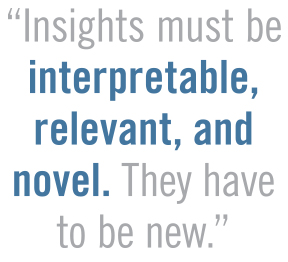
Unfortunately, insights have a shelf life. “Insights must be interpretable, relevant, and novel,” Wu says. “They have to be new.” Once an insight has been incorporated into a strategy, it’s no longer an insight, and the benefits it generates will cease to make a noticeable difference over time. To Target’s competitors, for instance, the kinds of signals that indicate pregnancy are now common knowledge, so Target now has less of an edge in this department.
Getting the Right Data
To get the right data leading to truly beneficial insights, a company must employ a sophisticated plan for collection, Mantha says. “Having a business case around the usage of data is the first important step,” Mantha says. A company should figure out what goals it would like to meet, how and why customer data is crucial to reaching them, and how this effort can help increase revenue and decrease costs, Mantha says.
Wu agrees, pointing out that “relevance is key,” and what is germane to a company is “determined by the problem [it is] trying to solve.” He distinguishes useful data as that which contains signal, and everything else he lumps under “noise.” But “one man’s signal can be another man’s noise,” he notes. If the target demographic is 18- to 34-year-old male sports fans living in New Jersey, it would make sense that the company would exclude information that falls outside those parameters.
Before we had countless tools to do the work for us, it was a no-brainer that companies would look only for the most pertinent data. “They’d start with the question, and collect the data that is specifically needed to solve the problem,” Wu says. Collecting more than that was impractical.
But today, the process can get confusing, because often data is accumulating before a set of goals has been outlined by stakeholders. “Data is being collected irrespective of any specific problem, question, or purpose,” Wu says. He points out that data warehouses and processing tools provided by the likes of Hadoop, NoSQL, InfoGrid, Impala, and Storm make it especially easy for companies to quickly attain large amounts of data. Companies are also at liberty to add on third-party data sources to enrich the profiles they already have, from companies such as Dun & Bradstreet. Unfortunately, most of the data, inevitably, is irrelevant. The key is to find data that pertains to the problem.
Mantha recommends setting parameters for data collection by identifying the right sources early on. “It could be a combination of internal data sources, which might include customer transactions, pipelines, or interactions that are logged in a CRM system,” Mantha says. “Determine some metrics that you monitor on an ongoing basis.” According to Mantha, having the key performance indicators (KPIs) in place will help companies identify the right data sources—the types of data sources that can help solve their problems.
Companies should also figure out what kinds of technology make sense for them. A company’s top concern might be risk, or the health of its potential customers. In that case, a vendor like FirstRain, which delivers commerce analytics, might be a good fit. The vendor’s solution can assess the likely outcomes from a signed deal. It analyzes the kinds of news, updates, and company changes that could affect an existing business relationship. “If you’re a finance department and trying to find out the risk of a client, you want to see their structured data—for instance, how much money they have in the bank,” Penny Herscher, president and CEO of FirstRain, says. “[But you] also want to see what’s being said about them.” Running a Big Data analysis of the company across the Web can yield indications of pending bankruptcy, for instance.
Of course, things change. Mantha emphasizes that data collection is an ongoing process that can be adjusted over time. “As the business needs change, and newer data sources are integrated, and newer business groups or lines of businesses are brought in as stakeholders, the dynamics and qualities will change,” Mantha says. “So this needs to be treated not as a one-time initiative, but as an ongoing program in which you continually enrich and enhance your data quality.”
And enterprises should continually monitor the success of their data usage and implementation to ensure they’re getting what they need out of it, Mantha says. There should be a constant feedback stream so that a company knows where it stands in relation to certain key metrics it has outlined. “If the data is not driving sales, go back to see if the insights were correct,” Mantha says. “If they were correct, were they complete? And were there other data points that could have been integrated? Or, was the data quality really an issue in driving insights?”
Risks
Companies must always be aware of the risks involved in using data, Wu says. The consequences of a prescription matter a great deal. He points to weather forecasts as an example. Though weather predictions are fairly accurate, there’s always the chance they’ll be wrong. Knowing the chance for rain is 85 percent tomorrow justifies bringing an umbrella to work. But the stakes aren’t high. If you bring an umbrella and it doesn’t rain, you haven’t sustained much of a loss—as you could with other kinds of faulty predictions. At the other end of the spectrum, our ability to predict earthquakes is weak, Wu points out, as we’re able to predict them only about three seconds ahead of when they’ll occur. Though, technically, that insight is predictive, as it sees into the future and determines the likelihood of an event taking place, it’s not actionable. Three seconds isn’t enough warning.
Companies shouldn’t use prescriptive analytics when there is significant room for error. It takes good judgment, of course, to determine when the payoffs outweigh the potential risks. Unfortunately, as in the earthquake example, it’s not always possible to get a prescriptive read on a situation. There are certain limitations. For one thing, collecting hard data from the future is impossible. Wu states it rather bluntly: “The future is inaccessible.” The closer something exists in time, the more likely it is that you can get a good prediction. The further ahead you have to look, the more open it is to errors.
People and Processes
Big Data adoption often becomes a change management issue, says Tanner, who notes that companies often steer clear of it. “Anytime a company wants to implement something that’s more data-driven, there’s a lot of resistance to it,” Tanner says.
Like most initiatives that propose technology as a central asset, Big Data adoption can create conflicts among the various departments of an organization. “It’s an interesting paradox,” Tanner says. “People struggle to accept data, but people also aren’t willing to give it up.” They feel they “own this relationship with the customer, and if [they] give it to you, you’re going to screw it up.”
To avoid such clashes, Mantha says, companies should make it clear from the outset which department owns the data. “Is it IT? Is it the individual practice owner? Is it the sales operations team?” he asks. Mantha suggests then putting the owner in charge of the data, having this person or department outline the business rules and how they should be applied to customers.
Tanner offers two key tips to company leaders, as they are the ones who must convince employees to get on board with data adoption and usage. The first: Give credit where credit is due. “Don’t dehumanize the job,” Tanner says. “Don’t attribute the success to the data, but to the person who does something with the data.”
The second piece of advice: Remember that change can’t just come from the top down. Big Data adoption requires more than executive support; it needs buy-in from everyone. He recalls the example of a holding company that simply did an informal presentation in which it convinced the various departments that shared data, if used across all departments, can lead to mutual growth. “It takes a grassroots movement,” Tanner says. 
Associate Editor Oren Smilansky can be reached at osmilansky@infotoday.com.