Interactive Video Breathes New Life Into Online Advertising
Traditional linear content is out; personalized dynamic content is in
By Maria Minsker

Traditional linear content is out; personalized dynamic content is in
By Maria Minsker
Traditional linear content is out; personalized dynamic content is in
By Maria Minsker

“Marketers are building advertisements for online video the same way they would build them for television.”
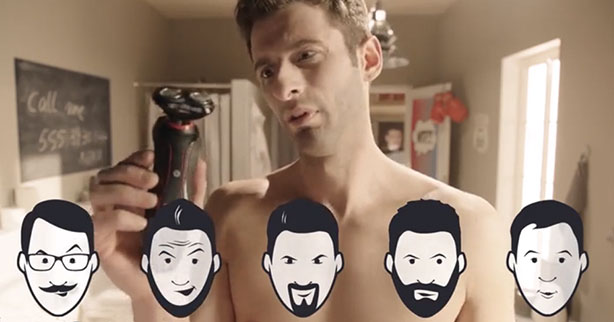
Philips' interactive video campaign for its Click and Style razor let viewers unlock different storylines by selecting a beard style for the main character.
Philips' interactive video campaign for its Click and Style razor let viewers unlock different storylines by selecting a beard style for the main character.
“Brand videos are always full of products, but without ways for consumers to engage with those products, they might as well not even be there.”
“Most consumers today have banner blindness. They've become immune to ads, and they don't like when brands are too forward about pushing them to make purchases.”
In the age of the DVR, most consumers have no patience for commercials. An increasing number of people no longer watch television programming when it actually airs anymore, opting instead to record and watch it without ads. Online video ads, the ones that appear before the intended content will load, don’t get much love either—most are terminated as soon as the skip button appears, yet marketers are still spending money on those coveted preroll spots. Video ad spending is projected to grow 22 percent annually, and with the traditional online video advertising model quickly succumbing to the same pressures that television advertising faces, marketers need to know there’s a better way to monetize video advertising.
From six-second Vines that flood social media to original programming from platform providers, online video is booming. Hoping to duplicate the success that Netflix has seen following the release of its original programs Orange Is the New Black and House of Cards, Yahoo, for example, is getting serious about video. CEO Marissa Mayer has announced that the company is fueling its video strategy with two new original series, and has hired former Today show anchor Katie Couric and Good Morning America’s Bianna Golodryga to join Yahoo’s news video production group. Hulu, which started out as a platform for television reruns, now has at least a dozen of its own original programs. And, in July, Amazon announced plans to invest $100 million in original video content this quarter. Even television network giants have embraced the Web; many now offer exclusive video content online.
Interest in on-demand video—be it user-generated video, television programming, or entirely original content—is growing. Smartphones and tablets have made it possible to watch videos whenever and wherever, creating greater viewing opportunities for consumers and more advertising avenues for marketers, says Andrew Lipsman, vice president of marketing and insights at comScore, a media analytics provider. Still, getting consumers to engage with ads hasn’t gotten any easier.
Linear Ads Are Losing Their Luster
Consumers aren’t the captive audiences they once were, trapped into watching television advertisements because there was no way to avoid them. Now they can fast-forward through a television commercial or “second screen” on their mobile device while they wait for the show to return. “Online, the story is even more bleak,” Lipsman says. Most preroll video ads can be skipped after only a few seconds of run time, and those that can’t are easily ignored. Viewers can hit mute or open a new tab and browse a different Web site while the ad runs.
As a result, preroll advertising is suffering—there are only three clicks for every 10,000 ads, according to Jonah Goodhart, CEO and cofounder of Moat, an advertising analytics and intelligence provider. The reason for the disappointing results, Goodhart says, is that “marketers are building advertisements for online video the same way they would build them for television, and failing to recognize how different the two channels are.”
For one thing, online advertisers can take advantage of programmatic marketing, which automates the delivery of data-driven, targeted, and personalized experiences to consumers as they interact with a brand’s various touch points, all in real time. With regard to video, programmatic ad buying means that brands can use first-party and third-party data to determine which consumers are most likely to be interested in certain products or campaigns and serve the ads containing the most pertinent content.
Though more dynamic than traditional ads, even programmatic advertisements are limited by their linear form. Most of the time, these 30-second videos are meant to merely raise brand awareness, leaving consumers no way to engage further with the brand. “Where there are calls to action within videos, they are often rudimentary and typically break the user experience by sending [viewers] off to another Web site to find out more about a pair of shoes or sign up for a B2B white paper,” Forrester analyst Anthony Mullen wrote in a recent report.
Most of the time, consumers are watching these ads while they wait for other content to stream or load, so asking them to abandon that content and explore a product is “asking a lot,” Mullen says. Furthermore, when it comes to the B2B space, the technology or solution is often too complex to explain in a 30-second video. “The technology might be interesting and appropriate, but B2B marketers can’t hope to convey all of the capabilities and benefits in a few seconds. And no one is going to watch a three-minute ad,” he says.
With linear videos, marketers are simply missing the mark, analysts agree. Online video is ripe ground, but brands are failing to harness the potential of the key thing that, for the time being, sets the Web apart from television: It can facilitate a real-time feedback loop with viewers.
Interactive Videos Are More Conversation than Campaign
Interactive video isn’t a new concept, but it is largely underutilized as a marketing tool despite the fact that it has been shown to drive engagement and conversion. Interactive marketing experiences run the gamut from self-guided explorations of certain brand products to clickable hotspots that allow consumers to click on different items and purchase them without ever navigating away from the video module. “Most televisions can’t quite do this yet, but computers and mobile devices can, and marketers aren’t taking advantage of this capability,” Mullen says.
Different types of interactive experiences carve out the path for different types of engagement, and most aren’t meant to replace traditional linear advertising. Rather, interactive video enables marketers to get on the on-demand video bandwagon by delivering rich content that consumers will eagerly seek out, rather than bombarding them with content they desperately want to skip or avoid.
Typically found on brands’ Web sites or social media pages, interactive videos perform better than linear advertisements, even though they aren’t served to an audience that has no choice but to view them before reaching other content. For linear videos, completion rates are as low as 50 percent, and even if a video is completed, there’s no guarantee that the viewer paid attention. Interactive videos, on the other hand, reach completion more than 90 percent of the time, which means a user continued to engage with the content, propelling the video forward. Click-through rates are higher as well, often reaching nearly 12 percent, compared to the industry standard of less than 1 percent for traditional video advertising, Mullen says.
“Consumers do more than just interact with brands at the point of sale,” Mullen says. “They also ‘like’ their favorite brands on Facebook, follow them on Twitter, and frequent their e-commerce sites for exclusive content,” he adds. Most marketing is becoming more conversation than campaign, and video can no longer be an exception to this trend. With a number of compelling solutions on the market, brands have several directions to explore.
Interactive solution vendor Rapt Media offers a branching capability that enables brands to build videos with a dichotomy structure, which takes consumers on personalized journeys based on the path they select. Each video asks viewers a series of questions with two possible answer choices, and depending on their answers, the video divides deeper into several paths, ultimately creating an experience driven by the consumers.
Last year, consumer electronics company Philips worked with advertising agency Ogilvy and Mather to create a campaign around its Click and Style electric razor, and enlisted Rapt Media to strengthen its creative efforts with interactive video. For Philips, the goal was to introduce men to new facial hair styles through a fun mobile interactive video experience without requiring them to download an app. The result was Philips’ “Designed to Play—One guy, 5 styles, 625 possibilities” campaign, which invited viewers to select the beard style of the main character to unlock different storylines.
The video opens with a man addressing the audience with the razor in his hand, struggling to remember what occurred the night before. Viewers are invited to help him remember by choosing one of five beard options, and then watch the story unfold as they continue to choose styles to propel the narrative forward. As the video plays and viewers make selections, their responses are recorded to track how they’re navigating and what styles are of interest to them.
“This helps Philips determine how to target individual consumers and give them additional information or offers on products that would be most appealing and relevant to them. Products for beard maintenance, for example, won’t be interesting to a man who prefers a clean shave, and the analytics that we provide can help brands better understand their audience,” Erika Trautman, CEO and founder of Rapt Media, explains.
Rapt Media’s Site Pairing feature sets up a direct communication pathway between the interactive video and the Web site, triggering the site to simultaneously load relevant product information and styling tips outside of the player. That way, when a viewer completes the video and starts browsing the site, all of the information on the site is targeted and customized based on how that viewer interacted with the video.
“When you’ve got an e-commerce site that consumers can buy from directly, this is particularly powerful because you know which items that consumer is interested in based on the video, and can put them right at the forefront, where they’re easy to find and buy,” Trautman says.
In Philips’ case, injecting an interactive element into its mobile-first campaign paid off—average mobile interactive video viewing time exceeded four minutes, and the average viewer interacted three to four times. The campaign performed so well that Philips and Ogilvy and Mather signed on to work with Rapt Media for at least another year, with plans to expand the campaign further, potentially leveraging the Eloqua integration that Rapt Media introduced in August.
With the integration in place, in-video user interactions will be captured by Eloqua’s marketing automation suite to allow marketers to score leads. “No one wants to fill out long forms anymore, but by building the marketing automation technology into the interactive videos, we’re giving marketers a way to not only gather valuable intel on consumers, but also make their follow-up communications with consumers simpler and more targeted,” Trautman says.
Rapt Media’s approach to interactive video isn’t the only one, however. While some brands may benefit from delivering a question-driven experience to their customers, others may prefer a more subtle interactivity. “Brand videos are always full of products, but without ways for consumers to engage with those products, they might as well not even be there,” says Chris Roebuck, CEO and cofounder of Clicktivated. Using Clicktivated’s technology, users can transform pre-existing videos into interactive content by making items in the video clickable and, in most cases, purchasable without being forced to answer a series of questions, interact with pop-ups, or navigate away to other sites.
Companies such as Garmental, an online fashion community that connects shoppers with local designers and boutiques, use Clicktivated’s technology to make the items featured in their styling videos easy to buy. If a viewer likes a particular item, he or she can click on it, and a link to purchase the item appears in a sidebar within the video module. The viewer can click on it once the video is over, or while it’s still running—the navigation is entirely in the hands of the consumer. Once the viewer is ready to buy, the link will redirect right to the buy page, streamlining the conversion process.
“Most consumers today have banner blindness. They’ve become immune to ads, and they don’t like when brands are too forward about pushing them to make purchases. Clicktivated’s approach gives consumers the autonomy to seek out the products that interest them, and, in our experience, that’s proven to be more effective,” Roebuck says. Clicktivated’s clients see an average conversion-to-purchase rate of 7 percent, along with high engagement and social share rates.
A marketing tactic that promises to be game changing for the B2C space, interactive video has much to offer B2B marketers as well. In the same way that B2C marketers can better engage consumers with interactive videos, B2B marketers can leverage the tools to target content more effectively and present information more relevant to specific user groups. “If you were on the phone with a prospect, you wouldn’t just talk at them for five minutes,” Michael Castellano, CEO of Engajer, says. “You’d structure your pitch or proposal as a conversation.”
Though Engajer works with consumer brands, the company also provides interactive video solutions for B2B organizations such as SugarCRM, Fujitsu, and Phoenix Systems. A sample video for SugarCRM, for example, starts with an introduction from CEO Larry Augustin, but then gives users the option to explore one of three sections—how CRM works, the benefits of using CRM, or why SugarCRM is the choice for them.
“For B2B marketers, the possibilities are just as vast as for B2C marketers,” Mullen says. “Interactive videos give them the opportunity to segment by industry, or dive deeper into a specific product focus. It’s just a better way to engage with viewers through personalized content,” he adds.
The Future of Video Advertising
With the buzz surrounding interactive video, one might assume that interactive ads pose an immediate threat to traditional ads that lead in to other online content, but that’s not the case, Mullen reiterates. Rather, the preroll approach to advertising will eventually taper off, and on-demand interactive content will become the most effective way to advertise through video, industry experts say.
Advertisements that serve as barriers between viewers and the content that they actually want to view don’t work because they’re inherently set up to fail. Not only are they blocking other content, but they’re also not as engaging and, often, not as relevant as they could be, Roebuck claims.
“Even the best ad targeting is really just highly sophisticated guessing. With interactive ads, the consumer herself is telling you what she’s interested in,” Trautman adds. “Everyone knows that shopping has become more about consumers doing their research and finding brands or products that interest them, so the demand for informative marketing content is there, no doubt about it,” she explains. In the coming years, consumers should expect to see fewer ads before or during online videos, and more appearing on brands’ Web sites or social media pages, where consumers can seek out the content themselves.
And interactive video isn’t just changing advertising online—TV ads will change as well. Advertisers have begun using a combination of text messaging, mobile applications, and second-screen solutions to enable users to respond to TV content, but this approach is largely transitional, Mullen says. Eventually, televisions will be able to receive interactive responses through mobile broadband IP connections, various TV platforms, smart TVs, game consoles, Blu-Ray players, and other technology.
“Picture an automotive television ad that can determine that both mom and dad are sitting on the couch. With a single command—‘drive’—they can both be placed in the new Jaguar model, explore the dashboard, and choose the track they would like to drive on using steering wheel and gearstick gestures,” Mullen wrote in his report. “You can already talk to an Xbox and give it commands, for example, so building this functionality into ads is just taking that one step further,” he adds.
In as little as five years, interactive advertising could become mainstream, and analysts are optimistic about what it can do for consumers and for marketers. “It’s going to be revolutionary,” Mullen says. 
Associate Editor Maria Minsker can be reached at mminsker@infotoday.com.