Required Reading
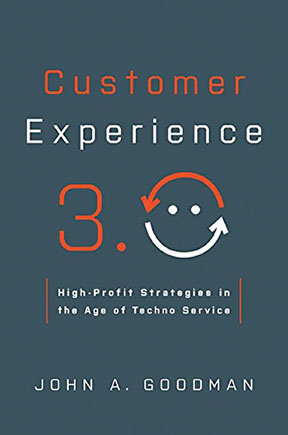
Introducing Customer Experience 3.0
The new era of CX must bring sales, marketing, and service closer together
Required Reading
Introducing Customer Experience 3.0
The new era of CX must bring sales, marketing, and service closer together
Required Reading
Introducing Customer Experience 3.0
The new era of CX must bring sales, marketing, and service closer together
The key is to not only capture the voice of the customer, but also to listen to it.
Modern devices and technologies have dramatically changed not only the way customers seek service and support, but the way companies deliver it as well. Though offering outstanding service has become easier in many ways, it has also become more tempting for brands to rely too much on technology and not enough on customer experience fundamentals. How can companies get back to their roots? John Goodman, author of Customer Experience 3.0 and cofounder of customer research firm TARP, says it’s all about breaking down the silos between sales, marketing, and service. He shared his insights with Associate Editor Maria Minsker.
CRM: How does the 3.0 in the title of the book reflect the evolution of customer experience?
John Goodman: In the 1990s, people coined the term customer experience. referring to wowing the customer with service. Then, in the early 2000s, a number of companies, IBM being one of them, started talking about customer experience 2.0, which was all about applying CRM technology. This was really just aimed at improving marketing and sales through personalization and segmenting. At first, customer experience was about service, and then it became about marketing and sales, but I see customer experience 3.0 as a combination of all three. Customer experience is moving past applying technology to just the sales part of the organization or the service part, [instead] applying it to the end-to-end journey.
CRM: What are some common mistakes companies make when it comes to customer experience?
Goodman: Web site structure is probably one of the biggest mistakes I’ve noticed. Usually, roughly 85 to 90 percent of [a company’s] Web site is marketing and sales, and then if you dig in, you can eventually find something that will take you to the support section of the Web site. But 80 percent to 90 percent of visitors to companies’ Web sites are existing customers who are trying to get help with something. So the home page for most companies is exactly the opposite of what it should be.
CRM: Can you describe the four-part customer experience framework you outline in the book?
Goodman: The first part is simple—do it right the first time. Design a product with a value that’s unique among others on the market, set proper expectations, and deliver it properly to the customer. This is where sales and marketing play a crucial role. The second phase is providing access to service and encouraging this access, and the third phase is the actual service itself. The big problem is that most companies don’t empower their representatives to solve problems and don’t provide valid explanations for certain policies. If companies are transparent, customers can be very forgiving. The last part is having an effective voice-of-the-customer system in place. Most companies rely on surveys and complaints, but 70 percent of these have very little impact on the product. The key here is to not only capture but also listen to the voice of the customer.
CRM: Can you provide an example of a company that’s getting it right?
Goodman: No company is perfect, but FedEx is consistently good. The company understands that customers want to track their packages, and it has been great about sending emails with constantly updated tracking information. Recently, FedEx took that experience a step further—it uses GPS transmitters in packages and shipping containers to automatically tell customers where their packages are, what temperature they’re at, or if they have recently been bumped. Their ad campaign is “Be the First to Know.” FedEx has also done a lot right in terms of being proactive about customer education. Its site has content on how packages get damaged and what customers can do to protect their packages. They’re a great example of how to combine powerful technology with service basics. And the efforts pay off. When a company delivers a good experience, it doesn’t need to spend a lot of money on marketing. That’s how powerful word of mouth can be.
CRM: How are emerging technologies reshaping customer experiences?
Goodman: Online video is having a huge impact. Increasingly, brands that rely on long documents and files to provide self-service support are transitioning that information onto videos because that’s the way customers prefer to consume content now. The key is to keep them helpful and informative, but short. Tesla had a good video on its company Web site recently, but it was 28 minutes long. No one was watching it. They broke it up into 16 chunks and all of a sudden, views are up. The Internet of Things is going to be a game changer as well. You’re going to have cars that can self-diagnose mechanical issues or refrigerators that will tell you when you’re out of milk. That’s going to require a different approach too.