ON THE SCENE: CRM Evolution 2014
Modern Marketers Must Focus on Context, Content, and Revenue
Good products are not enough to engage customers in the digital age
ON THE SCENE: CRM Evolution 2014
Modern Marketers Must Focus on Context, Content, and Revenue
Good products are not enough to engage customers in the digital age
ON THE SCENE: CRM Evolution 2014
Modern Marketers Must Focus on Context, Content, and Revenue
Good products are not enough to engage customers in the digital age
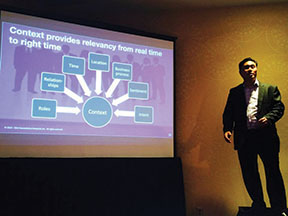
Constellation Research’s Ray Wang spoke on the role of context at CRM Evolution.
(Editor’s note: The following story appeared previously on DestinationCRM.com on August 18. The full story is available there.)
The digital transformation is forcing brands to break down the silos between marketing, sales, and customer service to deliver consistent cross-channel experiences, presenters agreed on day one of the CRM Evolution conference held in New York City. To keep up with this changing market, however, companies must transition their focus from selling products to delivering outstanding experiences driven by context, content, and revenue.
Such innovation is often not a product or service, but rather the context in which that product or service is delivered. “If you look at a company like Uber, the product is not that innovative. They’re a transportation company,” Ray Wang, principal analyst and founder of Constellation Research, said. “But at the same time,” he added, “they’re using social technology to generate driver reviews, mobile technology to deliver the app, cloud technology to power the whole thing, and big data analytics to track surges that alter their pricing. It’s a very innovative business, but it’s not about replacing taxis. It’s about removing an intermediary that gets in the way of inefficient transportation, and making the process simpler.”
Context is a differentiating factor for companies that succeed in the digital age because it can be the difference between real time and right time, Wang said. Though new technologies have made real-time marketing more lucrative and attainable, taking a contextual marketing (or right-time marketing) approach is often more rewarding because the product becomes more relevant.
But relevancy shouldn’t just apply to the context that marketing messages are delivered in; it should also dictate the messages themselves. “Marketing activities are shifting away from banner ads and pay-per-click, and towards sharing valuable content,” Jim Berkowitz, founder and CEO of CRM Mastery, said. “Content marketing should make you feel something that guides you to take an action on your own, instead of being told to take that action.”
Content marketing beginners should “figure out where they stand before they try to run,” Berkowitz urged, suggesting that evaluating a company’s current content strategy is the first step toward success. Subsequent steps include identifying the types of content that will resonate best with the brand’s audience, determining the best channels for content promotion, and integrating multimedia pieces throughout. Berkowitz also suggested that businesses leverage new content-driven approaches to advertising, including native and sponsored content.
Publishers are adopting new advertising models, which opens the door for businesses that want to advertise through quality content, according to Berkowitz. Increasingly, online magazines and newspapers are featuring articles and stories that brands have commissioned them to write or include. The New York Times, for example, has formed a new editorial team, the T Brand Studio, specifically to create content for brands.
In June, the newspaper ran a 1,500-word native ad for Netflix’s original series Orange Is the New Black. Rather than appear as a blatant ad, the content appeared as an article on female incarceration in the United States. Though there was a Netflix logo above the story to signify that the piece was branded content, the association wasn’t immediately obvious. “It’s a perfect example of how brands can organically build interest in a product,” Berkowitz said. “It’s not a banner ad that says ‘Click here to subscribe to Netflix and watch Orange Is the New Black.’ It’s relevant content that says ‘Here’s an article on a topic, and if this topic appeals to you, then you may want to check out this show,’” he explained.
Content marketing is also a critical component in revenue marketing. In the past, if a customer was interested in buying a product, salespeople were involved almost immediately, educating the consumer and guiding him through the purchase process. Now the buying cycle is different, and by the time sales teams enter the picture, the customer has already done preliminary research and is well-informed, Bruce Culbert, chief service officer at The Pedowitz Group, said. “Today, 60 to 80 percent of the B2B buying process is self-directed without any sales contact. So how can brands engage their customers and drive them to buy? Through revenue marketing,” he said.
Revenue marketing, which Culbert defined as the combined set of strategies, processes, people, technologies, content, and results across marketing and sales, is the future of selling, he said. While the traditional approach to marketing is siloed and focuses heavily on brand building and generating impressions, revenue marketing is analytics driven, and relies primarily on content marketing. “Content plays a huge role in breaking the silos between marketing and sales. Businesses have to map out their customer buying cycle and align their content strategy with this cycle,” he said.
—Maria Minsker