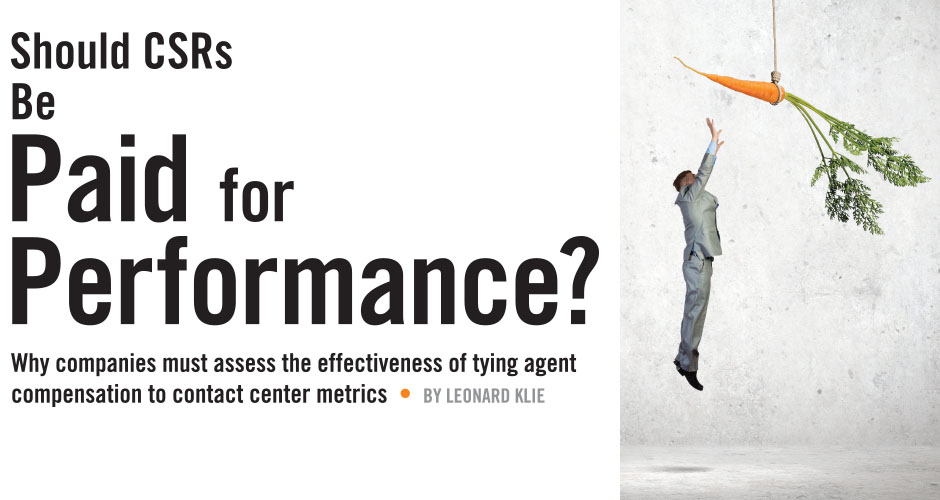
Why companies must assess the effectiveness of tying agent compensation to contact center metrics • By Leonard Klie

“If the program is fair, it can work.”
Not Everyone’s a Comcast
While Comcast might be seen as an example of a pay-for-performance program gone wrong, it is certainly not the typical case. For years, Xerox’s Affiliated Computer Service contact center outsourcing unit has been rewarding its employees with a variable pay system called Achievement-Based Compensation (ABC), which is often cited as a success story. Through ABC, employees are paid based on how well they deliver on the immediate needs of the client and the company. Typically, quality standards are tiered, with a percentage attached to each level. A dedicated ABC Oversight Team has the sole responsibility of implementing and improving on ABC programs companywide.
In one customer data capture unit, the ABC program resulted in a 21 percent increase in productivity and a 98 percent quality measure. In a customer care center implementation, absenteeism was reduced from 13 percent to 3 percent after ABC was introduced.
Among the benefits cited by the company have been reduced call handling times, reduced labor costs, efficiency gains, reduced supervision and coaching times, increased customer satisfaction, and the ability to increase the use of home-based agents.
Another success story is VForce, the outbound cloud contact center serving AAA clubs across the country. VForce saw similar results by changing its compensation structure. A few years ago, the company noticed that its 60 home-based agents, after hanging up from one call, weren’t jumping on the next call right away and were taking a lot of breaks. Moving to a performance-based structure enabled VForce to better align agent behavior with company goals, leading to a 20 percent increase in agent productivity.
Not Everyone’s a Comcast
While Comcast might be seen as an example of a pay-for-performance program gone wrong, it is certainly not the typical case. For years, Xerox’s Affiliated Computer Service contact center outsourcing unit has been rewarding its employees with a variable pay system called Achievement-Based Compensation (ABC), which is often cited as a success story. Through ABC, employees are paid based on how well they deliver on the immediate needs of the client and the company. Typically, quality standards are tiered, with a percentage attached to each level. A dedicated ABC Oversight Team has the sole responsibility of implementing and improving on ABC programs companywide.
In one customer data capture unit, the ABC program resulted in a 21 percent increase in productivity and a 98 percent quality measure. In a customer care center implementation, absenteeism was reduced from 13 percent to 3 percent after ABC was introduced.
Among the benefits cited by the company have been reduced call handling times, reduced labor costs, efficiency gains, reduced supervision and coaching times, increased customer satisfaction, and the ability to increase the use of home-based agents.
Another success story is VForce, the outbound cloud contact center serving AAA clubs across the country. VForce saw similar results by changing its compensation structure. A few years ago, the company noticed that its 60 home-based agents, after hanging up from one call, weren’t jumping on the next call right away and were taking a lot of breaks. Moving to a performance-based structure enabled VForce to better align agent behavior with company goals, leading to a 20 percent increase in agent productivity.
TV, phone, and Internet service provider Comcast made national news in mid-July when an eight-minute audio clip of a pushy customer service representative (CSR) trying to convince a customer not to disconnect his service went viral. In the audio, the agent is heard badgering the caller, pressing repeatedly for an answer: “Help me understand why you wouldn’t want the number-one service!” The agent carried on as if his salary depended on keeping the customer from churning. As it turns out, it did. Agents in Comcast’s retention department were being paid based on the number of customer accounts they saved. According to one account, Comcast can withhold agents’ bonuses if they fail to retain as many as 75 percent of cancellation requests.
Comcast issued a formal apology to the caller, tech editor Ryan Block. “The way in which our representative communicated with him is unacceptable and not consistent with how we train our customer service representatives,” Tom Karinshak, senior vice president of customer experience at Comcast, said in a statement.
Comcast also placed the agent on leave, even though Block requested that he not lose his job over the incident.
“While the overwhelming majority of our employees work very hard to do the right thing every day, we are using this very unfortunate experience to reinforce how important it is to always treat our customers with the utmost respect,” Karinshak added in the statement.
When a customer service debacle turns into a public relations nightmare, it puts a lot of pressure on an organization to find the cause of the problem immediately. The simple, and often public, response is to blame the agent. But is the agent solely at fault for his behavior, or is there a larger, more systemic, problem at hand? Contact center experts suggest it could be the latter, pointing to agent compensation as one of the biggest customer service snags.
Compensating CSRs
Base pay for contact center employees has always been low. The average annual starting salary for contact center agents is $27,542, while more experienced agents earn $34,777 on average. Team leaders/supervisors earn $43,977 per year on average, and pay for managers averages $67,580 per year, according to research firm ContactBabel’s 2014 study “U.S. Contact Center HR and Operations Benchmarking Report.”
The low salary for CSRs is one of the reasons that their turnover rate is so high, according to ContactBabel, which puts the mean attrition rate at 27 percent. It states that contact centers that offer a higher base salary see far lower attrition rates, averaging more than 10 percentage points below industry norms.
To compensate, many contact centers supplement low wages with performance-based bonuses, incentives, or rewards programs that can bolster salaries by several hundred to several thousand dollars, depending on the type of work the agent performs.
Agents who make outbound calls, for example, tend to receive lower base pay than those who handle inbound calls, but they typically get higher bonuses and commissions, according to ContactBabel’s report. Sales and collections agents also tend to get rewarded more often than customer service agents, the firm found.
The ContactBabel report notes that 86 percent of contact center operators offer bonuses to sales agents, typically in the form of commissions that average about 18 percent of their sales totals. In collections, agents also receive a percentage of the money they bring in.
“In the customer service arena, there are far fewer rewards for doing your job,” laments Donna Fluss, founder and president of DMG Consulting. “It’s not fair. Sales gets all the attention and the rewards.”
But some industry professionals question whether performance-based incentives belong in the contact center. “I am not a fan of these programs,” Kathleen Peterson, founder and chief vision officer at contact center advisory firm Powerhouse Consulting, states emphatically. Peterson says it would be far better for contact centers “to pay people what they deserve up front,” rather than having them compete with or outperform their peers to get extra pay.
Current research supports part of this claim. “One would think that higher pay should produce better results, but scientific evidence indicates that the link between compensation, motivation, and performance is much more complex,” researchers concluded in a study titled “Does Money Really Affect Motivation?” conducted by Harvard Business Review. In fact, dangling a financial carrot might actually have a negative impact, the research found. “The association between salary and job satisfaction is very weak,” the study’s authors concluded. “The more people focus on their salaries, the less they will focus on satisfying their intellectual curiosity, learning new skills, or having fun, and those are the things that make people perform best.”
Peterson also criticizes some of the metrics on which compensation is based, stating they are either unrealistic or out of agents’ control. “You can tell me as an agent that I need to handle twenty calls an hour to get a bonus, but if the call center doesn’t get that kind of volume, there’s nothing as an agent that I can do about it,” she says. “I can’t make the phone ring. Or, the phone system can go down. That’s an IT issue, not something I can control.”
Peterson also maintains that “far too often” these types of pay-for-performance programs come into conflict with stated customer experience goals. The now infamous Comcast call, Peterson says, “is a perfect example of someone trying to push something that was not in the interest of the customer, just to make a goal.”
Agent Compensation Is Not All Bad
Still, there are those who support the pay-for-performance structure when it is executed fairly and ultimately works toward improving the customer experience.
“If the program is fair, it can work,” Fluss says. “No matter what, when you reward people, it has to be balanced.”
And then, “the rewards need to be tangible,” she adds.
But even Fluss tempers her support for these types of programs. “We don’t want to motivate employees just to reduce average handling times at the cost of quality or customer satisfaction,” she says. “If you want to do it right, you want to reward [the agent] for offering good, quality customer service while also reducing handling time.”
Brad Cleveland, a senior advisor and former president and CEO of the International Customer Management Institute (ICMI), agrees. “These programs are usually effective in getting a desired result, but at what cost to the larger customer service objective?” he says. “You will get what you want, but you have to look at the broader picture—did we meet the customer’s needs and was it how we want our brand represented?”
Cleveland also says pay-for-performance programs “can have a temporary impact on performance,” but the improvements are all too often “not sustainable over time.”
For that reason, experts suggest mixing up the rewards a bit. “Programs need to be changed from time to time to keep them interesting and relevant,” Fluss says.
Gamification—turning the quest for rewards or incentives into a friendly competition, where employees can see where they are in relation to the goals and other employees—is also one way to build enthusiasm for the program, according to Fluss.
The caveat, though, is that leaderboards could disincentivize the person at the bottom. One way to overcome this, many gamification advocates suggest, is to spread the competition across teams rather than individuals, with shared incentives and bonuses going to the whole team. In this type of scenario, higher-performing agents provide mentoring and motivation to lower-performing ones for the benefit of the whole team.
Fluss also says that adding a little variety can help ensure that the program reaches the largest number of employees.
“You can’t have one rewards system that’s right for everyone,” she states. “There are some people who will work harder for a trophy and others for more money.”
Additionally, incentives, bonuses, and rewards in general will not appeal to everyone. “They will drive the behaviors of some but not others,” Fluss contends. “There will always be some people who come in at nine and leave at five, and there will be others willing to put in a little extra for some kind of reward. There are those who will strive to make the goal and those who will not.”
Based on this, companies looking to motivate their work forces “need to understand what their employees really value, and the answer is bound to differ for each individual,” the Harvard Business Review study’s authors suggested.
Among the firms that give added incentives or bonuses to employees, spot prizes (such as gift cards and vouchers) are the most widely used at nearly 88 percent of firms according to ContactBabel’s research. Some firms even reward employees with preferred parking or a free lunch in the company cafeteria.
The CSR-Cash Consideration
ContactBabel, however, suggests that added cash in agents’ paychecks might be a more effective motivator. In its research, it found that 44 percent of employees would prefer to receive financial incentives to other rewards.
Fluss also advocates for monetary rewards. “Organizations have the best chance of motivating people by offering tangible, monetary rewards,” she says. “It doesn’t have to be a big reward, but it should add up to something.”
On this point, though, there is widespread disagreement. Not everyone is convinced that additional financial compensation is the best carrot to wave in front of agents. The prevailing thought is that what makes an incentive meaningful is its perceived value, with that value not necessarily having to be monetary.
Kate Leggett, a vice president and principal analyst at Forrester Research, says financial compensation is only part of what motivates employees. “Bonuses are an effective motivator as long as the employee feels valued and has a career path within the company and has a job that satisfies her,” she says.
Regardless of the type of incentives offered, they need to be “additive,” says Brian Koma, vice president of research and enterprise feedback management at Verint Systems. “They should not be punitive.” That was also part of what was wrong at Comcast, according to experts. While agents were rewarded for the customers they kept, they were also penalized for the ones that they lost.
“What you’re trying to do with any rewards program is achieve desired goals,” Fluss says. Particularly in the customer service arena, “agents should be rewarded for going above and beyond to satisfy the customer,” she says. “And when you ask [an agent] to upsell and cross-sell, you’re asking her to take on an added responsibility, and there should be added compensation or reward for that.”
What to Weigh
“You have to make sure that you are focused on the right things,” ICMI’s Cleveland advises. “You want to establish incentives with goals and targets that are clearly designed, understood, and accessible to all.”
And then the criteria need to be “applied evenly across the board and communicated equally to all employees so that everyone has the same opportunity to earn a little something extra from time to time,” Cleveland says.
When it comes to the criteria used in determining bonuses and incentive pay, the most common factors are call duration, first call resolution rates, Net Promoter Scores, upselling and cross-selling successes, attendance, and availability, according to ContactBabel’s research.
Besides showing up for work, there are really two areas where the most attention should be placed, according to Cleveland—schedule adherence and quality. “Basically, it should come down to two questions,” he says. “Was I in the right place so I could be there when the customer needed me, and did we accomplish what the customer wanted? Did we provide the right solution to the problem?”
Weighing these two factors “consistently yields the best results,” he says. “Combined, they’re very powerful.”
Companies would also do well to consider whether the goals being sought provide any real value for the company. If not, there’s no reason to push employees to achieve them, Cleveland says.
It also helps to consider whether the goals warrant extra pay.
Koma maintains that sometimes a little recognition in the form of modeling some behaviors across the entire company can go a long way. “In many instances, this can be more powerful than monetary compensation.”
Koma also cautions against tying incentives to the wrong behaviors. “If employee compensation is tied to customer surveys, then the employees must have an ability to impact ratings,” he says. If not, it can discourage them or lead to situations where agents specifically request that callers give them high marks on post-call surveys.
After all, the last thing you want is for agents to try to influence the outcome of the surveys, Cleveland says.
That’s why Cleveland and others recommend using post-call survey questions that can be answered with yes and no responses.
It also doesn’t hurt to allow supervisors to weigh in. Supervisor scorecards are used in 48 percent of programs, according to ContactBabel, but that number should be much higher.
This is always a good idea in any contact center, even without a pay-for-performance program in place.
“If you look at why people are leaving call center jobs, one of the main reasons is that they’re not getting the attention they need from their supervisors,” Fluss contends. “Recognition, in conjunction with rewards, makes it better. And employee engagement, with recognition and rewards, is even better still.”
Cleveland agrees. “It’s not a trivial thing,” he says. “It can keep people around. It can be a motivator, but it has to be part of the broader company environment.”
No matter how you cut it, pay-for-performance programs can work well for some employees motivated to reach certain goals. However, they cannot and should not take the place of a positive workplace environment and proper agent training. Companies that keep these two factors in mind can avoid repeating Comcast’s recent public relations nightmare themselves. 
News Editor Leonard Klie can be reached at lklie@infotoday.com.