
Who Killed Sales Enablement?
The way sales enablement has been treated – by vendors, and by many sales and marketing professionals – borders on the criminal.
Neglected, dislocated, starved of resources and strategic planning, sales enablement barely has a pulse in many organizations. Who killed it? There’s plenty of guilt to go around.
All too often, marketing provides sales enablement tools only when their absence starts to derail deals and cost money. Vendors have made this all too easy by pushing point solutions without making any efforts to tie them to an underlying strategy. This reactionary approach provided sales with an incomplete set of tools, each working in isolation from the others, sputtering along and struggling to cope with an ever-more challenging sales environment.
According to Forrester, only 1 in 10 executives report getting value from meetings with salespeople. Clearly, sales is going into these meetings lacking critical tools. And according to the Ovation Sales Group, the average salesperson prospects for 6.25 hours to set each appointment. That means that, for every appointment a prospective customer finds useful, salespeople have invested 62 hours and 30 minutes – more than an entire working week.
It would be easy to leave sales enablement for dead, another victim of the extinction that looms for any business practice that falls behind the ROI curve. But bringing sales enablement back to life is not only possible but hugely profitable – and it’s easy if you approach it with the right definition and a defined strategy.
Sales Enablement Defined
Enablement has been hobbled by its definition – or rather, its lack of one. Like many other terms, “sales enablement” has been pushed, pulled, stretched and shaped to fit whatever is required in the moment. That means one thing for a vendor, another for a consultant and another for an actual practitioner. Becoming a buzzword means that “sales enablement” is a term that’s heard more often and understood less.
Analyst firms including Forrester have wrestled with a definition (they define it as “function within an organization, albeit an emerging and poorly defined one”) and agreement is hard to come by. So for clarity’s sake, let’s use a broad but practical view of sales enablement: it refers to the strategy, the methodology, the processes and the technology needed to arm sales people with the right skills, tools and content to win business.
When it comes to technology, there are some basics that you must have – playbooks, a content portal, workflow, collaboration and the ability to use these tools from a handheld device. These are not insignificant tools – in fact, they’re vital tools your sales team needs to best the competition, and they require attention and resources to configure correctly. But just having these and thinking you’ve got a complete enablement strategy in place is like having a baseball glove and thinking you’re a major leaguer. You’ve got to know how to use them – and you must realize they are merely the basic tools needed to help execute a much broader strategy. Real enablement goes much deeper and starts with strategic decisions that enable sales to use technology to the greatest effect.
So, what should you focus on in order to truly enable your sales team?
Training – Now and in the Future
After you’ve hired the right people, you must on-board them. But training can’t stop there. According to CSO Insights, two-thirds of reps take seven months or more to be productive. Clearly, most companies are not achieving what they need with their early-stage training of sales reps. And it goes downhill from there. Most sales reps don’t get much training after they’re on-boarded, which is another productivity killer, but for a different reason. After three years, most sales reps have reached their potential and are now at their most productive – but it’s at this stage that many start looking for their next opportunity, in part because they feel the company has disengaged with them – with no further professional development, they feel like mere cogs in the wheel.
A smart enablement strategy builds ongoing training into the sales program – not classroom training which takes sales reps away from selling, but training provided in formats they can use on their time. Training delivered through a mobile platform, for example, allows them to view training in times and places that are convenient – and certainly more convenient than a classroom.
Turning Managers into Coaches
Sometimes, sales reps need individualized coaching reach their potential. This is education targeted at specific individuals – and something that training on its own can’t deliver. Any sales enablement system should have a component of coaching built into it, helping managers deliver precisely the kind of coaching a rep needs quickly and effectively. The manager shouldn’t have to create this coaching on his or her own – the sales enablement system should deliver it directly and in a form that’s ready for use in the way the manager wants to deliver it.
Aligning with Marketing Around Common Data
If sales hopes to close more leads, it needs to understand how the leads it receives were collected, scored, prioritized and researched. Recent CallidusCloud research revealed that almost two-thirds (62.57) of businesses still had all or part of their lead data in systems that were visible only to marketing. That takes a critical element of context away from sales, and forces sales reps to re-discover aspects of the leads they’re working, wasting valuable time.
Aligning around a common set of data eliminates this. It allows marketing to pass a more complete picture of each lead to sales, improving the chances of a closed deal. It also enables sales to provide feedback to marketing that can help fine-tune the definitions of qualified leads and tap sales’ experience to make the leads they get from marketing better and more likely to close.
Automating Processes to Speed Sales
Sales reps who sell faster sell better – so it’s critical to make the sales process faster and easier through automation of key tasks to drive performance.
The most basic form of this comes in the form of notifications and schedule alerts that help sales reps manage their time. But automation goes far beyond this. For example, configure price quote (CPQ) turns the process of building quotes into a point-and-click exercise, reducing the time needed to create a quote from hours or days to minutes, and automatically delivers content based on products selected in the quote. Not only does this help the rep create quotes faster, but it helps avoid errors . It also has a major impact on the customer, who gets the products and services he or she wants faster and with greater precision.
Contract lifecycle management (CLM) has a similar impact. By allowing sales reps to be alerted to contract expirations, CLM avoids manual research into the details of customer contracts and allows reps to be proactive in seeking renewals – and, at the same time, up-selling and cross-selling the customer at exactly the right time.
Customer Experience: Setting the Stage for the Next Sale
The experience sales creates has a direct impact on whether the customer buys not just today but also in the future, especially as customers demand more subscription-based offerings. This puts the onus in the business to measure customer experience more often, and understand the impact that sales people and the processes they use have on that experience. This data can be useful in individual sales, allowing reps to change things to suit a customer’s particular needs. This data can be even more useful in aggregate, when it can identify trends and areas in the selling process that negatively impact customers and hamper sales’ ability to sell to them.
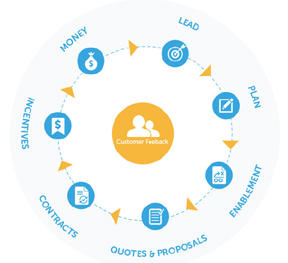
None of these ideas is traditionally thought of as a part of sales enablement – they’re not the tools most of us are accustomed to. But if you want to breathe new life into sales enablement, stop looking at it as a set of tactics or tools and realize it’s instead a strategic framework for making sales more productive, better trained, and more plugged in to sales and marketing data. True sales enablement helps you turn leads into money. 
About CallidusCloud
CallidusCloud is the global leader in cloud-based sales, marketing and learning solutions. CallidusCloud enables organizations to accelerate and maximize their lead to money process with a complete suite of solutions that identify the right leads, ensure proper territory and quota distribution, enable sales forces, automate configure price quote, and streamline sales compensation — driving bigger deals, faster. Over 3,500 leading organizations, across all industries, rely on CallidusCloud to optimize the lead to money process to close more deals for more money in record time.
Give your marketing and sales teams a solution that helps them stay in sync, on track, and committed to the joint cause of bringing in revenue. Contact our experts today at
www.calliduscloud.com or call 1-866-812-5244