Required Reading
Finding the Soft Edge
Solid strategy and great execution are just two sides of the long-term success triangle
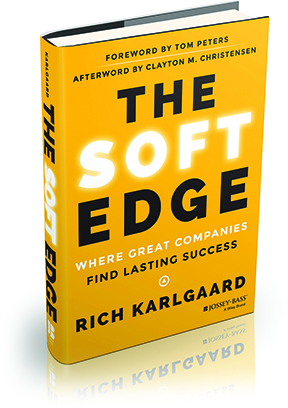

Since the 2009 recession, politicians have been eager to declare that the worst is over, and that the American economy is back in full swing. Still, statistics have shown that more than 70 percent of Americans believe the nation is struggling, and only 30 percent see an improvement. According to Rich Karlgaard, author of The Soft Edge: Where Great Companies Find Lasting Success, this pessimism stems from the unevenness of the U.S. economy—in September 2012, Apple was declared the most valuable company in the world, while Kodak, which Karlgaard calls “the Apple of 20th-century America,” declared bankruptcy, both within the span of one month. So what makes some great companies succeed and others fail? The difference, according to Karlgaard, is the soft edge. He shared his insight with Associate Editor Maria Minsker.
CRM: In The Soft Edge, you suggest companies build their business around a triangle model. Can you explain what each side represents, and what makes the soft edge particularly important?
Rich Karlgaard: At the base is strategy. To be successful, companies need to know who their customers and competitors are, and they must be good at seeing all of the potentially disruptive threats. Second, the company must excel at execution—this is the hard-edge side of the triangle. Good execution means that financial officers and operations people are managing costs well, managing logistics, and using analytics. Truthfully, if you stop right there, you’ve already got a great company. But companies that have lasted a long time and have survived economic storms to inspire real passion do a third thing—they’re really good at expressing their cultural values and greater purpose through the side I call the soft edge.
CRM: What are some of the factors that contribute to thriving on the soft-edge side?
Karlgaard: I narrowed it down to five attributes. First, companies that embody the soft edge are creating an atmosphere of trust. Second, they are good at organizational learning or “smarts,” meaning they’re dedicated to educating their employees and making them better. The third factor, teams, is a two-parter. One element is leveraging small groups, meaning eight to 10 people. The second part of the team factor is leveraging cognitive diversity, and that includes not only racial diversity, but also age, experiential, left brain versus right brain, and class diversity. Fourth is what Steve Jobs called taste—how to get people excited. And lastly, number five is telling a story, and adding the voice of the customer into that story.
CRM: As new analytics and measurement tools place more emphasis than ever on hard-edge metrics, how can companies stay on point with their soft-edge tactic?
Karlgaard: I think we’re living in an age where we’re swamped with terms like big data and analytics, and these are driving us to think that our success is going to be found solely on the hard edge. Our culture is threatened by the idea of “analytics everywhere.” Steve Jobs used to say, “The market survey would not have told you that the people wanted an iPhone,” because it didn’t exist yet, and I think the same thing applies to analytics. Analytics can only tell you so much, and can only bring you so much success. But that loyalty and that passion from customers…those come from the soft edge.