
Organizations are facing a problem: Consumer behaviors and expectations are evolving in ways that most contact centers aren’t prepared to handle. At the same time, the customer experience is playing an increasingly critical role in customer loyalty and company profitability. In order to not only survive, but also grow, companies must change their mindset and implement solutions to empower, engage and serve customers on the channels they prefer to use.
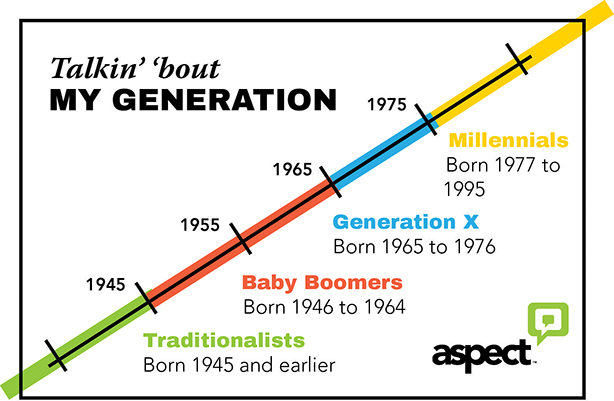
While the shift in engagement preferences is happening across generations, it’s being led by Millennials, currently ages 19 to 37. And if you think you can ignore them, think again. They are poised to outspend Baby Boomers by 2017. The generation that drove the growth of many major brands over the last 30 years is about to be overtaken by a new generation - one that largely doesn’t carry cash or care to communicate via traditional customer service methods.
A new report, published by Aspect Software and the Center for Generational Kinetics found that Millennials, more than any other generation (77%), think customer service should be available in a wide variety of communication channels. Additionally, the report states that over the past year, when compared with other generations, more Millennials have moved away from at least one company because of bad customer service. This translates into billions of dollars in lost revenue and profit from existing customers because a company did not deliver good customer service.
If you want to increase loyalty and share of wallet with Millennials, understand and implement solutions that address their expectations when it comes to service. Here are four that you can’t afford to ignore:
Know Me
A majority of Americans report that if they have to repeat their customer information or story more than once, they are going to scream. Historically, customer self-service applications were designed with a company’s cost-savings in mind. These applications are difficult to navigate and result in a frustrating experience. Developing self-service strategies as true omni-channel solutions, allowing customers to conduct an interaction on one channel and seamlessly pick up on another channel without having to repeat themselves is an advantage. In fact, 69% of Americans say they are more loyal to organizations that “make me feel like they know me when I contact their customer service people.”
Let Me Do It Myself
Across all generations surveyed, online customer service is the most preferred type of customer service. In fact, the traditional phone channel ranked second for almost every generation. When you consider over 65% of all Americans say that they feel good about themselves and the company when they are able to solve a problem without talking to a customer service representative, implementing strong self-service options can increase a customer’s positive view about a company is an easy win.
Omni-channel self-service is the preferred means of engagement. Because your customers want to try to solve their problems on their own first, offer them the opportunity to do so. Then, do it in ways that are engaging, mobile and connected to the rest of your interaction channels so if they are unable to complete their transaction or find a resolution, they can pick up where they left off on another channel.
Save Me Time
According to the Associated Press, in 1998 the average attention span was 12 minutes. By 2008 it dropped to five minutes. Patience with “waiting in line” and dealing with customer service representatives keep getting shorter, meanwhile, customer expectations continue to rise. Consumers want convenient, fast access to personalized information. Don’t make your customer wade through several menus only to be frustrated when they can’t access the information they are looking for. Furthermore, thirty-six percent of Millennials said they would contact a company more frequently if they could text them. Offering communication options like SMS allow customers opportunities to contact you while multi-tasking, ultimately saving them time.
Fit Into My Life
Pew Research Center reported in April 2015 that 64% of adults have a smartphone. That’s up from 35% in the spring of 2011. Millennials are always connected. In fact, 50% of Millennials surveyed say that their smartphone is more important than their computer. And 47% say they regularly use their smartphones to pay for things. This is more than three times the rate of Baby Boomers. Having a mobile strategy is imperative to meet the expectations of Millennials and future generations who will likely never have owned an “old-fashioned” feature phone.
The expectations and behaviors of the Millennial generation have a vast influence on other generations. It’s important to plan for the future customer experience and how expectations will evolve with continued technological innovation. Delivering on the needs of Millennials can mean the difference between growth and stagnation for your organization. 
Read the full report and get five take-action steps to apply the research findings to your business. Download “The Aspect Consumer Experience Index: Millennial Research on Customer Service Expectations” at http://www.aspect.com/millennials