
Like many other tech investments, creating a more efficient workflow was The Business Journals objective when it set out to implement a centralized, automated ad sales platform.
The company, a division of American City Business Journals, which itself is a unit of Condé Nast parent Advance Publications, is a sprawling organization, with print products, dozens of websites and hundreds of events around the country targeted at business leaders. Its products reach down to local businesses and all the way up to multinational corporations. Prior to 2008, its ad sales efforts were fragmented, inefficient and required a lot of manual interfacing, which led the company to rethink its entire infrastructure.
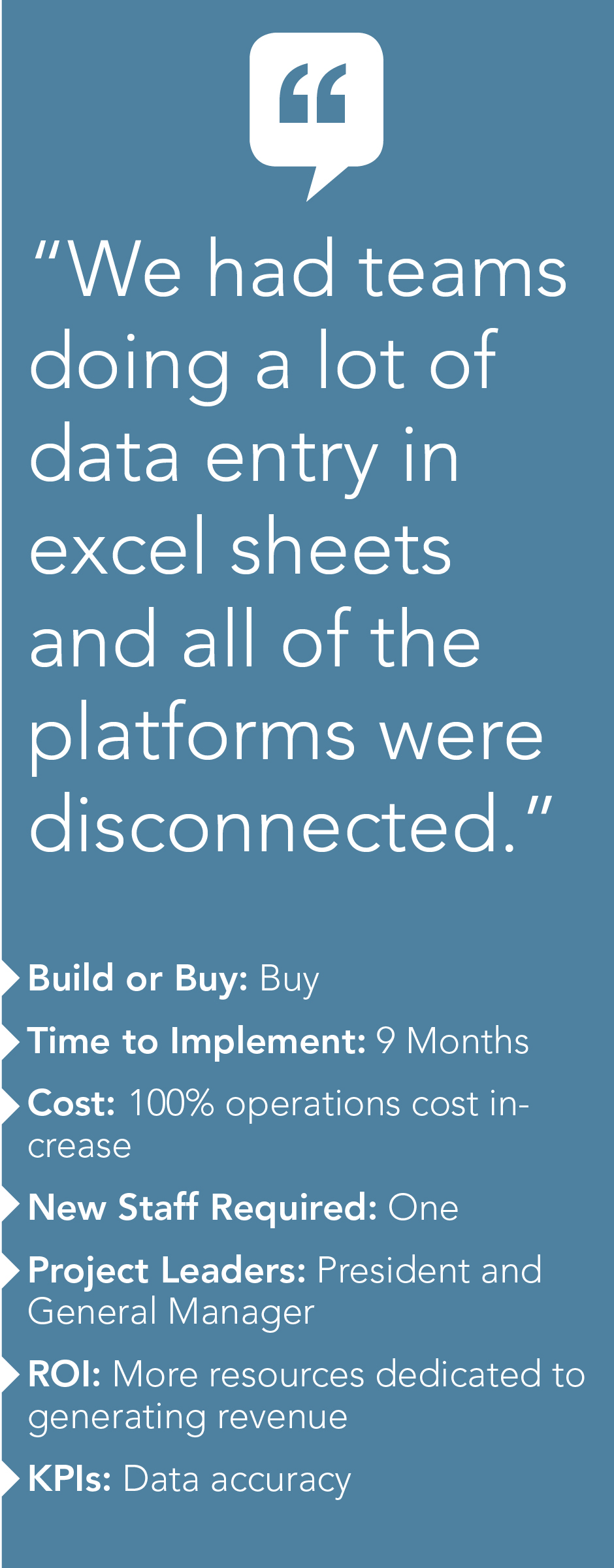
“We’ve been tinkering with our platform for many years,” says general manager Ryan Whittington. “Originally, it was a pretty a basic Web-based platform. The sales reps had to fill out forms in order to generate emails; we had teams doing a lot of data entry in excel sheets and all of the platforms were disconnected.”
Not surprisingly, Whittington says this system was highly inefficient. Compounding things more was that the company was growing at a rapid pace, requiring more and more staff to facilitate the sales process. Whittington and the rest of the digital team realized that a larger investment would be necessary in order to better allocate its resources and strengthen its margins.
The Process
A few options were carefully considered, including building out its own hub. Ultimately, Whittington says the decision to contract Fattail for its Adbook platform made the most sense.
“We have 40 Bizjournals across the country, each having its own sales team,” he says. “So there are a lot of complexities. I’m confident we could have built it, but it would have been tough to manage with all the changes that are constantly going on, we needed a partner that would stay on top of those changes.”
>Still, it wasn’t a quick and easy decision. Whittington says that it required about six months of research and due diligence. However, once the decision was made, the implementation was easier than expected. “We were up and going in three months,” he says. “Now it would be very hard though, with all the complexities we’ve added.”
The decision also had to factor in cost. As a private company, Whittington is not willing to disclose the exact dollar amount spent to integrate Adbook, but he says that the new platform required an investment double what it was spending on its previous ad solution.
Another obstacle was getting everyone up to speed and effectively comfortable with the new platform. To address that the company hired a platform manager who is essentially in charge of training users, and to stay on top of upgrades and workflow changes. Otherwise, no additional staff was needed to implement the platform, or maintain it.
The company rolled out Adbooks with a 3-year partnership agreement. It recently resigned with another 3-year contract. Just over the past few years, Whittington says that the company has tripled the size of its team, and points to its ad platform as the catalyst. What’s more, it has reorganized the company to leverage its human capital assets more effectively.
The Results
“The best ROI is that the people using this tool are freed up to generate more revenue as opposed to waiting for a screen to load or a spreadsheet to add things up correctly,” he says. Now we can shift those resources to client-facing activities.” It’s a tool that most people in the company wouldn’t know the name of unless its not working right, but fortunately that hasn’t really been an issue.”
Accuracy is another essential key performance indicator for the platform. That is, the old system, besides being slow and inefficient, lent itself to human error. Now, Whittington says, the data that it feeds advertisers is on point. What’s more, the speed of order entry and inventory search is immeasurably faster.
“It also adds a lot of transparency to our inventory, Whittington says. “When it was about spreadsheets and old-school stuff I would have to make a call or send an email. Now I can see it real time. That’s actually a piece that we are trying to expand on more and to other parts of our business, like print. There isn’t an inventory management system like this for print. We also do a lot of events and are trying to understand how to manage our inventory there too.” 