5 Digital Metrics Your Magazine Should Consider
Social media should be part of your 360-degree view. By Stephanie Paige Miller
Brands get a lot of power from metrics, and everyone should take advantage of useful quantitative data. But page views and unique visits aren’t everything. Social media should be part of your 360-degree view.
Why? Because social media creates a consumer narrative, telling you where users are coming from, what they’re doing and what they’re saying. Qualitative data can fill gaps in your brand strategy.
A monitoring tool such as Adobe Social, Hootsuite, Chartbeat, or any of the Salesforce products (like Radian 6) will help you craft your social narrative. Here are five critical metrics (often overlooked!) that you should focus on:
1. Social Referral Activity
Do your Twitter followers behave differently than Facebook fans once they land on site? Are those coming in via Pinterest consuming more pages than those coming from Tumblr? Pinpointing what social followers are doing on site allows you to anticipate consumer needs and will help develop your editorial calendar.
2. Quality of Your Followers
You may have 200,000 likes on Facebook, but how many of these users “liked” your page to get a deal or as part of a sweepstakes entry? I’d argue that it’s more valuable to have a small, highly-engaged social following than a large, flat number—especially if advertisers want to see click-throughs, conversions and comments.

3. On-Site Social Engagement
Having a grasp on the most-shared content indicates what stories have the most virality. Include share buttons on slideshows and blog posts and pin-it buttons on all images. Encourage readers to share, comment, tweet and pin on every page. And when you discover something’s hot, repurpose it: Lead your newsletter with one of your most-shared items.
4. Share of Voice
How does your brand perform during a key moment? Whether a b-to-b trade show or a red carpet event like the Oscars, is your brand surfacing as an authority? Set metrics that will demonstrate how your social media presence boosted the number of @ mentions on Twitter, led to heightened activity on Pinterest, increased tags and followers on Instagram or influenced more connections on LinkedIn.
5. New and Returning Visitors
Consider your seven-day and 30-day visitors. There may be a loyal following that returns to the site every day, but how long can you depend on that traffic? Are returning visitors exploring new sections or coming back to a specific page? If your brand’s audience refreshes seasonally (bridal magazines, for example), it’s important to have social strategies in place to keep unique traffic consistent.
UBM Tech Relaunches EE Times With Community, Events Focus
Company linking digital and events properties throughout portfolio. By Michael Rondon
After shuttering its print products earlier this year, UBM Tech has unveiled the first elements of a new community-driven strategy.
The group relaunched flagship electronics site EETimes.com in July, emphasizing comments, user-generated content and events on its homepage.
The changes—which include a recent comment panel above the fold, comment posting directly from the homepage and seamless integration of blogger and editor content—bring EE Times more in line with a popular community-driven subsection of the previous site called EE Life, says Karen Field, senior vice president, editorial director of EE Times and general manager of DESIGN West.
Moving that dynamic to the front page brings a mix of information and conversation that drives engagement.
“Engineering is one of those professions where a lot of tacit knowledge is shared within the community,” Field says. “That conversation now is not just relegated to EE Life, it’s threaded throughout our entire site. Even the smartest engineer out there isn’t interested in just seeing equations.”
The shift in content mix requires a commensurate shift in editorial focus though. While the edit staff has remained unchanged from a personnel standpoint, it’s taking on more of a moderator role.
Integrating Events
Managing a community instead of a content stream means taking on events. EE Times editors—and, by extension, its readers—were integral in developing content for DESIGN West.
“Just blatantly promoting to readers to come to our show isn’t very useful,” Field says. “But when you have an engaged audience, who’s been following the whole development of a workshop as its being put together by the editor, we then see an audience who’s built awareness, who’s having fun, who’s weighing in on how things ought to go. It helps create ownership.”
Field says a few of the company’s smaller brands have had success with similar engagement models. And that meshing of digital and events properties has been making its way through the company’s personnel ranks.
Field’s own recent promotion from content director of DESIGN West to SVP, editorial director of EE Times and general manager of DESIGN West, Patrick Mannion’s promotion to vice president and brand director of the Electronics Group, link media and events at an executive level.
3 Lessons On Responsive Design
What seems like a no-brainer still has its challenges. By Hugh Byrne
If you’re like most b-to-b publishers, you’re delivering a PC experience in a soon-to-be post-PC world.
It’s time to migrate to responsive design, displaying content that arranges automatically based on the device and screen size of the viewer. This lets you provide optimal reading and navigating on anything from a PC to a mobile phone.
The transformation is underway at GreenBiz. Here’s what we’ve discovered—and what we have yet to learn.
It’s true that most b-to-b users are still using PCs to browse websites, but that’s rapidly changing. In fact, PC shipments are forecast to drop 7.8 percent worldwide in 2013, IDC reports.
So, it makes sense that Mashable declared 2013 the year of responsive design (conveniently announced as it launched its own responsive site). With the rise of technology to support multiple platforms, you’d think every publisher would have made the switch by now.
The diminishing clout of the PC is further highlighted by the dramatic rise in mobile traffic:
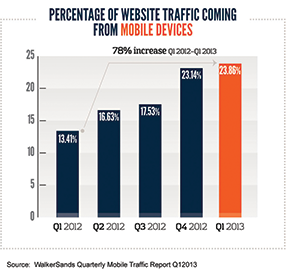
Tablets are gaining ground, surpassing laptop sales in 2013 and projected to outsell all PCs by 2015. And smartphones appear unstoppable, on pace to sell nearly a billion units this year.
Our site has won awards for years, and we want that to continue, so rsquo;ve drunk the mobile-first Kool-Aid. But what seemed like a no-brainer still has its challenges:
1. Mobile Loves Pictures
Creating multiplatform news requires rethinking the role of images. Images are often an afterthought in a desktop environment. On a mobile device, images play a larger role (literally). Our editors are going to spend more time thinking about how images contribute to telling the story across platforms.
2. Farewell My Leaderboard
Ad-serving technology is still playing catch-up to responsive design. There’s just not a great solution for 728x90 leaderboards. While you can use javascript code to swap ad tags based on device size, it’s an inelegant solution. But 300x250 works just fine across all platforms. And sponsored content is particularly well-suited for mobile.
3. Plug-Ins Need to Catch Up
Like a lot of publishers, we’ve added capabilities to our site that involve skinning third-party tools to appear native. Job boards, directories, e-commerce tools and marketing automation are going to stick out when accessed via tablet or mobile. We’re re-evaluating vendors based on their mobile roadmap.